Sales and Marketing Alignment in 2026: The Complete Guide to Building One Revenue Engine
Misalignment costs B2B companies up to 38% of revenue. Here is the 2026 framework – shared ICP, SLA, unified data, and AI agents – to align sales and marketing into one revenue engine.
TL;DR
- Sales and marketing alignment means both teams operate from one shared definition of the ideal buyer, one set of revenue goals, and one connected data layer instead of two disconnected funnels.
- Misalignment is expensive. Forrester estimates B2B companies lose up to 38% of revenue to poor alignment, and the total cost across businesses is put near $1 trillion a year.
- Aligned teams grow faster: roughly 24% faster three-year revenue growth, up to 32% higher annual revenue, and 38% higher win rates.
- The 2026 model is built on four pillars: a shared ICP, a service level agreement (SLA), unified data, and AI agents that enforce the handoff automatically.
- MarqOps replaces 7+ disconnected tools with one brand-intelligent platform, giving sales and marketing a single dashboard for content, ads, SEO, and analytics.
Sales and Marketing Alignment in 2026: The Complete Guide to Building One Revenue Engine
For two decades, “sales and marketing alignment” was the corporate equivalent of a New Year’s resolution: everyone agreed it mattered, few teams actually did it. In 2026 the excuses are gone. AI agents, unified data, and revenue operations have turned alignment from a soft cultural goal into a measurable, automatable system. This guide walks through what alignment really means today, why misalignment quietly drains a third of your revenue, and the exact framework high-growth teams use to build one connected engine.
Table of Contents
- What Is Sales and Marketing Alignment?
- Why Alignment Matters: The 2026 Data
- The Hidden Cost of Misalignment
- The Four Pillars of Modern Alignment
- How to Build a Sales and Marketing SLA
- Where AI Agents Change the Game
- A 90-Day Alignment Roadmap
- Metrics That Prove Alignment Is Working
- Frequently Asked Questions
What Is Sales and Marketing Alignment?
Sales and marketing alignment is the practice of getting both functions to operate from one shared definition of the ideal buyer, one set of revenue goals, and one connected data layer. In an aligned organization, marketing is not judged on lead volume while sales is judged on closed deals. Both are measured against the same outcome: pipeline that becomes revenue.
The old model treated the two teams as a relay race. Marketing ran the first leg, generated leads, and threw the baton over a wall. Sales picked it up (or dropped it) and ran the rest. The problem is that a wall sits in the middle, and batons get dropped there constantly. Modern alignment removes the wall entirely and replaces the relay with a single team running the same track, a shift closely tied to the rise of revenue operations (RevOps) and pipeline marketing.
In one sentence: Alignment is what you get when marketing and sales share the same buyer definition, the same numbers, and the same source of truth, so a lead never falls into the gap between them.
Why Alignment Matters: The 2026 Data
Alignment is not a feel-good initiative. The numbers behind it are some of the most consistent in all of B2B research, and they have only sharpened as revenue teams have matured.
24%
Faster three-year revenue growth for organizations with aligned sales and marketing operations
Beyond that headline figure, aligned teams consistently outperform on almost every metric that matters:
- Aligned organizations achieve up to 32% higher annual revenue, while poorly aligned companies can see revenue decline.
- Businesses with aligned teams see 38% higher sales win rates and are meaningfully better at closing deals.
- Alignment drives 67% more qualified leads and materially higher pipeline conversion when marketing stays involved past the handoff.
- Companies that align people, process, and technology report roughly 36% more revenue growth and up to 28% more profitability.
The mechanism is simple. When marketing understands exactly what a sales-ready buyer looks like, it stops flooding the pipeline with volume and starts feeding it fit. When sales trusts that a handoff is genuinely qualified, response times drop and follow-up improves. That trust compounds, and it is why alignment now sits at the center of every serious demand generation strategy.
The Hidden Cost of Misalignment
If the upside sounds abstract, the downside is brutally concrete. Forrester’s widely cited research estimates that 38% of B2B revenue is lost when marketing and sales are not aligned. For a company doing $10M a year, that is up to $3.8M leaking out of the pipeline annually, mostly invisibly.
$1 Trillion
Estimated annual cost of sales and marketing misalignment across businesses
Zoom out and the aggregate cost of misalignment across all businesses is estimated near $1 trillion a year. Yet only about 8% of companies describe their alignment as strong, and just 43% have any formal service level agreement between the two teams. The gap between “we should align” and “we actually did” remains enormous.
Where does the money go? It leaks through three predictable holes:
- Wasted spend. Roughly a quarter of B2B marketing budgets fund campaigns that hit engagement targets but produce zero attributable revenue, a problem that better multi-touch attribution exposes quickly.
- Leaky handoffs. The average B2B funnel converts just 13% of MQLs to SQLs, and most of that loss happens at the marketing-to-sales handoff where definitions do not match.
- Slow follow-up. Contacting a lead within 60 minutes can lift conversions by up to 7x, but without a shared response standard, qualified leads sit and cool.
A telling perception gap sits underneath all of this: 82% of C-level executives believe their teams are already aligned, while 65% of the sales and marketing professionals doing the work say they are not. Leadership thinks the problem is solved. The front line knows it is not.
The Four Pillars of Modern Alignment
Alignment in 2026 is not a workshop or an offsite. It is a system built on four pillars, each of which can now be operationalized in software rather than left to goodwill.
Pillar 1: A Shared Ideal Customer Profile
Everything starts with agreeing on who you are actually selling to. If marketing chases one profile and sales wants another, no process will save you. A living, data-backed ideal customer profile (ICP) becomes the single reference both teams point to when they debate whether a lead is worth pursuing.
Pillar 2: A Service Level Agreement
The SLA turns good intentions into commitments. Marketing agrees to deliver a set number of qualified leads that meet an agreed bar. Sales agrees to a response window, a minimum number of contact attempts, and a structured accept-or-reject process. We cover the full build below.
Pillar 3: Unified Data
You cannot align two teams that read from different scoreboards. A single source of truth for account and contact data, connected to an AI customer data platform, means both teams see the same buyer journey, the same touch history, and the same score. Because AI amplifies whatever is in your data, clean shared data is now the foundation, not an afterthought.
Pillar 4: Agentic Enforcement
The newest pillar. Rather than auditing the SLA by hand each month, routing, scoring, and disposition logic increasingly move into the CRM and into AI agents. The handoff enforces itself, and humans review exceptions rather than every record. This is closely tied to the rise of the AI SDR and GTM engineering roles.
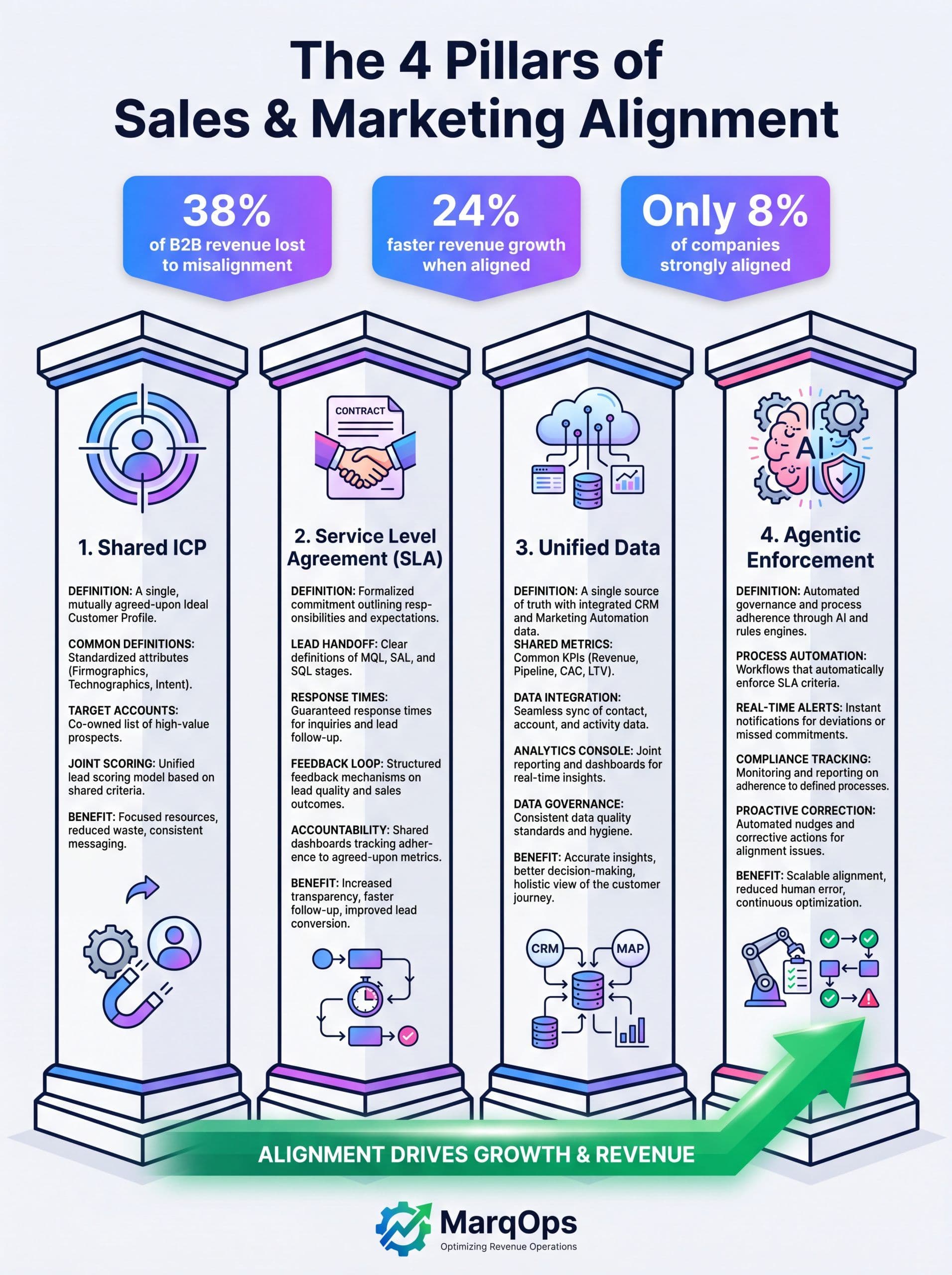
The four pillars of modern sales and marketing alignment and the revenue impact of each.
How to Build a Sales and Marketing SLA
A service level agreement is a written contract between marketing and sales that defines reciprocal commitments. It is the single highest-leverage artifact in the entire alignment process, and yet fewer than half of companies have one. Here is what a modern SLA contains.
| SLA Component | Marketing Commits To | Sales Commits To |
|---|---|---|
| Lead volume | A defined number of qualified leads per period | Working every lead that meets the bar |
| Lead quality | Leads that match the shared ICP and score threshold | Honest, structured feedback on fit |
| Response time | Real-time alerts on high-intent activity | Same-business-day outreach on qualified handoffs |
| Follow-up depth | Content and context for each lead | A minimum number of contact attempts |
| Enforcement point | CRM fields for source, last touch, content consumed | Disposition logged on every record |
The most important upgrade for 2026 is this: a useful SLA names the CRM enforcement point for each clause, the exact field, workflow, or timestamp that proves whether the commitment was met. That makes the agreement auditable rather than aspirational. Anchor the SLA in a shared definition of what a Marketing Qualified Lead and a Sales Qualified Lead actually are, backed by consistent AI lead scoring, and review it in a standing monthly meeting.
Quick win: If you write only one clause this quarter, make it the response-time standard. Same-day (ideally sub-hour) outreach on qualified leads is the single change with the fastest, most visible revenue impact.
Where AI Agents Change the Game
Alignment used to fail because it depended on humans remembering to do the boring parts: updating the CRM, routing the lead, checking the score, following up on time. AI removes that dependency. By 2026, AI is embedded in an estimated 73% of RevOps GTM stacks, contributing to a 36% reduction in deal cycle length and a measurable lift in revenue for teams that use it well.
In an aligned, AI-native motion, agents handle the connective tissue between the two teams:
- They read intent data and buying signals in real time, so a spike in account activity triggers a handoff automatically.
- They score and route leads the instant they arrive, enforcing the ICP without a human gatekeeper.
- They keep records clean and complete, which is what makes the SLA auditable in the first place.
- They orchestrate consistent messaging across channels, connecting to broader marketing orchestration so the buyer sees one coherent story.
The catch is that AI amplifies whatever you feed it. Point agents at fragmented data spread across seven tools and they will automate the chaos faster. Point them at one unified system and they compound your alignment. That is precisely the problem a platform like MarqOps is built to solve: it replaces 7+ disconnected marketing tools with one brand-intelligent system, giving sales and marketing a single dashboard for content, ads, SEO, and analytics instead of a pile of tabs that never quite reconcile.
A 90-Day Alignment Roadmap
You do not need a year and a reorg. Most teams can reach functional alignment in a single quarter by working in three focused phases.
Days 1 to 30: Agree on Reality
Get both leaders in a room and define the ICP, the MQL, and the SQL together. Write down where they currently disagree. Audit your data: is there one source of truth, or seven versions of it? Establish the shared revenue number both teams will be measured against. This phase is about language and definitions, not tooling.
Days 31 to 60: Write and Wire the SLA
Draft the SLA using the components in the table above. For every clause, name the CRM field or workflow that proves it happened. Turn on lead scoring and routing so handoffs are automatic and consistent. Set the response-time standard and instrument it so you can actually see whether it is met.
Days 61 to 90: Automate and Review
Layer in AI agents to enforce the routine parts of the SLA. Stand up a shared dashboard both teams look at daily. Hold the first monthly alignment review, using real data rather than anecdotes. From here, alignment becomes a habit reinforced by the system, not a project that quietly dies. Teams that have built a mature marketing operations function will move through these phases fastest.
Metrics That Prove Alignment Is Working
Alignment that cannot be measured tends to quietly regress. Track a small, shared set of numbers that both teams own together:
- MQL-to-SQL conversion rate. The clearest single indicator of whether the handoff definition is working. Watch it climb above the 13% benchmark.
- Lead response time. Median minutes from qualified handoff to first sales touch.
- Pipeline velocity. How fast qualified opportunities move through the stages.
- Marketing-sourced and marketing-influenced pipeline. Revenue, not lead count, tied to marketing activity.
- Win rate on marketing-qualified deals. Proof that fit, not just volume, is improving.
- SLA compliance. The percentage of handoffs where both sides met their commitments.
When those numbers live on one shared dashboard, the old blame game (marketing says the leads were fine, sales says they were junk) is replaced by a single, mutually visible truth. That shared visibility is the quiet engine behind every aligned revenue team.
The bottom line: Sales and marketing alignment in 2026 is not a personality fix, it is an operating system. Shared ICP, a real SLA, unified data, and AI enforcement turn two competing teams into one revenue engine, and the data says that engine grows meaningfully faster.
Three Alignment Mistakes to Avoid
Even well-intentioned teams sabotage alignment in predictable ways. Watch for these three.
1. Treating alignment as a meeting, not a system. An offsite where everyone agrees to “communicate better” produces zero durable change. Alignment holds only when the shared ICP, the SLA, and the enforcement logic are wired into your tools. Culture follows structure, not the other way around.
2. Measuring the two teams on conflicting goals. If marketing is paid on lead volume while sales is paid on closed revenue, they will optimize against each other no matter how friendly the standup is. Put both teams on shared pipeline and revenue targets so incentives point the same direction.
3. Automating on top of messy data. Layering AI agents over seven disconnected tools just automates the confusion faster. Unify the data first, then let agents enforce the handoff. This sequence, unify then automate, is the difference between AI that compounds alignment and AI that scales chaos, and it is exactly why a consolidated marketing intelligence platform matters more than any single point tool.
Frequently Asked Questions
What is sales and marketing alignment in simple terms?
It is when marketing and sales work from the same definition of the ideal buyer, the same revenue goals, and the same data, so leads move smoothly between them instead of falling into a gap. Both teams are measured on pipeline that becomes revenue, not on separate metrics that pull them apart.
How much revenue does misalignment cost?
Forrester estimates B2B companies lose up to 38% of revenue to poor alignment, and the aggregate cost across businesses is put near $1 trillion a year. For a $10M company, that 38% figure translates to as much as $3.8M leaking out of the pipeline annually.
What is a sales and marketing SLA?
A service level agreement is a written contract between the two teams. Marketing commits to delivering a defined number of qualified leads that meet an agreed quality bar, and sales commits to a response window, a minimum number of contact attempts, and a structured accept-or-reject process. In 2026, each clause also names the CRM field or workflow that proves it was met.
How do AI agents improve alignment?
AI agents handle the connective tissue between the teams: reading intent and buying signals in real time, scoring and routing leads instantly, keeping CRM records clean, and enforcing the SLA automatically. This removes the human forgetfulness that caused most alignment to fail, but it only works if the underlying data is unified rather than scattered across many tools.
How long does it take to align sales and marketing?
Most teams reach functional alignment in about 90 days: 30 days to agree on the ICP and shared definitions, 30 days to write and wire the SLA into the CRM, and 30 days to automate enforcement and stand up a shared dashboard. Alignment then becomes an ongoing habit reinforced by the system rather than a one-time project.
Keep following the signal