Demand Generation in 2026: The AI-Powered B2B Playbook for Predictable Pipeline
The complete 2026 guide to demand generation: what it is, how it differs from lead gen, the AI-powered framework, tactics, channel mix, measurement, and the modern tech stack that drives 4-5x pipeline coverage.
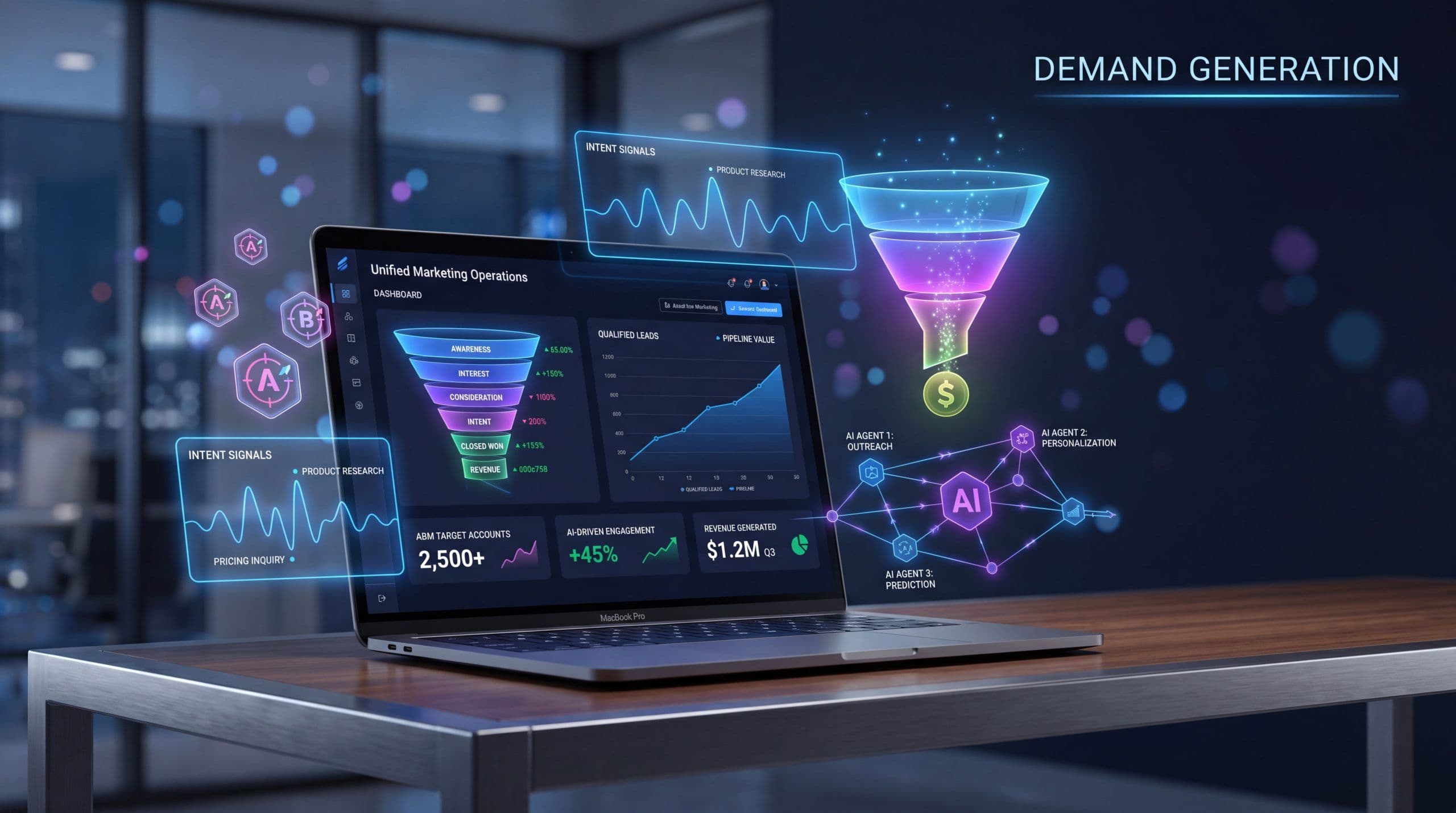
Modern AI-powered demand generation dashboard
TL;DR
- Demand generation is the full marketing motion that builds awareness, educates buyers, and creates measurable pipeline. It is the upstream engine that makes lead generation work.
- In 2026, 80% of the B2B buyer journey now happens in the dark funnel through AI search, private communities, and peer reviews before any form fill.
- Teams using AI agents for intent scoring, dynamic nurture, and content personalization are running 4 to 5x pipeline coverage while volume-only programs stall at 2.5 to 3x.
- The 2026 stack collapses 7 disconnected tools into a unified brand-intelligent platform that handles content, ads, analytics, and orchestration in one place.
- This guide covers the modern demand gen framework, AI tactics that actually move pipeline, channel mix, measurement, and the tech stack that makes it scale.
Table of Contents
- What Is Demand Generation in 2026?
- Demand Generation vs Lead Generation: The Real Difference
- Why Demand Generation Matters More in 2026
- The AI-Powered Demand Generation Framework
- 10 Demand Generation Tactics That Actually Move Pipeline
- The 2026 Demand Generation Channel Mix
- How to Measure Demand Generation ROI
- The Modern Demand Generation Tech Stack
- Demand Generation Examples That Worked
- Getting Started: Your 90-Day Plan
- FAQs
Most B2B marketing teams in 2026 are stuck. They are spending more on ads, publishing more content, and running more campaigns, but pipeline coverage is flat and the CFO keeps asking the same question: where is the revenue?
The answer is almost always the same. Their lead generation engine is humming, but their demand generation engine is broken. They are catching demand instead of creating it. And in a world where 80% of the buyer journey now happens before anyone fills out a form, that gap is the difference between hitting your number and missing it by a mile.
This guide breaks down what modern demand generation looks like in 2026, how AI is rewriting the playbook, and the exact framework, tactics, and stack you need to build predictable pipeline. Whether you are a CMO rethinking your strategy, a marketing ops leader untangling your stack, or a demand gen manager trying to prove ROI, this is the practical reference you can come back to.
What Is Demand Generation in 2026?
Demand generation is the end-to-end marketing motion that builds awareness, educates buyers, and creates measurable interest in your product or service across the entire funnel. It is not a single tactic. It is the integrated system that pulls accounts from cold to closed-won.
Traditional definitions focus on top-of-funnel awareness. In 2026, that definition is too narrow. Modern demand generation spans three connected motions:
- Demand creation: Educating buyers who are not yet aware they have a problem, through thought leadership, podcasts, ungated research, and community presence.
- Demand capture: Converting buyers who already know they have a problem through search ads, intent-driven outreach, and high-converting landing pages.
- Demand expansion: Nurturing existing accounts to expand contract value, drive cross-sell, and turn customers into advocates.
The simplest way to think about it: lead generation captures the hand-raisers who already want what you sell. Demand generation creates the future hand-raisers and earns the trust that makes them choose you when they raise their hand.
Demand Generation vs Lead Generation: The Real Difference
This is the question every marketing leader hears in board meetings. The answer is not “they are the same thing.” Demand gen and lead gen are different motions with different goals, different metrics, and different audiences.
Lead generation captures buyer intent and turns it into actionable contacts. It is bottom-of-funnel, conversion-focused, and measured by MQLs and SQLs. Demand generation builds the awareness and interest that makes lead generation possible in the first place. It is full-funnel, education-focused, and measured by influenced pipeline and brand search lift.
| Dimension | Demand Generation | Lead Generation |
|---|---|---|
| Goal | Build awareness and interest | Capture qualified contacts |
| Funnel stage | Full funnel, weighted to top | Mid to bottom funnel |
| Primary metric | Influenced pipeline, brand search lift | MQLs, SQLs, cost per lead |
| Content type | Ungated research, podcasts, thought leadership | Gated assets, demos, free trials |
| Time horizon | 6 to 18 months | 7 to 90 days |
The mistake most teams make is treating these as either/or. The 2026 playbook runs both, sequenced together. Demand generation first to build awareness and trust, lead generation second to capture and convert the demand you created. Teams that do both produce higher quality pipeline, faster sales cycles, and stronger close rates than teams that lead with forms.
Why Demand Generation Matters More in 2026
Three structural shifts have made demand generation non-negotiable this year.
1. The dark funnel now owns the buyer journey
Roughly 80% of the B2B buyer journey now happens anonymously across AI search, private Slack communities, podcasts, peer review sites, and LinkedIn DMs. By the time a buyer fills out a form, they have often already shortlisted vendors based on signals you never saw. The traditional MQL is a lagging indicator of a decision that was already made in the dark.
2. Generative AI changed how buyers discover vendors
The top four AI research tools collectively generate over 7.6 billion visits per month. Seventy percent of B2B buyers now use ChatGPT, Claude, Perplexity, and Gemini to research vendors before talking to anyone. If your brand is not surfacing in those answers, you are invisible during the most important phase of the buying cycle. This is why Answer Engine Optimization has become a core demand gen discipline.
87%
of marketing spend funds activity that never reaches a sales conversation, because only 13% of MQLs convert to SQLs
3. AI bifurcated the performance curve
Programs that adopted AI-assisted lead scoring, dynamic nurture, and intent activation are running 4 to 5x pipeline coverage. Volume-only programs that still rely on manual list pulls and one-size-fits-all email sequences are stalling at 2.5 to 3x. The gap is widening every quarter. Teams that lean into AI agents for marketing are not getting a 10% lift. They are getting a step change.
The AI-Powered Demand Generation Framework
The modern demand gen engine is built on three layers. Get all three right and you have a self-improving pipeline machine. Miss one and the whole thing wobbles.
Layer 1: The data foundation
Every modern demand gen program starts with a unified data layer that combines first-party engagement signals, third-party intent data, firmographic enrichment, and your existing CRM and product usage data. Without this foundation, AI agents are guessing. With it, they can identify in-market accounts weeks before competitors notice.
Pull together: website visits, content downloads, video watch time, podcast listens, LinkedIn engagement, review site activity, intent feeds from Bombora or 6sense, technographic data, and CRM stage transitions. This is the fuel that powers everything downstream.
Layer 2: The intelligence layer
This is where AI does the heavy lifting. Predictive scoring models identify which accounts are entering the buying window, which contacts are decision-makers, and which content will resonate. AI lead scoring replaces the brittle, hand-tuned point systems that drove the old MQL playbook with continuously learning models that get sharper with every closed deal.
The intelligence layer also handles AI customer segmentation, propensity modeling, churn risk scoring, and next-best-action recommendations for both marketing and sales.
Layer 3: The orchestration layer
This is the activation engine. AI agents trigger personalized email sequences, route hot accounts to sales, dynamically swap ad creative based on account stage, and adjust nurture cadence based on engagement. The orchestration layer is what turns insight into pipeline.
This is also where consolidation matters most. A 2026 demand gen team running on 7 disconnected tools spends 40% of its time on data syncs, attribution arguments, and tab-switching. Teams running on a unified platform like MarqOps get that time back and pour it into strategy.
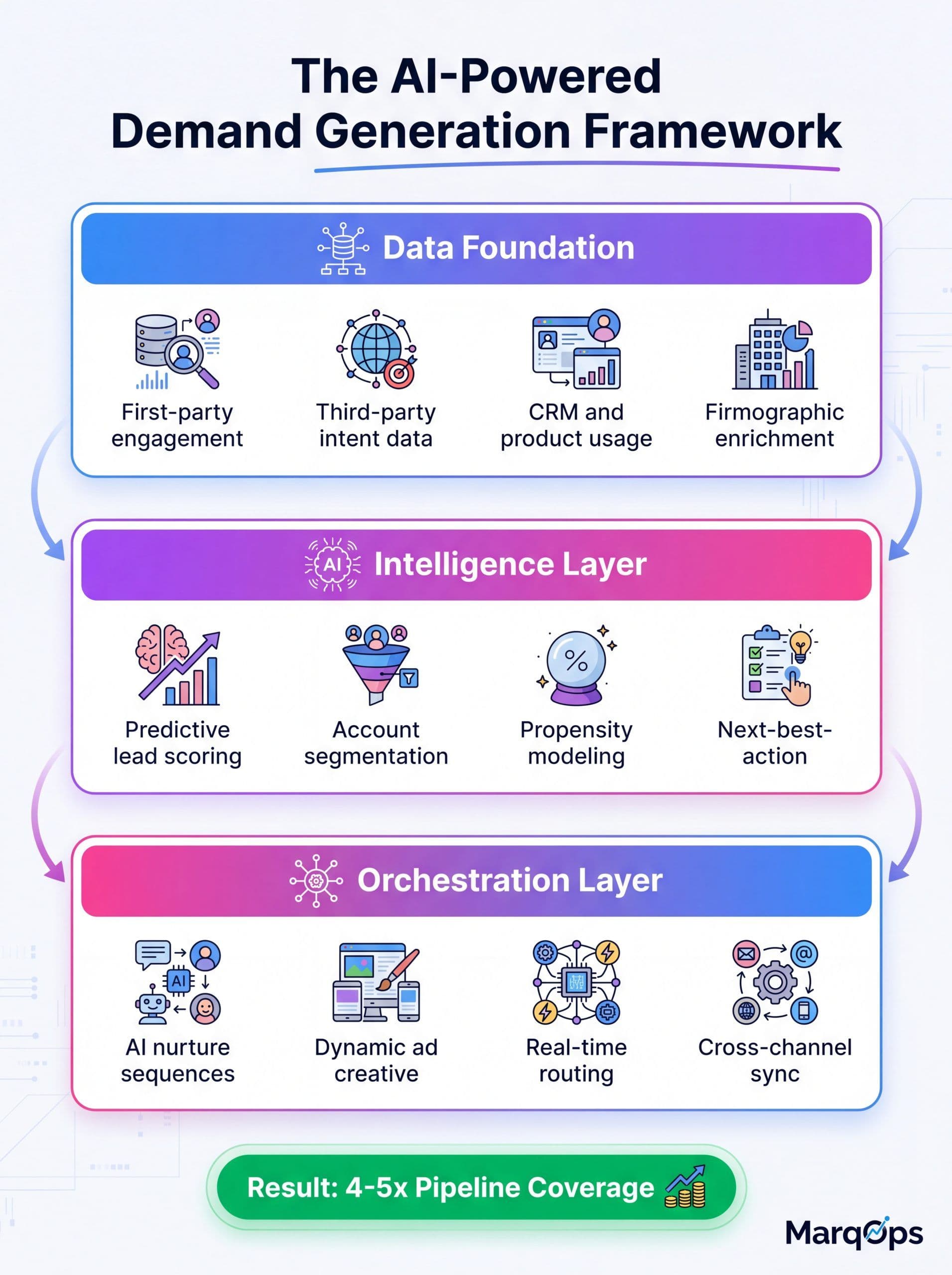
The three layers of the modern AI-powered demand generation engine
10 Demand Generation Tactics That Actually Move Pipeline
Here are the ten tactics that are working right now for B2B teams running modern demand gen programs. Pick three to start. Most teams try to do all ten at once and end up doing none of them well.
1. Ungated thought leadership
Stop hiding your best content behind forms. The teams winning in 2026 publish their deepest research, frameworks, and benchmarks ungated. The reach you get from one well-distributed ungated report dwarfs the lead count from gating it. The trade-off is real, but the math has shifted.
2. Branded podcast or video series
Podcasts and short-form video on LinkedIn are the highest-leverage content formats for demand creation. They build category authority, generate inbound demos from anonymous listeners, and create endless repurposable clips. A 30-minute podcast can fuel a month of social, email, and ad content.
3. Intent-based ABM
Layer intent signals on top of your ideal customer profile to identify the 200 to 500 accounts most likely to buy in the next quarter. Then run coordinated ads, email, and SDR outreach on just those accounts. AI ABM platforms have made this motion 10x more efficient than the spray-and-pray ABM of 2022.
4. AI-personalized email nurture
Static drip sequences are dead. Modern nurture uses AI to adjust send time, content variant, subject line, and CTA based on each contact’s engagement history. The lift over static sequences is typically 30 to 60% in click-through and 2 to 3x in pipeline contribution.
5. Answer Engine Optimization (AEO)
Optimize your content to surface in ChatGPT, Claude, Perplexity, and Google AI Overviews. This means publishing comparison content, definitive guides, and structured data that LLMs can cite. Brand mentions in AI answers are the new top-of-funnel currency.
6. Community-led demand
Build or sponsor private communities where your buyers already gather. Slack groups, Discord servers, LinkedIn communities, niche Substacks. Demand created here compounds because it travels by word-of-mouth, which converts at 5 to 10x the rate of paid channels.
7. Customer-led growth content
Turn your best customers into the face of your demand gen. Case studies are table stakes. Joint webinars, customer-hosted podcasts, and account-specific microsites convert at 3 to 5x the rate of vendor-produced content.
8. Paid social with creative iteration
LinkedIn and Meta still drive significant demand when paired with AI dynamic creative optimization. The teams winning here are testing 15 to 30 creative variants per campaign and letting AI auto-promote the winners. The cost-per-lead difference between top and bottom performers is often 5 to 10x.
9. Conversational AI on the website
Replace static “Contact Sales” forms with AI assistants that qualify in real time, book meetings, and answer technical questions. Speed-to-response is one of the highest-ROI levers in the entire stack. AI SDRs can lift inbound conversion rates by up to 70% from speed alone.
10. Influencer and creator partnerships
AI influencer marketing in B2B is no longer fringe. Identifying the 50 voices your buyers actually trust and partnering with them on content, events, and product launches is one of the cleanest paths to building category awareness with the right audience.
The 2026 Demand Generation Channel Mix
No single channel wins anymore. The teams hitting plan are running a diversified mix that compounds over time. Here is the channel allocation we see at high-performing B2B SaaS companies in 2026.
| Channel | % of Budget | Primary Job |
|---|---|---|
| Content and SEO | 20 to 25% | Compounding demand creation |
| Paid search and AEO | 15 to 20% | Demand capture |
| Paid social (LinkedIn, Meta) | 15 to 20% | Awareness and retargeting |
| Events and field | 10 to 15% | Account-based demand |
| Email and nurture | 10% | Conversion and expansion |
| Influencer and community | 5 to 10% | Trust and word-of-mouth |
| Podcast and video | 5 to 10% | Category leadership |
The exact mix depends on your category, deal size, and sales cycle, but the rule of thumb holds: roughly 60% of budget should go to demand creation and only 40% to demand capture. Most teams are still inverted, spending 70% on capture and wondering why pipeline is stagnant.
How to Measure Demand Generation ROI
Measuring demand gen is harder than measuring lead gen, but it is not impossible. The trick is to stop trying to assign every dollar of pipeline to a single touch and start measuring the system.
Lagging indicators
- Influenced pipeline: Pipeline that touched at least one demand gen asset before the opportunity opened.
- Brand search lift: Growth in branded search volume quarter over quarter.
- Pipeline coverage: Open pipeline divided by quarterly quota. Healthy is 3 to 4x; great is 5x+.
- Marketing-sourced revenue share: The median in 2026 is 36%.
Leading indicators
- High-intent account volume: Number of ICP accounts showing 3+ intent signals in a 30-day window.
- Content engagement depth: Average time-on-page and scroll depth on pillar content.
- Dark funnel signals: Direct traffic, branded search, podcast listens, community mentions.
- Speed-to-respond: Time from inbound signal to first sales touch.
Modern teams build all of this into one dashboard rather than running quarterly reports out of spreadsheets. The right marketing dashboard setup pulls intent data, CRM, ad platforms, content analytics, and revenue attribution into a single view. Combined with multi-touch attribution and marketing mix modeling, you finally get a defensible answer to “what is our demand gen ROI?”
The Modern Demand Generation Tech Stack
The 2026 demand gen stack used to require 7 to 10 separate tools. CMS, SEO platform, content marketing tool, marketing automation, ABM platform, intent provider, ad management, analytics, attribution, and creative tools. Each with its own login, its own data model, and its own monthly fee.
That model is collapsing. The new stack consolidates around three layers:
- The unified marketing operations platform that handles content production, SEO ops, paid ad management, analytics, and creative generation in one place. This is where consolidation creates the biggest unlock. MarqOps sits in this layer, replacing what used to take 7+ tools with one brand-intelligent system.
- The data and intent layer that feeds the system. CRM, product analytics, intent providers, and customer data platforms.
- The orchestration and execution layer that handles automated workflows, email nurture, SDR cadences, and event management.
The strategic logic is simple: every additional tool in your stack creates a data sync, an attribution gap, and a context switch. The teams getting 6x content output and 4x pipeline coverage are not using more tools. They are using fewer, better-integrated ones. For a deeper look at how this plays out, the marketing tech stack guide walks through specific recommendations by company size.
Demand Generation Examples That Worked
Three examples from the last 12 months that show what modern demand gen looks like in practice.
Example 1: Madison Logic and the AgentSync ABM play
Madison Logic ran an AI-powered ABM motion for AgentSync that combined machine learning intent identification, coordinated display and LinkedIn ads, and content syndication targeted at in-market accounts. The result was a 116% ROI on the program and a meaningful shift in marketing-sourced pipeline share. The key was running the orchestration as one motion across channels rather than three disconnected campaigns.
Example 2: The B2B SaaS podcast flywheel
A mid-market B2B SaaS company launched a category-defining podcast with weekly interviews of industry leaders. Eighteen months in, branded search was up 340%, organic demos were up 220%, and the podcast was attributed in 41% of closed-won deals as an early touch. Total program cost was less than 8% of total marketing spend.
Example 3: The unified-stack consolidation
A growth-stage SaaS company collapsed 7 marketing tools (separate creative tool, SEO platform, content tool, ad manager, analytics dashboard, attribution tool, and creative automation) into a single unified platform. Within 6 months, content output went 6x, blog publishing went from 2 to 12 posts per week, and the team eliminated $2,400 per month in wasted ad spend through unified keyword analysis. The team reallocated 30% of their time from operations to strategy. This is the playbook MarqOps has packaged for teams that want to skip the integration headache.
Getting Started: Your 90-Day Plan
Here is the practical sequence that works for teams starting from scratch or rebuilding from a broken program.
Days 1 to 30: Foundation
- Audit current demand gen: channels, content, conversion rates, pipeline contribution by source.
- Define your ICP and tier accounts into Tier 1 (200 named accounts), Tier 2 (next 1000), and Tier 3 (everyone else).
- Stand up your data layer: CRM hygiene, intent provider, web analytics, and a unified dashboard.
- Identify three pillar topics for category authority content.
Days 31 to 60: Build
- Launch your first pillar content asset (deep research, benchmark report, or definitive guide). Ungated.
- Set up AI-powered lead scoring and routing.
- Launch the first cohort of intent-based ABM ads on your Tier 1 accounts.
- Start building your AI content strategy calendar.
Days 61 to 90: Scale
- Layer in AI-personalized email nurture for engaged accounts.
- Launch your branded podcast or video series.
- Start AEO optimization on your top 20 highest-intent keywords.
- Report first 90-day results: influenced pipeline, brand search lift, and high-intent account volume.
The teams that win at demand generation in 2026 are not the ones with the biggest budgets. They are the ones with the tightest feedback loops between data, content, and orchestration. Consolidate your stack, lean on AI for the heavy lifting, and measure the system not the single touch.
FAQs
What is the meaning of demand generation?
Demand generation is the marketing motion that creates awareness and interest in your product or service across the full funnel. It includes everything from thought leadership and podcasts that build brand authority to paid search and intent-based ABM that capture in-market accounts.
What are examples of demand generation?
Common examples include ungated industry research reports, branded podcasts, intent-based ABM campaigns, AI-personalized email nurture, community sponsorships, customer-led webinars, paid LinkedIn campaigns with dynamic creative, and answer engine optimization for AI search visibility.
What is the goal of demand generation?
The goal is to build a predictable, scalable pipeline by creating awareness, educating buyers, and earning their trust before they are ready to buy. Measured by influenced pipeline, brand search lift, and marketing-sourced revenue share.
What is demand generation vs lead generation?
Demand generation builds awareness and interest. Lead generation captures qualified contacts. Demand gen is upstream and full-funnel; lead gen is downstream and conversion-focused. The 2026 playbook runs both together, with demand gen first.
How is AI changing demand generation in 2026?
AI is rewriting every layer of the demand gen stack: predictive lead scoring identifies in-market accounts weeks earlier, dynamic nurture personalizes email at scale, generative AI produces brand-perfect content 6x faster, and AI agents orchestrate campaigns across channels. Teams using AI-powered demand gen are running 4 to 5x pipeline coverage versus 2.5 to 3x for volume-only programs.
What tools do I need for a modern demand generation program?
The modern stack collapses around three layers: a unified marketing operations platform for content, ads, analytics, and creative; a data and intent layer (CRM, intent provider, product analytics); and an orchestration layer for workflows and nurture. Platforms like MarqOps replace 7+ disconnected tools with one brand-intelligent system.
How much should I budget for demand generation?
B2B SaaS benchmarks put demand gen at 8 to 12% of revenue for growth-stage companies and 5 to 8% for established ones. The split should weight roughly 60% to demand creation (content, podcast, brand) and 40% to demand capture (paid search, retargeting, conversion).