AI Customer Data Platform in 2026: The Complete Guide to Unified Data, Real-Time AI Activation, and Brand-Perfect Personalization
Complete 2026 guide to AI Customer Data Platforms. Architecture, vendor comparison, use cases, implementation roadmap, and the brand intelligence layer that makes them actually work.
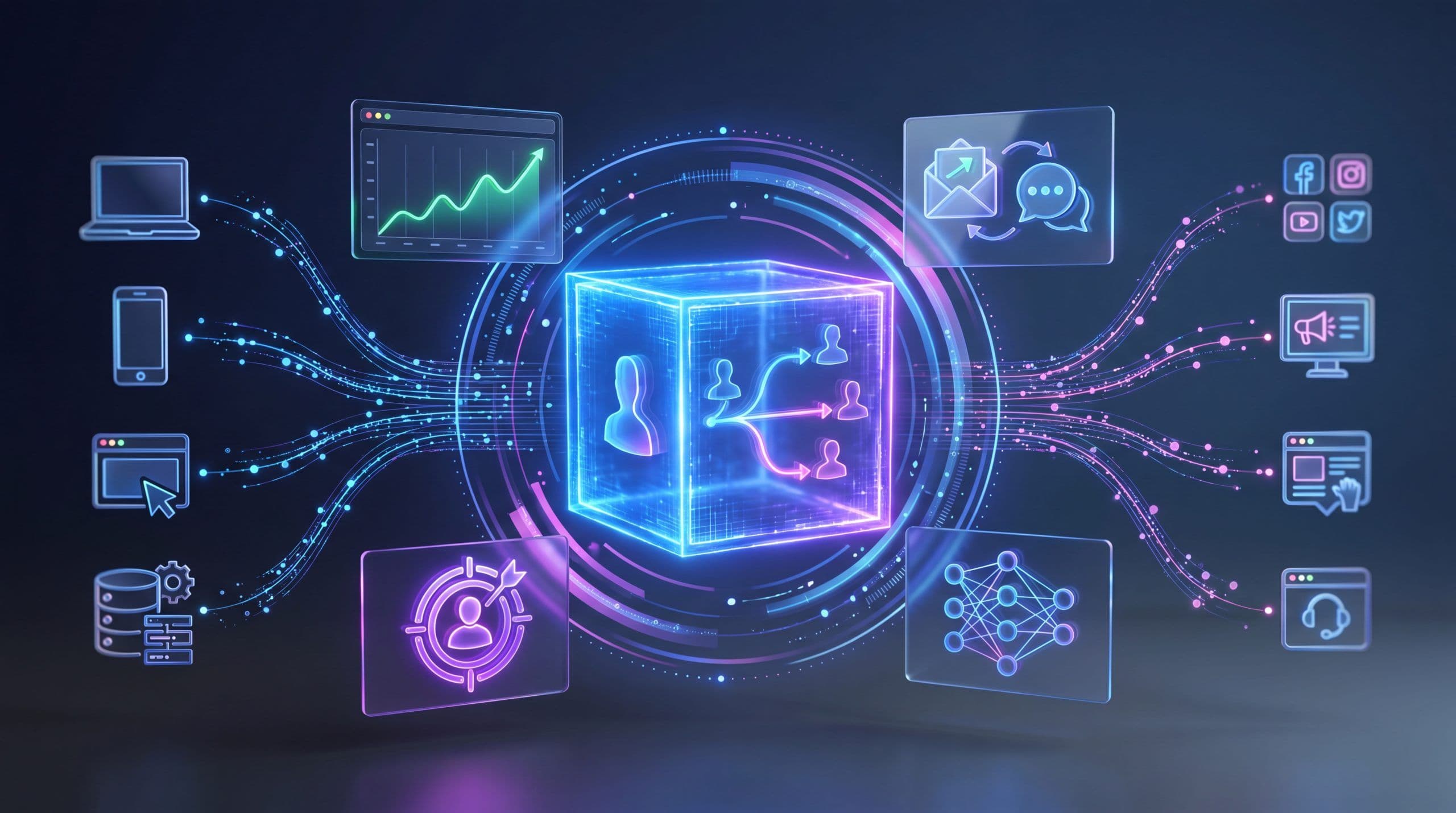
Modern AI Customer Data Platform architecture – unified profile, real-time activation, brand intelligence.
AI Customer Data Platform in 2026: The Complete Guide to Unified Data, Real-Time AI Activation, and Brand-Perfect Personalization
By MarqOps Editorial Team · Updated June 1, 2026 · 12 min read
TL;DR
- An AI customer data platform unifies fragmented customer data, resolves identities across channels, and lets AI agents activate that data in real time across email, web, ads, and support.
- The global CDP market is projected to grow from USD 9.72 billion in 2025 to USD 37.11 billion by 2030 at a 30.7% CAGR, driven by AI personalization demand.
- Three architectures dominate in 2026: traditional packaged CDPs, composable warehouse-native CDPs, and the emerging agentic CDP where AI agents are the primary consumers of customer data.
- 81% of CDP users report high satisfaction with AI/ML support, but only 64% of deployed CDPs deliver significant value. The gap is rarely the technology. It is identity quality, activation discipline, and brand consistency.
- MarqOps unifies CDP-style customer profiles, Brand Intelligence DNA, and AI execution in a single workspace so marketing teams stop stitching 7+ tools together.
Table of Contents
- What Is an AI Customer Data Platform?
- Why AI CDPs Are the Center of Gravity in 2026
- Architecture: Traditional vs Composable vs Agentic CDPs
- 10 High-Impact AI CDP Use Cases
- Top AI Customer Data Platform Vendors
- How to Implement an AI CDP Without the Usual Mess
- Why Brand Intelligence Is the Missing Layer
- Metrics That Prove an AI CDP Is Working
- Common Pitfalls and How to Dodge Them
- FAQs
What Is an AI Customer Data Platform?
An AI customer data platform is a system that ingests every signal a customer leaves across web, mobile, ads, email, CRM, support, commerce, and offline channels, resolves those signals into a single persistent profile, and then uses machine learning and AI agents to predict, decide, and act on that profile in real time.
Traditional CDPs were built to answer one question: “Who is this customer?” An AI CDP answers a sharper one: “What should we do next for this customer, and can we do it without a human in the loop?”
The 2026 evolution sits on three pillars:
- Identity resolution: deterministic and probabilistic matching across devices, emails, anonymous sessions, and offline IDs.
- Real-time profile access: sub-second lookups so an agent or model can score a behavior the instant it happens.
- AI activation: predictive scoring, propensity modeling, next-best-action engines, and autonomous agents that orchestrate journeys end to end.
Plain version: a CDP without AI is a clean address book. An AI CDP is a colleague who already knows which customer to text, what offer to send, and which channel will convert. The hard work happens between the rows.
This is where modern teams stop tab-switching. Instead of stitching together a CDP, an ESP, an ad platform, an analytics tool, a personalization engine, and a creative tool, you run the loop in a single system. A unified marketing intelligence platform uses CDP-style profiles as the foundation and layers AI execution directly on top.
Why AI CDPs Are the Center of Gravity in 2026
Three numbers explain why every marketing leader has a CDP project in their 2026 plan.
USD 37.11B Projected global CDP market by 2030, growing at 30.7% CAGR
81% of CDP users say their platform makes AI/ML projects easier, and 84% say their CDP makes AI tasks more practical day to day. The CDP has stopped being a data project. It is now the launchpad for every AI agent a marketing team deploys.
At the same time, the readiness gap is widening. According to the CDP Institute, only 64% of deployed CDPs deliver significant value, and that figure has dropped over the last two years. McKinsey could not find a single Fortune 500 marketer in a recent study who could cleanly measure martech ROI. The pain is not “should we get a CDP.” It is “how do we run one well.”
Three shifts are pulling AI CDPs into the spotlight right now:
- Agentic marketing is real. AI agents for marketing need clean, real-time data to act safely. The CDP is the data spine that makes autonomous orchestration possible.
- Privacy resets the rules. With cookie deprecation and stricter consent regimes, first-party data is the only durable asset. A CDP is how you treat it like one.
- Channel fragmentation is at peak. The average enterprise marketing team runs across 91 SaaS apps. Without a unifying customer record, omnichannel marketing is a slideshow promise, not an operating reality.
Architecture: Traditional vs Composable vs Agentic CDPs
The old “packaged vs composable” debate is dead. In 2026 there are three architectures, and most teams will end up with a hybrid.
Traditional (Packaged) CDP
A pre-built system that ingests, stores, models, and activates data inside the vendor’s own infrastructure. Strengths: fast time-to-value, opinionated identity resolution, marketer-friendly UI. Trade-offs: data duplication with your warehouse, vendor lock-in on schema, slower iteration on custom models. Examples: Treasure Data, Tealium, Bloomreach, ActionIQ.
Composable (Warehouse-Native) CDP
An unbundled layer that reads from your existing warehouse (Snowflake, BigQuery, Databricks, Redshift) and activates data without duplicating it. Strengths: SQL-level governance, no data movement, engineering control. Trade-offs: multi-vendor complexity, slower real-time loops, heavier engineering ownership. Examples: Hightouch, Census, RudderStack.
Composable/warehouse-native CDP vendors recorded 7.8% organic employment growth in early 2026, nearly 6x the industry average. The category is heating up, but it is not a silver bullet. Data engineering led shops love it. Marketing led shops often hit feedback-loop friction.
Agentic CDP (the emerging category)
A CDP designed for AI agents as primary consumers, not humans. Sub-second profile reads, programmable activation, structured tool calls, native model hosting, and an event bus that lets agents take next-best-actions autonomously. Gartner and Forrester both flag this as the breakout category of 2026. Expect Salesforce Data Cloud, Adobe Real-Time CDP, Treasure Data, and Twilio Segment to converge here through 2027.
Practical take: if you already run a strong warehouse and have data engineers, start composable and add a real-time activation layer. If you do not, run a packaged CDP and let it grow into your warehouse over time. Either way, plan for agentic activation as the next 12-month bet, not the next 36-month one.
10 High-Impact AI CDP Use Cases
These are the use cases marketing teams report the strongest payback on in 2026, ordered by reported ROI density.
- Next-best-action orchestration: propensity models score each customer hourly and trigger the right channel and offer.
- Real-time cart and form abandonment: agents fire personalized recovery within seconds, not the next morning.
- AI customer segmentation: dynamic segments that update as behaviors change, replacing the static lists most teams still manage. See our deep dive on AI customer segmentation.
- Predictive lifetime value (LTV): spend allocation by predicted value, not cost per click.
- Churn prediction and save flows: the data spine for customer churn prediction and pre-emptive retention.
- Lookalike and suppression audience syncs: feeding Meta, Google, and TikTok with high-intent and exclusion segments at the platform level.
- Dynamic creative optimization: profile signals drive on-the-fly variants. We unpacked this in AI dynamic creative optimization.
- Identity-resolved attribution: stitched journeys make multi-touch attribution finally trustworthy.
- Agent-driven outbound: SDR-style AI agents pull live profile context before sending the first message.
- Brand-safe AI content: profile context plus brand DNA produces output that fits the customer and the brand on the first attempt.
Top AI Customer Data Platform Vendors
The CDP market is mature enough that vendor selection is about fit, not feature checklists. These are the platforms most cited in 2026 Gartner Magic Quadrant, Forrester Wave, and CDP Institute evaluations.
| Vendor | Best Fit | AI Strength |
|---|---|---|
| Salesforce Data Cloud | Salesforce-anchored enterprises | Einstein activations, native agent fabric |
| Adobe Real-Time CDP | Adobe Experience Cloud users, enterprise B2C | Customer AI, predictive scoring, NBA |
| Treasure Data | Global enterprises needing governance and scale | Flexible ML pipelines, agentic roadmap |
| Twilio Segment | Developer-first, integration-heavy teams | 1,300+ destinations, AI predictive traits |
| Tealium | Privacy-heavy, multi-region enterprises | Real-time event streaming and consent |
| Hightouch / Census | Warehouse-native, data engineering led | Composable activation, SQL-first audiences |
| Bloomreach / ActionIQ | Retail and B2B respectively | Vertical AI personalization workflows |
One pattern to notice: every leader is racing toward the same end state, where a marketer can talk to an AI agent that already knows the customer, the brand, and the channel rules. The platforms that own all three layers will compound fastest.
How to Implement an AI CDP Without the Usual Mess
Most CDP failures are not vendor failures. They are scoping and sequencing failures. This is the rollout pattern teams use when the project actually ships.
Phase 1: Identity foundations (weeks 1-6)
Pick three to five sources that cover the most ground: web, app, email, CRM, and order history. Map identity keys. Land them. Confirm match rates above 70%. Do not skip this. Identity drift is the silent killer of every downstream model.
Phase 2: Two high-value use cases (weeks 6-12)
Pick one acquisition use case (lookalike sync) and one retention use case (churn risk score). Wire them end to end with real activation and real measurement. Resist the urge to launch ten use cases in parallel.
Phase 3: Real-time activation (months 3-6)
Add streaming triggers and sub-second profile reads. This is where the AI use cases unlock. Without it, your CDP is still batch software with extra steps.
Phase 4: Agentic workflows (months 6-12)
Let AI agents take actions inside guardrails. Start with low-risk paths: lifecycle email decisioning, ad audience refresh, segment grooming. Move up to creative selection and channel arbitration.
Discipline check. Nearly half (47%) of martech decision-makers cite poor system or data integration as their top hurdle. 34% point to underskilled teams. Both problems compound when you launch every use case at once. Sequence the rollout. Win one. Then expand.
Why Brand Intelligence Is the Missing Layer
Here is the part most CDP guides skip. A CDP tells you who the customer is. It does not tell your AI how your brand talks to that customer. Push profile data into an ungoverned AI stack and you ship 200 personalized emails that sound nothing like your brand. The customer hears noise. Conversion drops.
This is exactly why MarqOps built Brand Intelligence DNA as a peer layer to the CDP, not a downstream consumer of it. Every AI generation, segmentation, and activation inside MarqOps reads the brand DNA at the same time it reads the customer profile. The result: brand-perfect output on the first attempt, not after three rounds of edits.
The deeper play is unification. MarqOps replaces 7+ disconnected marketing tools by combining CDP-style customer profiles, brand intelligence, AI creative production, SEO operations, paid ad management, and analytics in one workspace. Marketing teams that switch report 6x faster content output and the end of tab-switching across CDP, ESP, ad manager, content tool, and analytics dashboard. For the wider picture, see our breakdown of AI-powered marketing platforms and how unified stacks beat best-of-breed.
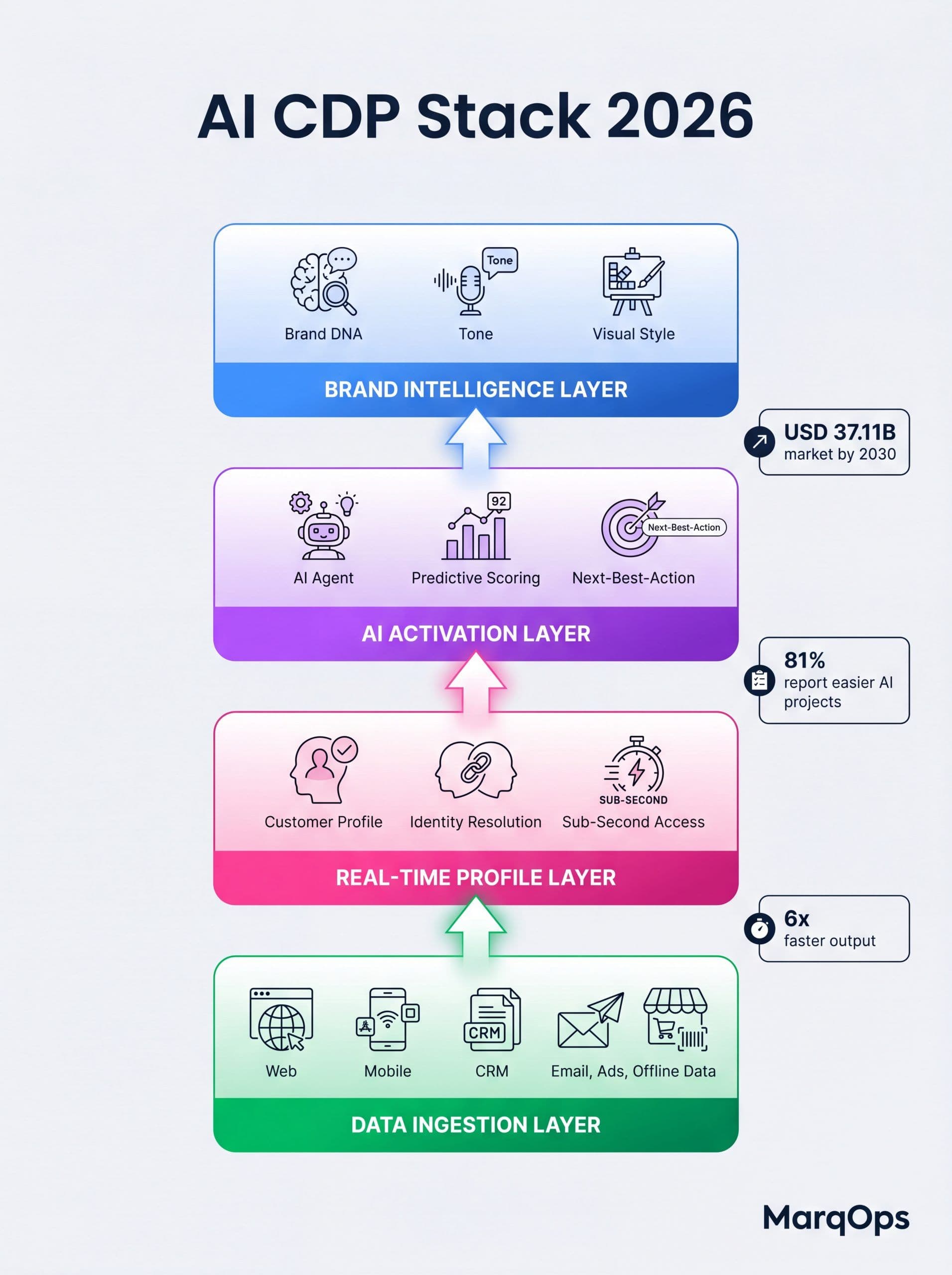
The 2026 AI Customer Data Platform stack: identity, real-time, AI activation, and brand layer.
Metrics That Prove an AI CDP Is Working
The CDP business case lives or dies on five numbers. If your dashboard is not showing all five within 90 days of activation, the project is drifting.
- Profile match rate: percentage of records resolved across sources. Healthy floor: 70%. Best-in-class: 85%+.
- Time to activation: from event to in-channel response. Real-time means sub-second. Anything in minutes is a batch CDP wearing a costume.
- Lift on AI segments vs static: incremental conversion rate of AI-driven segments compared to rule-based ones. Target: 20%+ lift.
- Predicted LTV accuracy: how close your model’s 12-month LTV predictions land. Above 80% directional accuracy unlocks budget reallocation.
- Use cases live: count of AI use cases running in production with measurable revenue impact. Two by month six. Six by month twelve.
Tie these to your broader AI marketing ROI framework. CDPs that fail in the boardroom always fail the same way: nobody can connect the technology spend to revenue impact.
Common Pitfalls and How to Dodge Them
- Treating the CDP as a data warehouse. It is an activation layer, not a storage layer. If it is not pushing audiences and triggering actions, it is failing.
- Over-modeling before any activation. Ship one churn model in production beats six in a notebook.
- Skipping consent and identity governance. Privacy regulators are catching up fast in 2026. Bake consent into the schema, not as an afterthought.
- Buying based on demos. Every CDP demo is gorgeous. Insist on a 30-day proof of value with your real data and real activation channels.
- Ignoring the brand layer. Personalization without brand consistency damages trust faster than no personalization at all.
- Underestimating change management. 34% of teams fail because they are under-skilled, not because the tool is broken. Budget for enablement.
FAQs
What is an AI customer data platform in simple terms?
It is a system that brings every signal a customer leaves across your channels into one profile, then uses AI to decide what to do next for that customer and triggers the action automatically. The CDP is the data layer. The AI on top makes it act.
How is an AI CDP different from a traditional CDP?
A traditional CDP focuses on collecting and unifying data. An AI CDP layers predictive scoring, segmentation, and increasingly autonomous AI agents on top, so it does not just describe the customer. It decides and acts in real time.
Do I need a CDP if I already have a CRM?
Usually yes. A CRM tracks deals, contacts, and sales activity. A CDP unifies behavioral signals across web, app, email, ads, and offline at the individual profile level and activates them in marketing channels. The two are complementary, not interchangeable.
What is the difference between composable and traditional CDPs?
Traditional CDPs store and process data inside the vendor’s infrastructure. Composable CDPs activate customer data directly from your existing data warehouse without duplicating it. Composable is better for engineering-led teams with warehouse maturity. Traditional is faster to value for marketing-led teams.
How long does it take to implement an AI CDP?
Identity foundations and two production use cases typically take 8 to 12 weeks. Full real-time activation and agentic workflows reach maturity around the 9 to 12 month mark. Most failed CDP projects tried to do all of this in three months.
What are good examples of AI CDP use cases?
Real-time cart abandonment with personalized recovery, predictive churn scoring with auto-triggered save flows, next-best-action across email and on-site, lookalike audience syncs to ad platforms, and dynamic creative optimization driven by profile signals. These five cover most of the early payback.
How does MarqOps compare to a traditional CDP?
MarqOps unifies CDP-style customer profiles with Brand Intelligence DNA, AI creative production, SEO operations, paid ad management, and analytics in a single workspace. A standalone CDP solves the data layer. MarqOps closes the loop so the data, the brand voice, and the execution all live in one place, which is why teams report 6x faster output and one platform replacing 7+ tools.
Where to go next
If you are scoping a CDP project or rationalizing your stack, these companion guides will save you a quarter of work.
- Marketing tech stack 2026 guide
- Customer journey orchestration
- AI personalization in marketing
- Predictive marketing analytics
No credit card. Spin up a unified marketing workspace in minutes.
Keep following the signal
Related field notes
Marketing
Brand Asset Management in 2026: How to Run It Without Adding Another Tool
14 min readMarketing Operations
Marketing Project Management Software in 2026: How to Choose Without Adding Tool #122
11 min readMarketing Analytics