Buying Signals in 2026: The Complete Guide to Detecting and Acting on Buyer Intent
Buying signals reveal when a prospect is ready to buy. Learn the three signal types, how to score them by strength, the dark funnel problem, and a capture-score-route-respond framework for 2026.
TL;DR
- Buying signals are the verbal, non-verbal, and digital cues that reveal a prospect is moving toward a purchase. In 2026 the digital ones matter most, because roughly 73% of B2B buying decisions happen before a buyer ever talks to sales.
- Forrester estimates 70% to 80% of the B2B evaluation now happens in the “dark funnel” of review sites, peer communities, LinkedIn, and AI search, where buyers stay anonymous.
- Teams that detect and act on real signals see conversion rates rise around 35% and sales cycles shrink about 23%, yet 87% of organizations say their intent signals are unreliable or inflated.
- The winning playbook is simple to say and hard to do: capture signals across every channel, score them by strength, route them to the right person, and respond fast.
- Fragmented tools are the real blocker. Unifying signal capture, scoring, and activation on one platform is what turns scattered data into pipeline.
Table of Contents
- What Are Buying Signals?
- The Three Types of Buying Signals
- Signal Strength: Which Cues Actually Predict Revenue
- Why Buying Signals Define GTM in 2026
- The Dark Funnel and the Signal Quality Problem
- A Framework to Capture, Score, and Act on Signals
- How to Respond to Buying Signals
- Turning Signals Into Pipeline With One Platform
- Frequently Asked Questions
What Are Buying Signals?
A buying signal is any action or statement that indicates a prospect is interested in buying and is moving closer to a decision. It can be a sales rep hearing “how soon could we start if we moved forward?” on a call, or it can be an anonymous cluster of visits to your pricing page from three people at the same company in a single week. The signal tells you that intent exists right now, which is very different from a name sitting in a database.
The reason buying signals have become the center of modern go-to-market is that buyer behavior changed. Today’s B2B buyers run roughly 80% of their interactions through digital channels and complete 60% to 90% of their decision-making before contacting a vendor. By the time a form gets filled out, the real evaluation is often over. Reading signals is how marketing and sales teams re-enter a process they used to control but no longer own. If you want the data layer that powers this, start with a strong point of view on intent data and how it maps to real accounts.
Quick definition: a buying signal is evidence of intent. Intent data is the aggregated, scored version of many signals across accounts. Signal-based selling is the motion of acting on those signals before your competitors do.
The Three Types of Buying Signals
Most teams find it useful to sort signals into three buckets. Each one shows up in a different place and needs a different response.
Verbal signals
These are the things a prospect says out loud on a call, in a demo, or in an email thread. Asking detailed questions about features, pricing, implementation timelines, or contract terms is a verbal signal. So is a direct statement of readiness like “what happens next?” These are among the clearest cues you will get, because the buyer is telling you where they are in their own words.
Non-verbal signals
Non-verbal cues are the behaviors that show engagement without a stated intent. A prospect who nods along, takes notes during a demo, reviews the materials you sent, or invites a colleague from finance or IT into the next call is signaling that the evaluation is getting serious. Bringing more people into the conversation is one of the most reliable non-verbal signals, because B2B purchases are made by buying groups, not individuals.
Digital signals
Digital signals are where 2026 lives. Repeat visits to pricing and comparison pages, multiple visitors from one company, case study downloads, integration doc clicks, ROI calculator use, competitor content engagement on LinkedIn, and anonymous website visits identified by de-anonymization tools all fall here. Product telemetry, such as rising feature usage or a team member upgrading a seat, is often the single strongest digital signal because it reflects real behavior inside your product rather than stated interest. Pairing these signals with a clear ideal customer profile is what separates noise from opportunity.
Signal Strength: Which Cues Actually Predict Revenue
Not every signal deserves the same reaction. Treating a first-time blog visit like a booked demo is how teams burn trust and waste rep hours. Here is a practical way to rank common signals by how strongly they predict a near-term purchase.
| Signal | Type | Strength |
|---|---|---|
| Booked a demo or requested a quote | Verbal / digital | Very strong |
| Rising in-product usage or seat upgrade | Digital | Very strong |
| Multiple visitors from one account on pricing pages | Digital | Strong |
| Prospect brings finance or IT into the call | Non-verbal | Strong |
| Case study download or comparison page view | Digital | Moderate |
| Single blog visit or newsletter open | Digital | Weak |
The point is not the exact ranking, it is that strength should drive routing and speed. Very strong signals belong with a human within minutes. Weaker signals belong in a nurture track. This is exactly the logic that good AI lead scoring automates, so reps spend their time only on accounts that are genuinely in-market.
Why Buying Signals Define GTM in 2026
The shift toward signal-based go-to-market is not a trend piece, it is a response to hard numbers. The B2B buyer intent data market is worth an estimated $4.5 billion in 2026 and is growing at roughly a 15.9% CAGR. Adoption is broad, with about 92% of B2B teams now integrating intent data into their marketing stacks. The reason is that the results are measurable.
35%
higher conversion rates for teams acting on intent signals, alongside sales cycles about 23% shorter
Buyer preference is driving the change too. According to Gartner’s March 2026 sales survey, 67% of B2B buyers now prefer a rep-free buying experience, up from 61% a year earlier. When buyers do not want to talk to sales early, signals become the only way to know they are in the market at all. This is why pipeline marketing and demand generation teams have moved from measuring form fills to measuring revenue influence from the accounts that showed real intent.
It is also why the discipline of GTM engineering exists now. Signals are only useful if they are captured, enriched, scored, and routed automatically. Doing that by hand across a dozen tools does not scale, which is where the operational side of RevOps becomes the difference between a signal that converts and one that expires unnoticed.
The Dark Funnel and the Signal Quality Problem
Here is the catch. Most buying activity is invisible. Forrester estimates that 70% to 80% of the B2B evaluation process happens in what teams call the dark funnel: research on review sites, private Slack and peer communities, LinkedIn, and increasingly AI search tools. About 89% of B2B buyers now use AI assistants during their research, which means a growing share of the journey never touches your website or your analytics at all.
That invisibility creates two problems. First, you miss real intent. Second, the signals you can see are often low quality. Roughly 87% of organizations say their marketing investments produce unreliable or inflated intent signals, and about 70% of B2B teams cite signal quality as their single biggest challenge. Buying a third-party intent feed and firing outreach at every “spike” is a fast way to annoy accounts that were never really in the market.
The fix for signal quality is not more feeds. It is combining first-party behavior you own with third-party context, then scoring the combination. Only about 26% of B2B marketers rely on first-party data alone and 19% on third-party alone. The 55% who blend both consistently get cleaner reads.
Your best signals are the ones you own outright. Strengthening your first-party data foundation, and asking buyers directly for context through zero-party data, gives you signals that no competitor can buy and no privacy change can switch off.
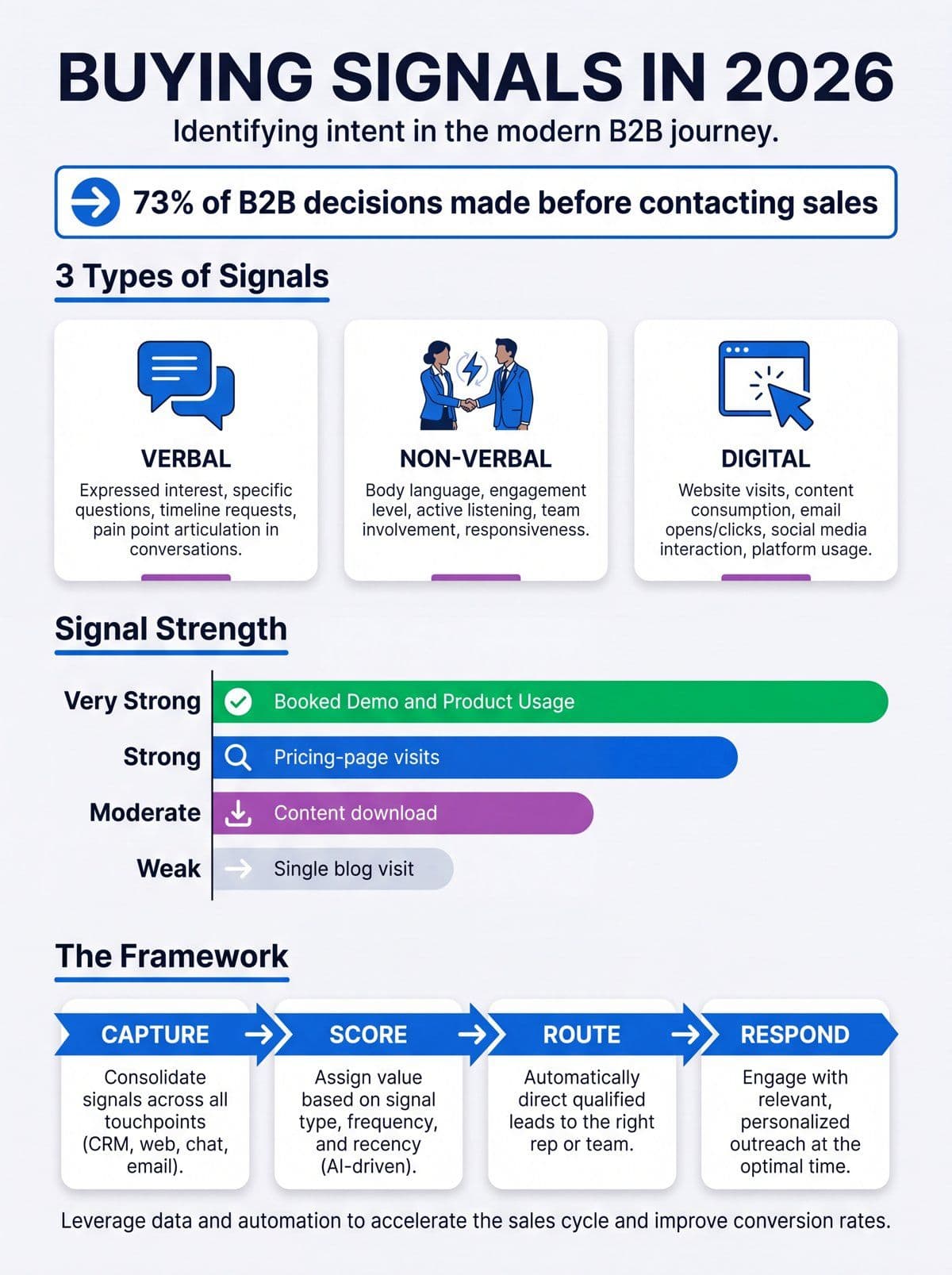
The signal-based marketing framework: capture across channels, score by strength, route by fit, respond by speed.
A Framework to Capture, Score, and Act on Signals
A repeatable signal motion has four stages. Skipping any one of them is where most programs quietly break.
1. Capture everywhere
Collect signals from every surface you can: website behavior, product telemetry, CRM activity, ad engagement, LinkedIn interactions, review-site alerts, and enriched third-party intent. The goal is a single stream, not fifteen dashboards. If your customer data platform cannot see product usage and web behavior in the same place, your strongest and cheapest signals stay siloed.
2. Score by strength and fit
Combine signal strength with account fit. A very strong signal from an account that matches your ICP is a fire alarm. A strong signal from a poor-fit account is a note for later. Modern scoring is dynamic, updating as new signals arrive, which is why AI marketing analytics has replaced static point systems that went stale within days.
3. Route to the right motion
High-intent, high-fit accounts should trigger human outreach or a personalized conversational marketing experience. Medium-intent accounts belong in orchestrated nurture. This routing logic is the backbone of good customer journey orchestration, where the next best action depends on the signal, not the calendar.
4. Respond fast
Speed is the whole game. A very strong signal has a short shelf life, sometimes hours. Teams that respond within the same day capture the account while intent is still hot. This is where an AI SDR earns its keep, handling instant first-touch on signals that would otherwise sit in a queue overnight.
How to Respond to Buying Signals
Response should match signal strength. Overreacting to a weak signal feels like surveillance, and underreacting to a strong one loses the deal.
For strong signals, act immediately and specifically. When a prospect asks about pricing, walk them through the packages and offer a custom quote conversation. When they raise a use case, validate it with a relevant customer example and book a technical deep dive. When they ask what happens next, lock in the follow-up before the call ends and send the calendar invite within the hour. When multiple people from one account hit your pricing page, have the account owner reach out with context, not a generic template.
For weaker signals, stay useful and patient. A single content view or an early-stage question deserves a thoughtful, low-pressure response that keeps the relationship warm without pushing. Feeding those accounts into a well-designed AI marketing funnel lets you nurture them automatically until their signals strengthen enough to justify a human.
Rule of thumb: the stronger the signal, the faster and more human the response. The weaker the signal, the more automated and patient it should be.
Turning Signals Into Pipeline With One Platform
The hardest part of signal-based marketing is rarely the strategy. It is the plumbing. Signals live in your analytics tool, your ad platforms, your CRM, your product, and your intent provider, and stitching them together is where most programs stall. When capture, scoring, and activation each live in a different tool, signals decay before anyone acts on them.
This is the exact problem MarqOps was built to remove. One platform replaces 7 or more disconnected marketing tools, so signal capture, scoring, analytics, creative, and paid activation share the same data instead of fighting over it. Its Brand Intelligence DNA means every response, from an ad to an outreach email, comes out on-brand from the start, and teams ship that response up to 6 times faster because they are not switching tabs to assemble it. A unified dashboard for analytics, ads, SEO, and creative is what lets a strong signal become a same-day, on-brand touch instead of a stale note in a spreadsheet.
Start Free – No Card RequiredSee How MarqOps Works
Frequently Asked Questions
What is an example of a buying signal?
Booking a demo is a classic strong buying signal, because the account is both problem-aware and solution-aware and is ready to act. Other examples include asking about pricing or implementation timelines, multiple people from one company visiting your pricing page in the same week, and rising usage inside a free product trial.
What is meant by a buying signal?
A buying signal is any verbal, non-verbal, or digital cue that shows a prospect is interested and moving toward a purchase decision. It indicates active intent in the moment, which is different from a static contact record that shows fit but not readiness.
What are the three main types of buying signals?
The three types are verbal signals, such as questions about pricing or timelines, non-verbal signals, such as bringing more stakeholders into a call, and digital signals, such as repeat pricing-page visits or increased product usage. In 2026 digital signals carry the most weight because most of the buyer journey happens online and anonymously.
How do you respond to a buying signal?
Match your response to the signal’s strength. For strong signals, respond quickly and specifically, such as sending a calendar invite within the hour or having the account owner reach out with context. For weaker signals, respond thoughtfully and keep the account in an automated nurture track until intent strengthens.
What is the difference between buying signals and intent data?
A buying signal is a single piece of evidence that a prospect is interested. Intent data is the aggregated, scored view of many signals across accounts, often blending your first-party behavior with third-party research activity. Signals are the raw input, and intent data is the organized output your team acts on.
Keep following the signal