Intent Data in 2026: The Complete Guide to Turning Buyer Signals Into Pipeline
Intent data reveals which accounts are in market right now. Learn the signal types, how it is collected, and how AI turns buyer intent into pipeline in 2026.
Intent Data in 2026
Your best-fit buyers are already researching a solution like yours. The hard part is knowing which accounts, which week, and what they care about. That is exactly the gap intent data closes. This guide breaks down what intent data is, how it is collected, the signal types that actually matter, and how AI-native marketing teams turn raw buyer signals into pipeline in 2026.
TL;DR
- Intent data is the behavioral signal layer that reveals when an account is actively researching a solution, before they ever fill out a form.
- It splits into first-party (your own properties), second-party (a partner’s data), and third-party (aggregated across the web). The best programs blend all three.
- The B2B intent data market is worth roughly $4.5 billion in 2026, growing near 16% a year, yet only about 25% of companies actually use it well.
- Done right, intent data predicts buying behavior with 60 to 75% accuracy and tightens targeting, scoring, and timing across the funnel.
- A growing blind spot: buyers now research inside ChatGPT, Perplexity, and Google AI Overviews, where traditional intent providers cannot see.
- MarqOps unifies first-party signals, scoring, and brand-perfect activation in one platform, so intent data drives campaigns instead of sitting in a dashboard.
Table of Contents
- What Is Intent Data?
- Why Intent Data Matters More Than Ever in 2026
- The Three Types of Intent Data
- How Intent Data Is Collected
- Buyer Intent Signals: What to Actually Watch
- How AI Changes the Intent Data Game
- 7 Ways Marketing Teams Use Intent Data
- The AI Search Blind Spot
- How to Build an Intent Data Strategy
- Common Intent Data Mistakes to Avoid
- Turning Intent Into Action With MarqOps
- Frequently Asked Questions
What Is Intent Data?
Intent data is the set of behavioral signals that reveal when a company or person is actively researching a product, service, or category. Instead of guessing who might be interested, you watch what people actually do: the content they consume, the searches they run, the pricing pages they linger on, and the topics they suddenly start engaging with across the web.
The reason this matters is simple. According to Gartner research, B2B buyers spend only about 17% of their purchase journey meeting with potential suppliers. The other 83% happens independently, across review sites, search engines, peer communities, and vendor websites, long before anyone talks to sales. Intent data is how you get visibility into that hidden 83%.
Think of it as the difference between firmographic data and behavioral data. Firmographics tell you a company fits your ideal customer profile. Intent data tells you that same company is in market right now. One describes potential, the other describes timing. Pair them and you get the holy grail of demand generation: the right account, with the right need, at the right moment.
Quick definition: Intent data is behavioral evidence that an account is researching a solution. It answers “who is in market right now and what do they care about,” which is something a static contact list can never tell you.
Why Intent Data Matters More Than Ever in 2026
Buying committees got bigger, budgets got tighter, and attention got shorter. The teams winning in 2026 are not the ones sending more outreach. They are the ones sending relevant outreach to accounts that are already paying attention. The numbers back this up.
$4.5B
Estimated size of the B2B intent data market in 2026, growing around 16% a year
Here is what stands out in the current data. Roughly 96% of B2B marketers who use intent data report success with it, and yet only about 25% of companies actually leverage these tools. That gap is the opportunity. When the majority of your competitors are still spraying generic campaigns, an intent-led program is a genuine edge.
The performance lift is real, too. Teams that operationalize intent data report meaningfully higher conversion rates, dramatically better click-through on targeted campaigns, faster sales cycles, and larger qualified pipeline, with many seeing return on investment within six months. The mechanism is not magic. You are simply spending budget and rep time on accounts that have already raised their hand, instead of the ones that never will.
This is also where intent data connects to the broader shift toward first party data strategy and privacy-first marketing. As third-party cookies fade and regulation tightens, behavioral signals you can collect and act on responsibly become more valuable, not less.
The Three Types of Intent Data
Not all intent data is created equal. The signals vary by where they come from, how much you can trust them, and how broadly they cover the market. There are three core types.
1. First-Party Intent Data
This is data collected directly from your own digital properties: website visits, pricing page views, content downloads, webinar registrations, email engagement, and product usage. First-party intent has the highest fidelity of any signal. A prospect sitting on your pricing page is a stronger buying indicator than almost any external topic surge, because the action happened on your turf and maps directly to your offering.
The catch is coverage. First-party data only sees accounts that have already found you. It is deep but narrow. That is why mature programs treat it as the anchor signal and layer other sources on top. If you are building this foundation, it pairs naturally with zero party data that buyers share with you directly.
2. Second-Party Intent Data
Second-party intent is simply someone else’s first-party data, shared through a partnership or a trusted intermediary. Think review platforms like G2 or TrustRadius, where a buyer comparing software products generates a high-intent signal that the platform can pass to relevant vendors. It is more targeted than the open web and often captures buyers at the comparison stage, which is late and valuable. Privacy-safe collaboration through data clean rooms is making second-party data sharing far more practical in 2026.
3. Third-Party Intent Data
Third-party intent is aggregated from large networks of publisher websites, content platforms, and search activity across the open web. Providers like Bombora, 6sense, and similar players track content consumption and topic engagement, then flag accounts showing a surge of research activity around your category. The strength here is reach. Third-party data can detect an account researching your space before they ever visit your website, which makes it the early-warning system of the stack.
The tradeoff is precision. Third-party signals are account-level and probabilistic, not a guarantee that a specific buyer is ready. The smartest move is to combine all three: third-party for discovery, second-party for comparison-stage timing, and first-party for confirmation and personalization.
The blended rule: Accuracy improves significantly when you stack multiple intent signals together. Combining first-party and third-party sources through an AI-powered platform is what pushes prediction accuracy into that 60 to 75% range.
How Intent Data Is Collected
Understanding collection helps you judge quality. Intent data is gathered through a few distinct mechanisms, each with its own strengths.
On your own properties, collection happens through website analytics, tags, reverse-IP and identity resolution, marketing automation tracking, and product telemetry. This is where you tie anonymous behavior to known accounts and feed it into your CRM.
Across publisher networks, third-party providers use cooperatives of websites that share content-consumption data. When devices and accounts repeatedly engage with content on a specific topic, the provider records a spike above that account’s normal baseline and reports it as an intent surge.
On review and comparison sites, platforms track which products a buyer views, compares, and shortlists, then surface those high-intent moments to vendors.
Once collected, the raw behavior is only useful if it is unified. That means resolving signals to accounts, removing noise, and connecting everything to the rest of your customer data platform so the signal can actually drive a campaign. Collection is the easy part. Activation is where most programs stall.
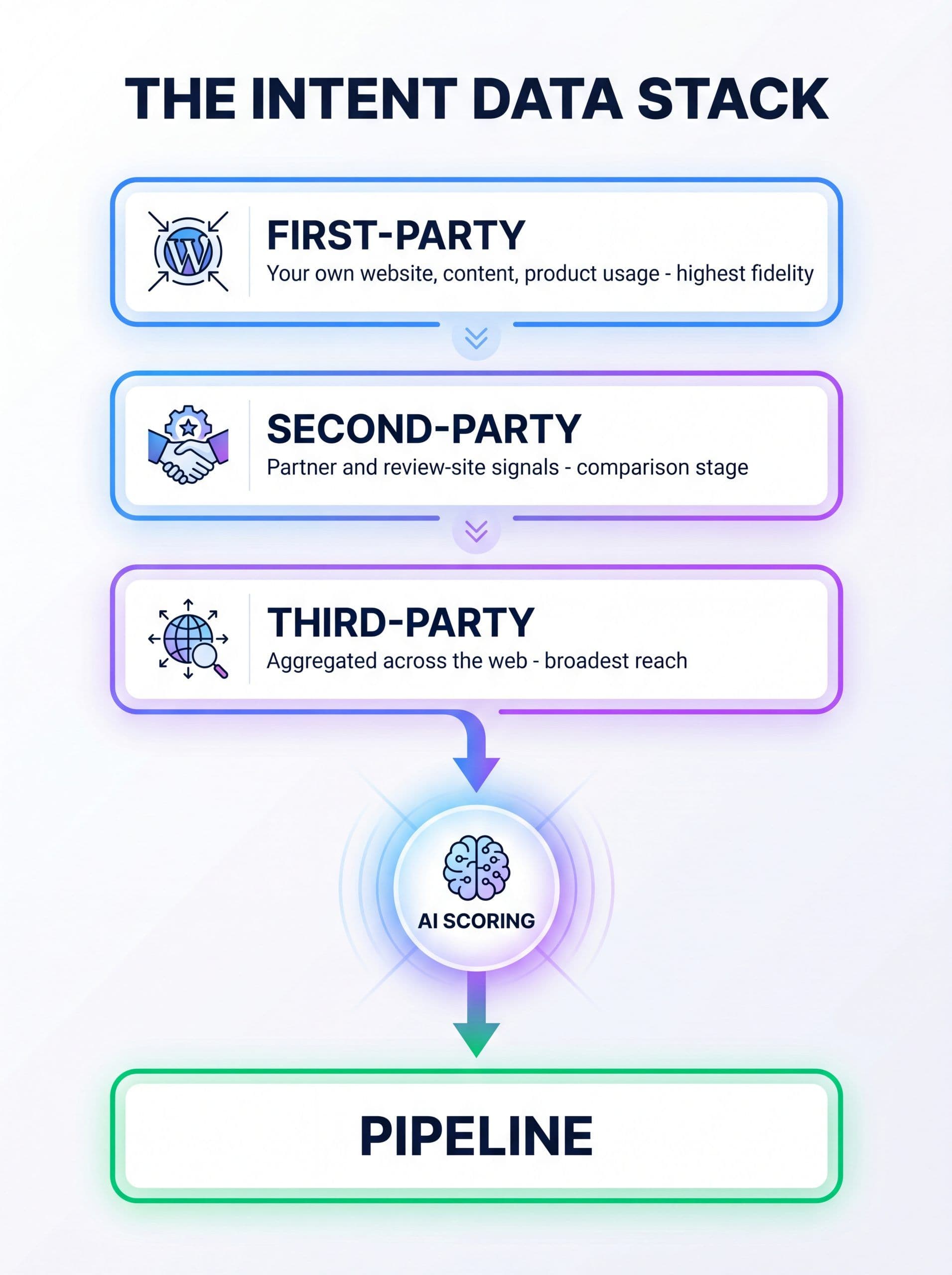
The intent data stack: first-party, second-party, and third-party signals unified and activated through AI.
Buyer Intent Signals: What to Actually Watch
Intent is not one signal, it is a pattern. Here are the categories that consistently predict buying behavior, roughly ordered from broad to high-confidence:
- Topic surges: An account suddenly consuming content about your category across the web.
- Search behavior: Increased searches for solution keywords, competitor names, and comparison terms.
- Website engagement: Repeat visits, pricing and demo page views, and multiple stakeholders from the same domain.
- Content downloads: Gated assets, buyer guides, and bottom-of-funnel resources.
- Review-site activity: Comparing your product against alternatives on G2 or TrustRadius.
- Competitive signals: Researching or reviewing a competitor you displace well.
- Trigger events: Champion job changes, funding rounds, hiring spikes, and tech-stack shifts.
The mistake is reacting to any single signal. A topic surge alone is weak. A topic surge plus two pricing-page visits plus a champion who just changed jobs is a meeting waiting to happen. This is exactly the kind of multi-signal pattern that feeds modern AI lead scoring models.
How AI Changes the Intent Data Game
For years, intent data created a familiar problem: too many signals, not enough time to act. A rep would get a list of 400 “surging” accounts on Monday and have no idea which five to call first. AI is what finally makes the signal usable.
Modern platforms combine first-party data from your CRM, website, and marketing automation with third-party intent collected across the web, then use machine learning to score every account by likelihood to convert. Instead of a flat list, you get a ranked, prioritized view of who is most ready, why, and what to say. AI handles the pattern recognition no human team could do at scale: weighing dozens of signals, learning from closed-won and closed-lost outcomes, and updating scores in real time.
It also closes the activation gap. Once an account crosses an intent threshold, AI can trigger the next step automatically, whether that is a personalized ad sequence, a tailored email, or a sales alert with suggested talking points. This is the engine behind predictive marketing analytics and the broader move toward agentic marketing, where AI agents act on signals without waiting for a human to notice them.
7 Ways Marketing Teams Use Intent Data
Intent data is only as good as what you do with it. Here are the highest-leverage plays:
- Account-based marketing: Prioritize and personalize ABM outreach to accounts actively in market, not just accounts that fit your profile.
- Lead scoring and prioritization: Feed intent into your scoring model so reps work the hottest accounts first.
- Ad targeting: Serve paid campaigns only to surging accounts, cutting wasted spend and lifting click-through.
- Sales prioritization: Give reps a ranked daily list with the context to open a relevant conversation.
- Content personalization: Tailor website and email content to the topics an account is researching.
- Churn prevention: Watch for existing customers researching competitors and intervene early.
- Demand generation: Build smarter demand generation programs that focus budget on accounts showing real signals.
Each of these works far better when intent data is not trapped in a standalone tool. The moment it flows into your B2B marketing automation and creative workflows, it stops being a report and starts being pipeline.
The AI Search Blind Spot
Here is the trend reshaping intent data in 2026: a growing share of buyer research now happens inside ChatGPT, Perplexity, Claude, and Google AI Overviews. A prospect can research your entire category, compare options, and shortlist vendors in a single AI conversation that never touches a publisher network or a tracked website. That activity is largely invisible to traditional intent data providers.
This does two things. First, it makes your own first-party signals even more important, because they are still fully observable. Second, it raises the stakes on being visible inside AI answers in the first place. If buyers are researching in AI tools and your brand is not getting cited, you lose the signal and the consideration. That is why intent data strategy increasingly overlaps with answer engine optimization and tracking your brand across AI search visibility tools. The next generation of intent platforms is already racing to incorporate new signal sources, from video engagement to community activity, to fill the gap.
How to Build an Intent Data Strategy
You do not need a six-figure data contract to start. You need a clear sequence. Here is a practical path:
Step 1: Nail your first-party foundation. Before buying external data, make sure you are capturing and unifying your own signals: website behavior, content engagement, product usage, and CRM activity. This is the highest-fidelity data you will ever have and it costs you nothing extra.
Step 2: Define what “intent” means for you. Map the specific behaviors that correlate with your closed-won deals. Pricing-page visits, demo requests, and specific topic combinations matter more than generic surges.
Step 3: Layer in third-party coverage. Add a provider to catch in-market accounts before they reach your site, then validate those signals against your first-party data.
Step 4: Score and prioritize with AI. Combine signals into a single account score so your team always knows who to work first. This is where AI marketing analytics earns its keep.
Step 5: Activate, do not just report. Wire intent into your campaigns, ads, sales alerts, and customer journey orchestration so signals trigger action automatically.
Step 6: Measure and refine. Track conversion lift, sales-cycle speed, and pipeline influence, then feed outcomes back into your scoring model so it keeps getting smarter.
Common Intent Data Mistakes to Avoid
- Buying data before you can act on it. A surge list with no activation workflow is money set on fire. Build the pipes first.
- Treating every signal as equal. Account-level third-party surges are not the same as a named buyer on your pricing page. Weight accordingly.
- Ignoring first-party data. It is the highest-fidelity signal you own, and most teams underuse it.
- Letting it live in a silo. Intent data trapped in a standalone dashboard does not move revenue. It has to flow into the tools your team actually works in.
- Forgetting the AI search blind spot. If you are not tracking and earning visibility in AI answers, you are missing a fast-growing slice of buyer research.
Turning Intent Into Action With MarqOps
The recurring theme across every section of this guide is the same: collecting intent data is easy, activating it is hard. Most teams end up with signals scattered across a third-party provider, a web analytics tool, a CRM, and a separate ad platform, with no single place where intent actually becomes a campaign.
That fragmentation is exactly what MarqOps was built to fix. Instead of stitching together seven disconnected tools, MarqOps unifies first-party signals, AI-powered scoring, creative production, and activation in one platform. Its Brand Intelligence DNA means the moment an account crosses an intent threshold, the system can generate brand-perfect, personalized campaigns up to 6x faster, across ads, email, and content, without anyone switching tabs. The result is that intent data stops being a report your team admires and starts being pipeline your team closes.
If your intent signals are currently sitting in a dashboard nobody acts on, a unified system is the difference between insight and impact.
Frequently Asked Questions
What is intent data in simple terms?
Intent data is behavioral evidence that a company or person is actively researching a solution like yours. It includes signals such as content consumption, search activity, website visits, and review-site comparisons, helping you spot in-market buyers before they fill out a form.
What is the difference between first-party and third-party intent data?
First-party intent data comes from your own properties, like website visits and product usage, and has the highest fidelity. Third-party intent data is aggregated across publisher networks and the open web, offering broader reach to catch accounts researching your category before they ever visit your site. The strongest programs blend both.
How accurate is intent data?
When properly implemented, intent data can predict buying behavior with roughly 60 to 75% accuracy. Accuracy improves significantly when you combine multiple signal types, integrate first-party and third-party sources, and apply AI-powered scoring rather than reacting to any single signal in isolation.
Is intent data worth it for small teams?
Yes, and you can start without a large budget. Begin by capturing and unifying your own first-party signals, which cost nothing extra and carry the highest fidelity. Add third-party coverage and AI scoring as you grow. Many teams see return on investment within six months when intent is wired into activation, not just reporting.
How is intent data affected by AI search tools like ChatGPT?
A growing share of buyer research now happens inside ChatGPT, Perplexity, and Google AI Overviews, where traditional intent providers cannot track activity. This makes your own first-party signals more important and raises the value of being cited inside AI answers through answer engine optimization, so you capture both the signal and the consideration.
Keep Building Your Data-Driven Stack
Intent data is one pillar of a modern, privacy-first marketing engine. To go deeper, explore our guides on first party data, predictive marketing analytics, and AI ABM platforms, then see how it all comes together in one AI-powered marketing platform.
Keep following the signal