RevOps in 2026: The Complete Guide to Revenue Operations for Marketing Teams
Revenue operations (RevOps) aligns marketing, sales, and customer success into one connected revenue engine. Here is what RevOps is, why it drives 36% faster growth, and how to build it in 2026.
TL;DR
- RevOps (revenue operations) unifies the people, process, data, and technology behind marketing, sales, and customer success so the whole revenue engine runs as one system instead of three disconnected teams.
- It works. Companies with a formal RevOps function report roughly 36% higher revenue growth and up to 28% more profitability, and by 2026 about 75% of high-growth companies are expected to run on a RevOps model.
- The problem RevOps fixes is fragmentation. The average B2B team juggles 10 to 15 tools, two-thirds of marketing teams run 16 or more, and 65.7% of organizations name data integration as their single biggest stack challenge.
- AI is now the engine of modern RevOps. 96% of revenue leaders expect their teams to use AI tools by the end of 2026, but bad data produces confidently wrong outputs at scale, so data integrity comes first.
- RevOps is an operations problem before it is a technology problem. A unified platform like MarqOps replaces 7 or more disconnected tools with one source of truth, which is exactly the foundation RevOps needs.
Table of Contents
- What Is RevOps (Revenue Operations)?
- Why RevOps Matters in 2026
- The Four Pillars of RevOps
- The Tool Sprawl Problem RevOps Solves
- How AI Is Reshaping RevOps
- How to Build a RevOps Function
- RevOps Metrics That Matter
- Where MarqOps Fits In
- Frequently Asked Questions
What Is RevOps (Revenue Operations)?
Revenue operations, almost always shortened to RevOps, is the practice of aligning the people, processes, data, and technology behind every team that touches revenue, namely marketing, sales, and customer success, so they operate as a single connected system. Instead of three departments each running their own tools, their own metrics, and their own version of the truth, RevOps gives them one shared model of how the business actually makes money.
The easiest way to understand RevOps is to look at the problem it was invented to solve. In most companies, marketing chases leads, sales chases deals, and customer success chases renewals, and each team optimizes for its own number. The handoffs between them leak. Marketing passes leads that sales ignores, sales closes accounts that churn in six months, and nobody can agree on why because every team is reading from a different dashboard. RevOps exists to close those gaps by owning the connective tissue: the data, the systems, and the processes that should flow cleanly from first touch to renewal.
RevOps is not just a renamed version of sales operations. Sales ops focuses on the efficiency of the sales team alone. RevOps takes the wider view across the full revenue lifecycle, which is why it sits so close to disciplined marketing operations. Where marketing ops makes one function run well, RevOps makes the entire go-to-market motion run as one.
Quick definition: RevOps is the alignment of people, process, data, and technology across marketing, sales, and customer success so a company can manage its entire revenue engine as one accountable, measurable system.
Why RevOps Matters in 2026
RevOps is no longer a fringe idea or a job title at a handful of fast-scaling startups. It has become one of the defining operating models of modern go-to-market, and the data behind that shift is hard to argue with.
The headline number is growth. Organizations that align the people, processes, and technology across their entire revenue engine experience roughly 36% more revenue growth and up to 28% more profitability than those that do not. That is not a marginal edge. It is the difference between a team that scales predictably and one that stalls the moment it adds headcount.
36% faster growth
Revenue growth advantage for companies with a formal RevOps function
Adoption is accelerating to match. By 2026, an estimated 75% of high-growth companies are expected to operate with a RevOps model, and the job market reflects it. The VP of Revenue Operations title grew by roughly 300% over an 18-month stretch, and revenue operations is now one of the fastest-growing roles in the United States with well over 174,000 open positions at any given time.
The market for RevOps tooling and services is expanding just as quickly. One widely cited estimate puts the broader revenue operations software market on a path from about $6.16 billion in 2025 to $21.70 billion by 2032, a compound annual growth rate north of 17%. The RevOps services market alone is projected to nearly quadruple between 2026 and 2035. Money and talent are flowing toward the function because the alternative, fragmented teams arguing over whose data is right, has become too expensive to sustain.
The deeper reason RevOps matters now is that buying has changed. Modern buyers move across channels, research on their own, and expect a consistent experience whether they are reading a blog, talking to sales, or renewing a contract. Delivering that requires a connected view of the customer that no single department owns, which is precisely the gap RevOps fills. It is the same logic driving investment in customer journey orchestration and unified customer data platforms.
The Four Pillars of RevOps
RevOps can feel abstract until you break it into the work it actually does. Most mature functions organize around four pillars, and a healthy RevOps team is balanced across all of them rather than buried in just one.
1. Operations and process
This is the plumbing: lead routing, territory and quota design, the deal stages in your CRM, renewal workflows, and the rules that move a record from marketing to sales to success without friction. When operations is strong, handoffs are clean and nobody wastes time on manual workarounds. When it is weak, reps spend their days fighting the system instead of selling. Strong process design here connects directly to effective B2B marketing automation.
2. Enablement
Enablement makes sure every revenue-facing person has the content, training, and tools to do their job well. That spans onboarding, sales collateral, competitive positioning, and the playbooks that turn a good quarter into a repeatable one. RevOps owns the systems and the measurement behind enablement so the investment actually shows up in win rates, a discipline closely tied to AI sales enablement.
3. Insights and analytics
This pillar turns scattered activity into decisions. RevOps builds the reporting layer that tells leadership what is working, where deals stall, which channels drive pipeline, and what the forecast really looks like. It is where multi-touch attribution and predictive marketing analytics live, and it is impossible to do well without clean, connected data feeding it.
4. Tools and technology
The final pillar is the stack itself: the CRM, marketing automation, analytics, enablement, and dozens of point solutions that the revenue teams rely on. RevOps owns the architecture, decides what gets bought, kills redundant tools, and keeps everything integrated. This pillar is where most teams quietly lose the most money, which deserves a closer look.
The Tool Sprawl Problem RevOps Solves
If RevOps has a single archenemy, it is tool sprawl. The modern go-to-market stack has grown into a tangle of disconnected software, and the cost of that tangle is the strongest argument for building a RevOps function in the first place.
The numbers are sobering. The average B2B sales team runs 10 to 15 different tools. On the marketing side, two-thirds of teams juggle 16 or more martech applications, and many companies between 25 and 500 employees are still running 20 to 40 disconnected marketing technologies, with a meaningful slice of the budget trapped in subscriptions almost nobody uses. Every one of those tools was bought to solve a real problem. Together they create a bigger one.
65.7%
of organizations name data integration as their single biggest stack challenge, far ahead of cost or skills
That fragmentation shows up as bad data. When systems do not talk to each other, the same customer exists three times with three different statuses. Over half of CRM managers report data accuracy below 80%, and roughly 23% of email addresses go invalid within a year as disconnected systems drift apart. The hidden labor is brutal too: mid-market teams spend 10 to 15 hours a month just managing integrations, troubleshooting sync failures, and deduplicating records, which works out to thousands of dollars per year in pure overhead before a single deal is influenced.
This is why so many teams are moving from accumulation to consolidation. B2B teams are deliberately cutting from 12 tools to 6, and marketing leaders are rationalizing bloated stacks into lean, revenue-driven ones. The goal is not fewer features. It is one source of truth, which is the foundation RevOps cannot function without and the reason a unified marketing tech stack has become a board-level conversation.
How AI Is Reshaping RevOps
The biggest force acting on RevOps in 2026 is artificial intelligence, and it is changing both what the function does and what it is responsible for. AI has moved past dashboards and into the realm of intelligent augmentation, where systems do not just report on the revenue engine, they actively run parts of it.
Adoption is near universal at the leadership level. According to Gong, 96% of revenue leaders expect their teams to use AI tools by the end of 2026, and Gartner projects that 40% of enterprise applications will include task-specific AI agents by the close of the year. These agents aggregate data from across the stack, surface leading indicators, route leads, score accounts, and generate forecasts that adjust as conditions change. The promise is a real shift in how time gets spent: sales reps currently sell during only about 28% of their day, and agentic AI is designed to hand back the rest by absorbing the busywork around the sale.
For RevOps the more profound change is to the job itself. The function is moving from being the steward of process and data to being the governor of intelligent systems, the team that decides how AI agents behave, what data they are allowed to trust, and how automation connects across the stack. That is a meaningful evolution of the AI agents for marketing trend, now applied to the entire revenue motion. RevOps increasingly leans on AI for AI lead scoring and richer AI marketing analytics to make those decisions at speed.
The hard truth of AI RevOps: when AI works with bad data, it produces confidently wrong outputs at scale, namely bad forecasts, mis-routed leads, and flawed attribution. By 2026, data integrity is the frontline barrier to scale. The teams winning with AI are the ones that fixed their data foundation first.
That caveat is the whole game. AI does not rescue a messy stack, it amplifies it. A model fed conflicting records from a dozen disconnected tools will make confident, expensive mistakes faster than any human could. This is exactly why the fragmentation problem and the AI opportunity are two sides of one coin: you cannot get reliable intelligence out of a system that cannot agree with itself. Clean, connected data is the precondition for every benefit AI promises a RevOps team.
How to Build a RevOps Function
You do not need a 20-person team or a seven-figure budget to start. RevOps is built in stages, and the early moves matter more than the org chart. Here is a practical sequence that works for teams of almost any size.
1. Audit your data and your stack
Start by mapping every tool your revenue teams use, what data lives where, and where the same record exists in more than one place. Most teams are shocked by how many tools they are paying for and how little of the data actually connects. This audit is the honest baseline everything else builds on.
2. Define one shared revenue model
Get marketing, sales, and customer success to agree on a single definition of a lead, an opportunity, a closed deal, and a renewal, plus the metrics that matter at each stage. If the three teams cannot agree on what a qualified lead is, no amount of software will align them. Alignment is a conversation before it is a system.
3. Consolidate toward a single source of truth
Kill redundant tools and connect what remains so customer data flows cleanly from first touch to renewal. The aim is one trustworthy record per customer that every team reads from. This is the step that pays for itself, both in software savings and in reclaimed hours, and it is where a unified platform earns its keep.
4. Build the reporting layer
With clean data in place, build the dashboards leadership actually needs: pipeline by source, conversion by stage, forecast accuracy, and customer health. A single shared marketing dashboard ends the era of three teams bringing three different numbers to the same meeting.
5. Layer in automation and AI, carefully
Only once data and process are solid should you add automation and AI agents on top, starting with low-risk, high-volume tasks like lead routing and data enrichment. Measure everything, expand what works, and keep a human governing the system. Build AI on a clean foundation, not on top of the mess.
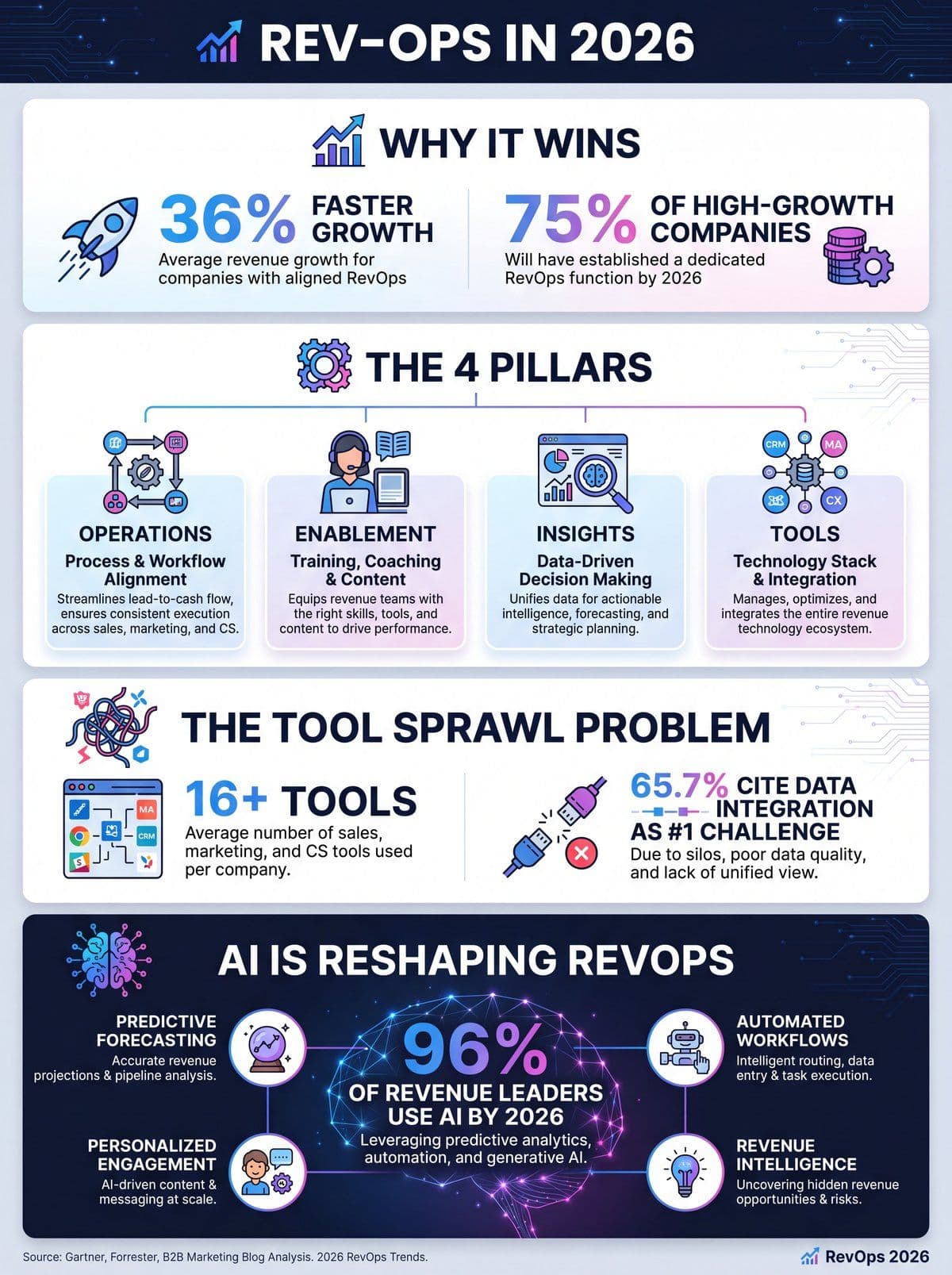
RevOps at a glance: why it drives 36% faster growth, the four pillars, the tool sprawl it solves, and how AI is reshaping the function in 2026.
RevOps Metrics That Matter
A RevOps function lives or dies by the numbers it is accountable for. The right metrics span the full revenue lifecycle rather than favoring any one team, which is exactly the point.
On the efficiency side, watch pipeline velocity, sales cycle length, and win rate, because RevOps is supposed to make the whole motion faster and tighter. On the revenue side, track annual recurring revenue, net revenue retention, and customer lifetime value, since RevOps owns the full arc from acquisition through expansion. Forecast accuracy deserves its own spotlight: a RevOps team that cannot forecast reliably has not yet earned trust, and AI-assisted forecasting is becoming the bar.
Two cross-cutting metrics separate mature functions from the rest. The first is data quality itself, measured as the percentage of records that are complete, accurate, and deduplicated, because every other number depends on it. The second is the cost and count of the tech stack, because consolidating tools is one of the clearest, fastest ways RevOps proves its value. Tie these back to overall AI marketing ROI and you have a scorecard the whole company can rally around. Strong RevOps reporting also sharpens upstream demand generation by showing which programs actually create revenue, not just leads.
Where MarqOps Fits In
Read back through this guide and one theme repeats in every section: RevOps succeeds or fails on whether your data and tools are connected. The growth advantage, the AI opportunity, the clean handoffs, the reliable forecast, all of it depends on a single source of truth that most teams do not have because their stack is a pile of disconnected software.
That is the exact problem MarqOps was built to solve. It replaces 7 or more disconnected marketing tools with one platform, so your content, campaigns, analytics, ads, SEO, and creative all flow from a single connected system instead of a dozen that barely talk. Its Brand Intelligence DNA keeps everything on-brand and consistent from the start, which matters enormously when the whole RevOps promise rests on data you can trust. Teams using it produce content up to 6 times faster, and a unified dashboard means marketing, sales, and leadership finally look at the same numbers instead of arguing over three versions. If you are rethinking your stack for a RevOps motion, our guide to AI-powered marketing platforms shows how a unified system changes the math.
RevOps is an operations problem before it is a technology problem, and the operations get a lot easier when the technology stops fighting you. Consolidating to one source of truth is the foundation, and it is the foundation MarqOps exists to provide.
Frequently Asked Questions
What is RevOps in simple terms?
RevOps, short for revenue operations, is the practice of aligning marketing, sales, and customer success around shared data, processes, and technology so they run as one connected revenue engine instead of three separate teams with three separate systems.
What is the difference between RevOps and sales operations?
Sales operations focuses on making the sales team more efficient. RevOps takes the wider view across the entire revenue lifecycle, aligning marketing, sales, and customer success together. Sales ops optimizes one function, while RevOps optimizes the whole go-to-market motion as a single system.
Does RevOps actually improve revenue?
Yes. Companies with a formal RevOps function report roughly 36% higher revenue growth and up to 28% more profitability than those without one. By 2026, an estimated 75% of high-growth companies are expected to operate with a RevOps model.
How is AI changing RevOps?
AI agents now handle lead routing, scoring, enrichment, and forecasting, and 96% of revenue leaders expect their teams to use AI tools by the end of 2026. The catch is data quality: AI fed bad data produces confidently wrong outputs at scale, so RevOps must fix its data foundation before automating on top of it.
How do I start building a RevOps function?
Begin by auditing your data and tools, then get marketing, sales, and success to agree on one shared revenue model and set of definitions. Consolidate redundant tools toward a single source of truth, build a shared reporting layer, and only then layer in automation and AI on a clean foundation.
Keep following the signal