AI SDR in 2026: The Complete Guide to AI Sales Development Representatives
What an AI SDR does, how AI SDRs compare to human reps on volume, cost, and conversion, where rollouts fail, and how to connect AI sales development to a unified marketing engine.
AI SDR in 2026: The Complete Guide to AI Sales Development Representatives
What an AI SDR actually does, how the numbers compare to human reps, where teams get burned, and how to fold AI sales development into a unified marketing and revenue engine.
TL;DR
- An AI SDR is an agentic AI system that researches prospects, writes personalized outreach, runs multichannel follow-up, qualifies replies, and books meetings, working around the clock with light human oversight.
- The market is scaling fast: roughly $5.81 billion in 2026 at a 32% CAGR, with enterprise adoption jumping from 12% to 41% of B2B teams in a single year.
- AI SDRs win on volume and cost (10x more sends, 40 to 80% lower cost per meeting) but trail humans on reply quality and opportunity conversion.
- The data is clear that hybrid beats pure automation: in one controlled test, a human-in-the-loop setup booked fewer meetings but generated 2.3x more revenue.
- Success is mostly plumbing. Clean data, tight ICP, deliverability discipline, and a unified view of marketing and sales decide whether an AI SDR scales pipeline or scales noise.
Table of Contents
- What Is an AI SDR?
- How AI SDR Agents Actually Work
- The AI SDR Market in 2026: Adoption and Growth
- AI SDR vs Human SDR: The Real Numbers
- Why the Hybrid Model Wins
- Where AI SDRs Go Wrong
- A Practical Implementation Roadmap
- Connecting AI SDRs to Your Marketing Engine
- Frequently Asked Questions
What Is an AI SDR?
An AI SDR is a software agent that performs the core work of a sales development representative: finding the right prospects, researching them, writing personalized outreach, following up across channels, qualifying responses, and handing warm meetings to human closers. Unlike a sequencing tool that just fires templates on a schedule, a modern AI SDR is built on agentic AI. It can make decisions, adjust its messaging based on how a prospect responds, and decide the next best action toward a goal without waiting for a human to push every button.
That distinction matters. The category exploded because revenue teams were drowning in manual prospecting while reply rates kept sliding. An AI SDR promises to take the highest-volume, lowest-judgment parts of the job and run them continuously. In practice the best deployments look less like a robot replacing a rep and more like a tireless research-and-drafting engine sitting underneath a smaller, sharper human team. If you have read our guide to AI agents for marketing, the AI SDR is simply that same agentic pattern pointed at outbound pipeline.
Quick definition: SDR stands for sales development representative, the role that owns top-of-funnel prospecting and qualification. An AI SDR automates most of that workflow using machine learning, natural language processing, and autonomous decision-making, then routes qualified conversations to people.
How AI SDR Agents Actually Work
Strip away the marketing language and an AI SDR runs a loop with five repeatable stages. Each stage used to be a separate tool or a separate human task. Agentic systems chain them together.
1. Prospect identification and research
The agent scores and prioritizes target accounts using firmographics, intent data, and past engagement, then enriches each contact by scraping public sources and cross-referencing internal knowledge. This is the same signal layer that powers good AI lead scoring, which is why the two capabilities are converging.
2. Personalized message generation
Instead of mail-merge tokens, the agent drafts outreach grounded in what it learned about the prospect, a recent funding round, a job change, a product launch, or a relevant pain point. The quality ceiling here depends entirely on the research feeding it.
3. Multichannel sequencing
Leading agents run email, LinkedIn, SMS, WhatsApp, and even voice in a coordinated cadence rather than blasting one channel. The agent decides timing and channel based on response behavior, which is the agentic part that separates 2026 tools from 2023 sequencers.
4. Qualification and conversation
When a prospect replies, the agent can ask discovery questions, interpret intent, apply consistent scoring, and decide whether the lead is sales-ready. This is where AI SDRs overlap with conversational marketing, since both turn an inbound or outbound reply into a structured qualification dialogue.
5. Meeting booking and CRM sync
Qualified conversations get booked onto a rep’s calendar, and the entire interaction history is written back to the CRM automatically. Clean handoff is the difference between a useful agent and an inbox full of orphaned threads.
The AI SDR Market in 2026: Adoption and Growth
The category is not a curiosity anymore. The AI SDR market is projected to grow from about $4.39 billion in 2025 to $5.81 billion in 2026, a compound annual growth rate of roughly 32%, and forecasts put it near $17.58 billion by 2030. Adoption tells the same story at the team level.
41%
of enterprise B2B teams ran at least one AI SDR in production in Q1 2026, up from 12% a year earlier and just 3% in early 2024
Among companies with 500 or more employees, AI SDR adoption had already passed 55% by early 2026. The drivers are familiar: wider CRM adoption, the shift to digital and remote selling, relentless competition for buyer attention, and pressure to do more pipeline with leaner teams. For most revenue orgs the question has moved from whether to use AI in sales development to how to deploy it without torching deliverability or buyer trust.
AI SDR vs Human SDR: The Real Numbers
The honest comparison is not “better or worse.” It is a trade between volume and cost on one side and reply quality and conversion on the other. Here is what the 2026 benchmarks show.
| Metric | AI SDR | Human SDR |
|---|---|---|
| Emails per day | 500 to 2,000 | 50 to 100 |
| Cold reply rate | 3 to 8% | 5 to 12% |
| Meeting-to-opportunity rate | ~15% | ~25% |
| Cost per meeting | $39 to $403 | $425 to $1,083 |
A few things stand out. The volume gap is real, often 10x or more. The cost gap is real too, with AI booking meetings at 40 to 80% lower cost. But the quality gap is also real: on a paired test of 100,000 sends, AI-generated outreach landed a 4.1% positive reply rate against 5.2% for human-written copy. That is a 1.1 point gap, and notably it narrowed from a 2.0 point gap in 2024, so the AI side is improving fast.
The bigger story is what happens after the reply. AI SDR meetings convert to genuine opportunities at roughly 15% versus 25% for experienced humans. Volume without qualification just shifts the bottleneck downstream onto your closers, which is exactly the kind of measurement problem we cover in the AI marketing funnel guide.
Why the Hybrid Model Wins
If you only remember one finding from this guide, make it this one. In a controlled test, an AI-only configuration booked 847 meetings at an 11% conversion rate, while a human-in-the-loop hybrid booked just 312 meetings at 38% conversion. The hybrid generated roughly 2.3x more revenue despite booking far fewer meetings.
Cost per qualified opportunity dropped from $487 in human-only pods to $224 in hybrid AI plus human pods. And human SDRs book 23% more meetings when working alongside AI than when working without it. The augmentation framing is the one backed by data.
The pattern is consistent across vendors and independent tests. AI handles research, signal monitoring, drafting, and follow-up. Humans provide judgment, approval, and authentic engagement on the conversations that matter. Treat “AI replaces SDRs” with skepticism and “AI augments SDRs” as real. The teams seeing 5 to 6x productivity gains are not firing their reps. They are giving each rep the output of five.
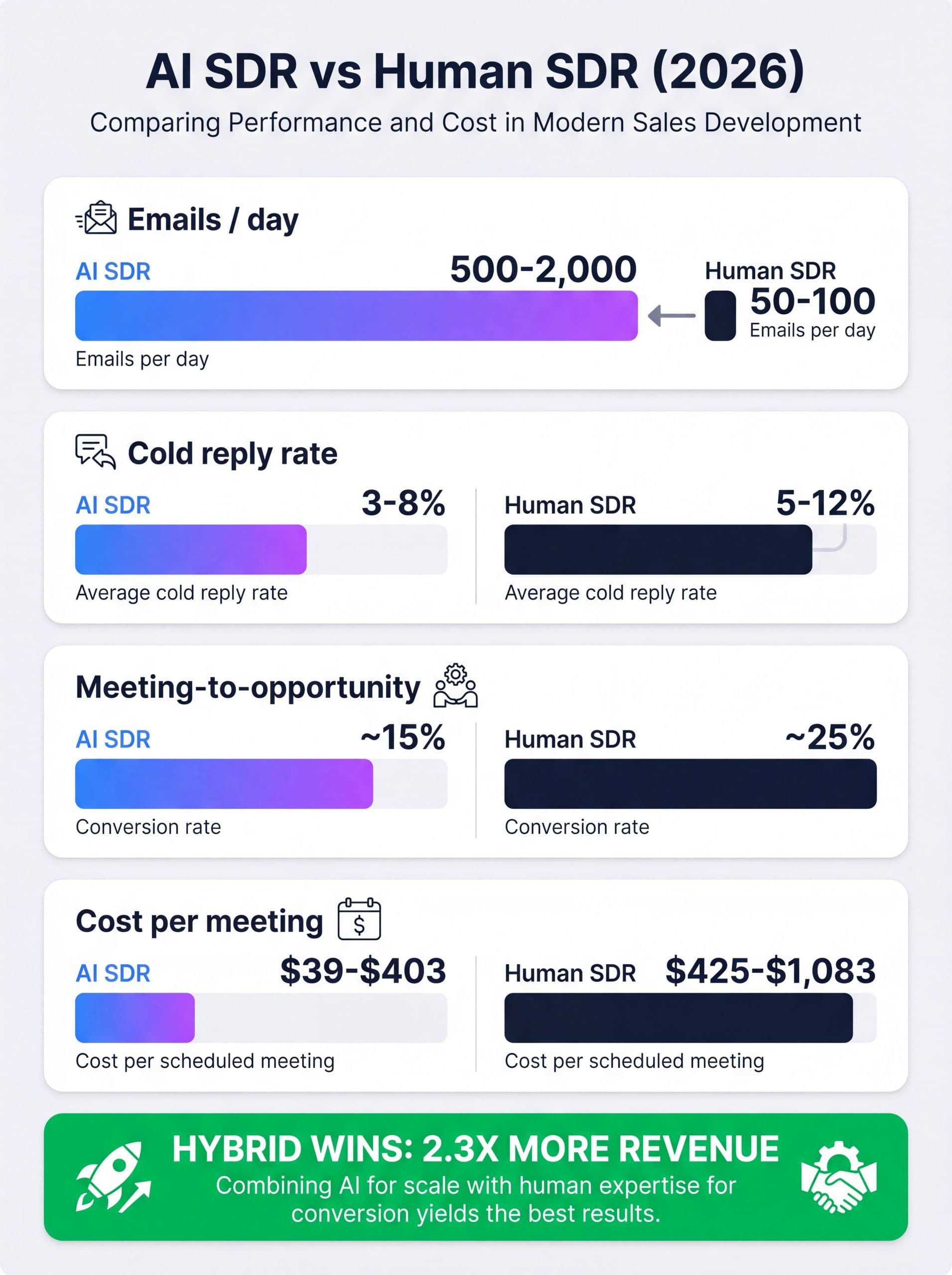
AI SDR vs human SDR: the 2026 trade between volume, cost, and conversion quality.
What AI SDRs Can and Cannot Do Yet
Vendor claims of 4 to 7x conversion lifts, 70 to 80% cost savings, and $100 million in pipeline make great headlines, and in narrow, well-run deployments some of those numbers are real. But it helps to separate what the technology reliably does today from what it is still bad at, so you buy for the right reasons.
What they do well: AI SDRs are excellent at the top of the funnel. They research at a scale no human can match, draft genuinely personalized first touches, never forget a follow-up, work nights and weekends, and apply scoring rules consistently across thousands of contacts. For high-volume outbound against a clear ICP, they remove the busywork that burns out human reps and let a small team cover a much larger market.
Where they still struggle: They do not yet close enterprise deals on their own, read nuanced buying-committee dynamics, or build the kind of trust that wins competitive, high-consideration purchases. They can also amplify mistakes at machine speed, so a bad ICP or a clumsy message becomes thousands of bad sends before anyone notices. The realistic framing for 2026 is that AI SDRs own volume and consistency while humans own judgment and relationships. Anchoring expectations there is the difference between a happy renewal and a 90-day cancellation, and it shapes how you should think about every marketing workflow automation decision around the agent.
Where AI SDRs Go Wrong
The failure rate is high for a reason. Roughly 70% of teams churn out of their AI SDR tool within 90 days, and almost always for the same avoidable reasons.
Dirty data scales the mess
If your CRM is messy and your ICP is fuzzy, an AI SDR will simply scale the mess faster. Experienced operators describe success as 80 to 90% plumbing: fix routing, scoring, and data hygiene first, then add the agent as the last 20%. This is the same data foundation argument behind every serious marketing tech stack decision.
Deliverability is the silent killer
Unverified emails bounce, ISPs flag your domain, and suddenly even your human reps land in spam. B2B cold reply rates have drifted from around 6.8% in 2023 to 4 to 5% in 2025 and 2026 as Gmail and Microsoft tune filters against AI-generated patterns. Discipline matters: keep to about 30 emails per day per inbox, warm new domains for at least 30 days, and pick a platform with native automated warmup.
Set-and-forget is a myth
The teams that churn treat the agent like an appliance. The teams that win budget 15 to 20 hours per week of human oversight, reviewing messaging, monitoring deliverability, and approving sends during the early phase. An AI SDR is a system you operate, not a switch you flip.
A Practical Implementation Roadmap
Here is a sequence that consistently separates the teams that scale pipeline from the ones that burn a domain and quietly cancel.
Step 1: Fix the foundation. Clean your CRM, tighten your ICP to one well-defined segment, and confirm your lead routing and scoring actually work. This is the 80% of the work that determines the outcome.
Step 2: Start narrow with a human in the loop. Run the agent on your best-defined segment with a person approving every send. You are testing data quality, deliverability, and message fit, not chasing volume yet.
Step 3: Protect the domain. Cap sends per inbox, warm domains properly, and watch bounce and spam-complaint rates daily. Deliverability health is non-negotiable.
Step 4: Measure opportunities, not meetings. Judge the agent on qualified opportunities and revenue influenced, not raw meetings booked. A 5-metric view that ties AI activity back to pipeline keeps you honest, the same principle behind strong RevOps measurement.
Step 5: Scale what converts. Once a segment shows healthy opportunity conversion and clean deliverability, expand to the next ICP. Let the human-in-the-loop ratio relax only where the data earns it. This staged rollout mirrors how mature teams approach B2B marketing automation in general.
Connecting AI SDRs to Your Marketing Engine
An AI SDR does not live in a vacuum. It is fed by marketing signals and it feeds the same pipeline marketing is measured on, which is why the smartest teams treat it as one node in a connected system rather than a standalone sales gadget. The prospect research it relies on is the same intent and engagement data that powers demand generation. The assets it sends should match the brand and messaging your AI sales enablement program already maintains. And the qualification logic should align with how the rest of your agentic marketing stack scores and routes leads.
This is exactly the fragmentation problem MarqOps was built to solve. When prospecting signals, brand-perfect messaging, analytics, and routing live in seven disconnected tools, every handoff leaks data and every team works from a different version of the truth. MarqOps unifies creative, content, analytics, and campaign operations on a single platform, so the signals that should inform outreach and the results that should prove it sit in one dashboard instead of being stitched together by hand. Its Brand Intelligence DNA keeps every AI-generated touch on-brand from the first draft, which is the part most AI SDR tools get wrong. The teams building durable pipeline in 2026 are the ones treating sales development as one connected layer of a unified marketing operation, a theme we explore further in our guide to GTM engineering.
Start Free – No Card RequiredSee How MarqOps Works
Frequently Asked Questions
What is an AI SDR in simple terms?
An AI SDR is an autonomous software agent that does the top-of-funnel work of a sales development representative: researching prospects, writing personalized outreach, following up across email, LinkedIn, and other channels, qualifying replies, and booking meetings for human reps. It runs continuously with human oversight rather than replacing the team outright.
Are AI SDRs better than human SDRs?
Neither is strictly better. AI SDRs win on volume and cost, sending 10x more messages and booking meetings at 40 to 80% lower cost. Human SDRs win on reply quality and opportunity conversion, around 25% versus roughly 15% for AI. The strongest results come from a hybrid model where AI handles research and drafting and humans handle judgment and key conversations.
How much does an AI SDR cost?
Pricing varies widely by platform and volume, but the meaningful number is cost per outcome. AI SDRs typically book meetings in the $39 to $403 range versus $425 to $1,083 for human reps, and hybrid pods have driven cost per qualified opportunity down to roughly $224. Factor in setup, data hygiene, and the 15 to 20 hours per week of human oversight a healthy deployment needs.
Why do so many AI SDR rollouts fail?
About 70% of teams churn within 90 days, usually because of dirty data, a fuzzy ICP, poor deliverability discipline, or a set-and-forget mindset. Success is 80 to 90% plumbing. Fix routing, scoring, and data hygiene first, protect your sending domain, and keep a human in the loop, especially in the early phase.
How do AI SDRs fit with marketing?
AI SDRs are fed by marketing signals like intent and engagement data and they feed the same pipeline marketing is measured on. They work best as one connected layer of a unified marketing and revenue operation rather than a standalone sales tool. Platforms like MarqOps unify those signals, brand-safe messaging, and analytics in one dashboard so outreach is informed by the same data that proves its impact.
Keep following the signal