GTM Engineering in 2026: The Complete Guide for Marketing Teams
GTM engineering is the fastest-growing role in revenue teams. Learn what it is, how it differs from RevOps, the tech stack, salaries, and how to build the function.
TL;DR
- GTM engineering is the discipline of building automated revenue systems – the data pipelines, signal detection, enrichment, and AI workflows that power modern go-to-market teams. A GTM engineer sits between RevOps and software engineering.
- The role is exploding. GTM engineering job postings surged 205% year over year in 2025, and LinkedIn went from roughly 1,400 open roles in mid-2025 to more than 3,000 by January 2026.
- Pay reflects the demand. US base salaries run from about $99K to $310K, with a median near $135K and technical Python-and-SQL builders earning software-engineer money at AI-native companies.
- The core shift is build vs. run. GTM engineers build new automated plays; RevOps governs and optimizes the systems that already exist. They are partners, not rivals.
- The output of every GTM engineering system is AI-generated content and personalization at scale – which only works if it stays on brand. MarqOps gives that output one brand-intelligent layer, replacing 7+ disconnected tools and helping teams ship up to 6x faster.
Table of Contents
- What Is GTM Engineering?
- Why GTM Engineering Exploded in 2026
- GTM Engineer vs. RevOps: Build vs. Run
- What a GTM Engineer Actually Does
- The GTM Engineering Tech Stack
- How to Build a GTM Engineering Function
- Metrics That Prove It Is Working
- Common Mistakes to Avoid
- Frequently Asked Questions
What Is GTM Engineering?
GTM engineering is the discipline of building and operating the systems, automations, and data pipelines that power a modern go-to-market team. A GTM engineer sits in the space between revenue operations and software engineering. They write code, design workflows, integrate APIs across the sales and marketing stack, and ship internal tools that compound the productivity of everyone responsible for pipeline.
In practical terms, a GTM engineer builds the machinery behind revenue: lead scoring logic, account routing, enrichment waterfalls, signal detection, reply triage, outbound personalization, and the custom dashboards that tell the team what is working. Where a traditional sales team scaled by adding people, a GTM engineering team scales by adding systems. One well-built pipeline can do the work that used to require a room full of reps.
The role exists because AI collapsed the distance between an idea and its execution. A few years ago, turning a clever go-to-market play into a working system meant filing a ticket and waiting on a developer or a data team. Now a single GTM engineer can design, test, and ship that play in an afternoon. That is the same operational mindset behind RevOps and broader marketing operations – treat revenue as a system to be engineered, not a series of heroic manual efforts.
Simple definition: A GTM engineer builds the automated systems that find, enrich, score, route, and reach buyers – so revenue scales with software instead of headcount.
Why GTM Engineering Exploded in 2026
This is not a slow-burn trend. GTM engineering went from a niche title used by a handful of startups to one of the fastest-growing roles in revenue teams in barely two years. The hiring data is striking: GTM engineering job postings surged roughly 205% year over year in 2025, and LinkedIn listings climbed from about 1,400 open roles in mid-2025 to more than 3,000 by January 2026. Depending on how you filter, that number kept climbing through the first half of the year.
205%
year-over-year growth in GTM engineering job postings in 2025
Compensation tells the same story. US base salaries for GTM engineers span a wide band, from roughly $99K to $310K, with a median base around $135K. The spread is unusually bimodal. Non-technical “configurers” who mostly operate tools land in the $108K to $140K range, close to a RevOps salary. Technical builders who write Python and SQL and orchestrate AI agents command software-engineer money, with total compensation reaching $210K to $310K at AI-native companies. Specialized individual contributors who could implement agentic workflows saw earnings jump about 23% in 2025 alone.
So why now? Three forces converged. First, buyers went dark – they research privately and ignore generic outreach, which makes precise, signal-based targeting essential. Second, AI made it possible for one person to automate what used to take a team, from research to personalized messaging. Third, leadership got serious about efficiency, and “one engineer who builds a system” became far more attractive than “five reps who send emails.” The same pressure pushing teams toward B2B marketing automation and leaner marketing tech stacks is what created the GTM engineer.
GTM Engineer vs. RevOps: Build vs. Run
The most common question about this role is whether it is just RevOps with a trendier name. It is not, and the cleanest way to understand the difference is the build vs. run model.
GTM engineering builds. The job is to create net-new automated revenue systems that did not exist before – a signal-detection pipeline, an enrichment waterfall, an AI agent that researches accounts and drafts outreach. GTM engineers are builders, shipping new machinery that creates leverage.
RevOps runs. The job is to govern, optimize, and scale the processes the company already depends on – CRM hygiene, forecasting, reporting, territory design, change management. RevOps keeps the revenue engine reliable and accountable across teams.
You can see it in the skill sets. GTM engineers bring SQL, Python, API integration, AI prompt engineering, and fluency with tools like Clay, LLMs, and agentic systems. RevOps professionals bring CRM administration, analytics, process design, and the cross-functional communication that keeps sales, marketing, and customer success aligned. One leans technical and creative; the other leans operational and organizational. The strongest revenue orgs in 2026 run both, with GTM engineering feeding new systems into a RevOps function that operationalizes and measures them. If you are weighing where to invest, our guides to AI sales enablement and AI lead scoring show where the two disciplines overlap most.
The mental model: GTM engineering is the R&D lab that invents new revenue plays. RevOps is the factory floor that runs them at scale, reliably, every quarter.
What a GTM Engineer Actually Does
Strip away the buzzwords and a GTM engineer spends the day designing and shipping automated plays. Here is what that work actually looks like.
1. Signal detection
The foundation of modern go-to-market is reacting to what accounts are doing right now, not blasting a static list. GTM engineers wire up live signals: hiring posts that reveal budget and new initiatives, funding events that mean fresh capital to deploy, technographic changes that open an evaluation window, and research activity captured as intent data. Each signal becomes a trigger that kicks off the right play at the right moment.
2. Data enrichment and modeling
Raw lists are useless without context. GTM engineers build enrichment waterfalls that stitch together firmographic, technographic, and contact data from multiple providers, then write the data models that turn that raw input into a clean, scored, routable record. This is where SQL and API work earns its keep.
3. AI workflow design
The job has shifted from “API plumber” to “AI systems architect.” GTM engineers now spend more time training models, refining prompts, building feedback loops, and orchestrating AI agents than wiring point-to-point integrations. They design the AI workflow automation that researches an account, drafts a personalized message, and routes it – all without a human touching each record.
4. Personalized outreach at scale
Instead of hiring five SDRs to send 500 generic emails a day, a single GTM engineer can build a system that runs 10,000 signal-triggered sequences a week, each personalized from live context. That is the kind of leverage that pairs naturally with AI personalization across the funnel.
5. Measurement and iteration
Every play is an experiment. GTM engineers build the dashboards that show which signals convert, which messages land, and which sequences quietly waste budget. Then they feed that learning back into the system, the same closed loop that powers good AI marketing analytics.
The GTM Engineering Tech Stack
There is no single “GTM engineering app.” The discipline is about orchestrating an entire layer of tools into one automated pipeline, from data sourcing to delivery. While stacks vary, a recognizable architecture has settled in for 2026.
Orchestration. Clay sits at the center of most serious GTM engineering stacks. It is where data sourcing, enrichment, and conditional logic live, and its built-in AI agent, Claygent, scrapes websites, news, job posts, and social activity for personalization signals. General-purpose automation tools like Make, n8n, and Zapier handle the connective tissue between systems.
AI agents. What was a preview feature in 2024 became production-grade in 2026. Multi-step research, conditional enrichment, and message drafting now run inside the orchestration layer itself, which is the practical face of AI agents for marketing and the broader move toward agentic marketing.
Delivery. Email sending runs through tools like Smartlead or Instantly, LinkedIn automation through platforms built for it, and website visitor identification through deanonymization tools. Each plugs into the orchestration layer so a triggered signal flows straight to an action.
Content and brand. Here is the gap most stacks ignore. A system that fires 10,000 AI-generated messages a week will produce 10,000 chances to drift off brand. The orchestration tools are brilliant at logistics and weak at brand governance. That is exactly the problem MarqOps solves: it gives all that AI-generated content and creative one brand-intelligent layer, so personalized output is brand-perfect from the start instead of something a human has to fix after the fact. For GTM engineers, that means the volume their systems create with generative AI stays consistent without becoming a new bottleneck.
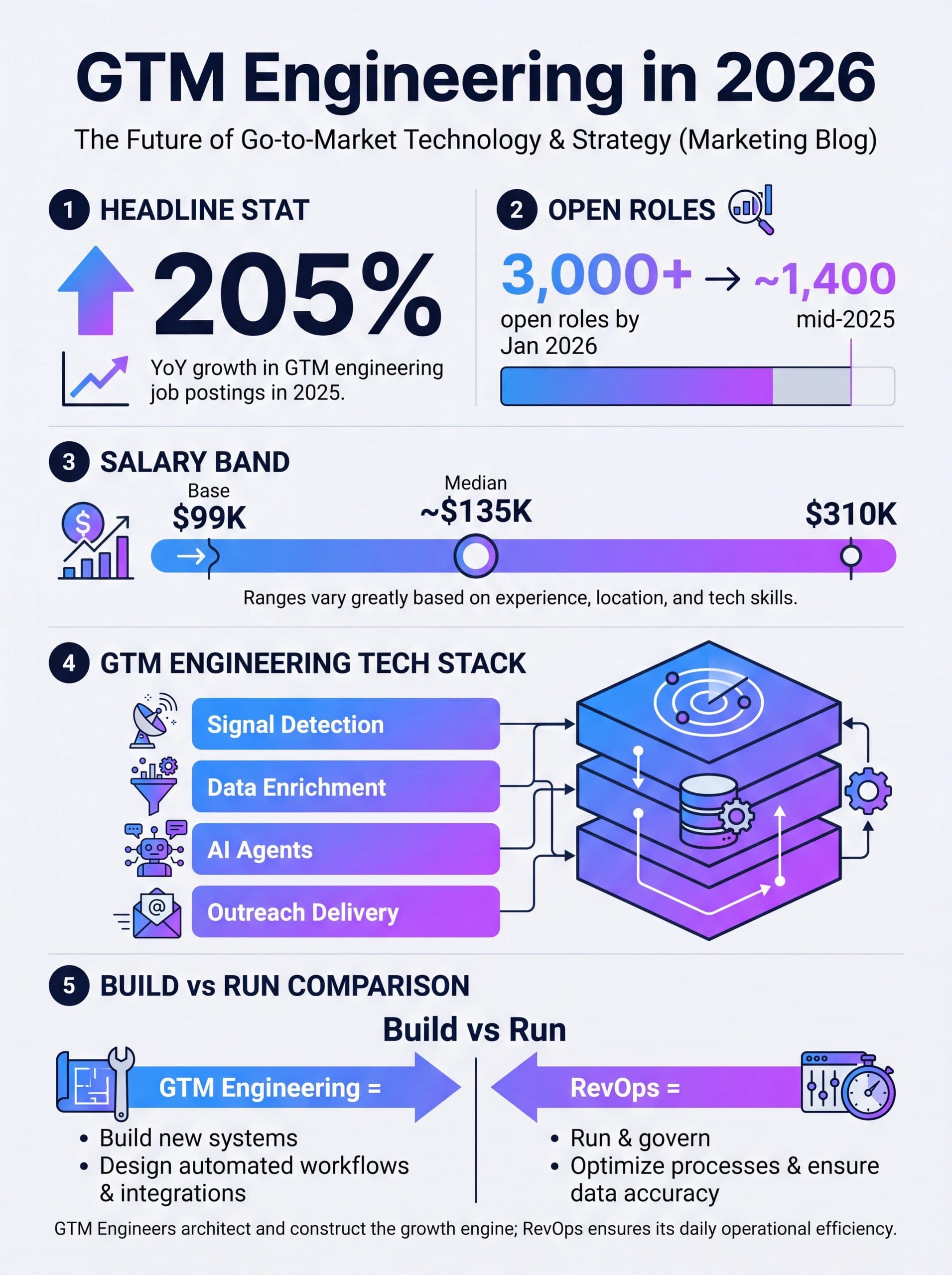
The layers of a modern GTM engineering stack and the numbers behind the role’s rise.
How to Build a GTM Engineering Function
You do not need a 10-person team or a six-figure tooling budget to start. GTM engineering is built in deliberate steps, each one removing manual work and adding leverage.
Step 1: Pick one painful, repeatable play
Do not try to automate everything at once. Find the single play your team runs constantly by hand – inbound lead enrichment, say, or outreach to companies that just raised funding. A narrow first win builds momentum and proves the model before you scale it.
Step 2: Map the signal and the data
Define the trigger that should start the play and the data you need to act on it. Where does the signal come from? What enrichment turns it into a complete, scored record? Documenting this before you build anything keeps the system clean and prevents the spaghetti that kills most automation projects.
Step 3: Build the pipeline, then automate the handoffs
Wire the signal to enrichment to scoring to action inside your orchestration layer. The goal is a record that flows from trigger to outreach without a human moving it manually. This is the same principle behind any good marketing workflow automation project: eliminate the handoffs where work waits.
Step 4: Govern the output
Once AI is generating messages and creative at volume, brand consistency cannot depend on people spot-checking each one. Encode your voice, messaging, and visual rules into the system so every asset inherits them automatically. MarqOps calls this Brand Intelligence DNA, and it is what keeps high-volume, AI-generated output on brand without a manual review queue. Pair it with a clear demand generation motion so the volume actually serves a strategy.
Step 5: Measure, then expand
Instrument the play, watch what converts, and only then build the next one. A GTM engineering function compounds: each system you ship makes the next one faster, because the data, the patterns, and the playbook are already in place.
Metrics That Prove It Is Working
A GTM engineering function is an investment, so measure whether it is paying off. These are the numbers that matter.
Pipeline per system. How much qualified pipeline does each automated play generate? This is the clearest measure of whether your engineering effort is creating revenue, not just activity.
Cost per opportunity. One GTM engineer running automated sequences should drive opportunities at a fraction of the cost of an equivalent SDR team. Track the trend – it is the entire economic case for the role.
Time from signal to action. How quickly does a fresh signal turn into relevant outreach? When a funding announcement triggers a personalized message in minutes instead of days, you are capturing intent at its peak.
Personalization rate at scale. What share of your outbound is genuinely tailored to live context versus templated? Rising personalization at flat or falling cost is the signature of a working system.
Brand consistency rate. As AI volume climbs, what percentage of generated content passes brand review on the first try? When brand is encoded into the system, this approaches 100% and review time collapses – the difference between scaling cleanly and scaling chaos.
Common Mistakes to Avoid
Hiring a title before defining the job. “GTM engineer” means wildly different things across companies, which is why salaries vary by six figures inside the same title. Decide whether you need a technical builder or a tool configurer before you post the role.
Automating volume without governance. Firing 10,000 messages a week is easy. Keeping all of them on brand and relevant is the hard part. Volume without quality control just scales your worst output.
Treating GTM engineering as a RevOps replacement. The two are partners, not substitutes. Build new systems with GTM engineering, run and govern them with RevOps. Cut either and the machine stalls.
Buying more tools instead of orchestrating better. Every new app is another seam where data breaks. The leverage comes from connecting fewer systems well, the same lesson behind a lean marketing tech stack.
Skipping the feedback loop. A system you do not measure is a system you cannot improve. Instrument every play so each cycle starts smarter than the last.
Keep your GTM engine on brand at scale
GTM engineering creates volume. MarqOps keeps it on brand – replacing 7+ disconnected tools with one brand-intelligent platform so your AI-generated content and creative ships up to 6x faster from a single unified dashboard.
Frequently Asked Questions
What is GTM engineering in simple terms?
GTM engineering is the practice of building automated systems that power go-to-market teams – the data pipelines, signal detection, enrichment, scoring, and AI-driven outreach that find and reach buyers. A GTM engineer builds revenue machinery so the team scales with software instead of headcount.
How is a GTM engineer different from RevOps?
It comes down to build vs. run. GTM engineers build net-new automated revenue systems, leaning on SQL, Python, APIs, and AI agents. RevOps governs and optimizes the processes that already exist, leaning on CRM administration, analytics, and process design. The best revenue teams run both.
How much does a GTM engineer make in 2026?
US base salaries run from roughly $99K to $310K, with a median near $135K. Pay is bimodal: tool-focused configurers earn closer to RevOps salaries ($108K to $140K), while technical builders who code and orchestrate AI agents can reach $210K to $310K in total compensation at AI-native companies.
What tools does a GTM engineer use?
Most stacks center on an orchestration platform like Clay for data sourcing and enrichment, automation tools like Make, n8n, or Zapier for connections, AI agents for research and message drafting, and delivery tools for email and LinkedIn. A brand-governance layer keeps the AI-generated output consistent at scale.
Do I need to know how to code to be a GTM engineer?
Not always, but it changes your ceiling. Non-technical configurers can build powerful plays inside no-code orchestration tools. The highest-paid GTM engineers, though, bring SQL, Python, and API skills plus AI prompt engineering, which lets them build systems that no-code tools cannot – and that is reflected in the six-figure pay gap inside the same title.
Keep following the signal