Marketing Orchestration in 2026: The Complete Guide to AI-Powered Cross-Channel Coordination
Marketing orchestration connects every channel, tool, and team around one customer journey. Here is what it is, how it beats automation, the 4-layer stack, a 7-step strategy, and the 2026 ROI data.
TL;DR
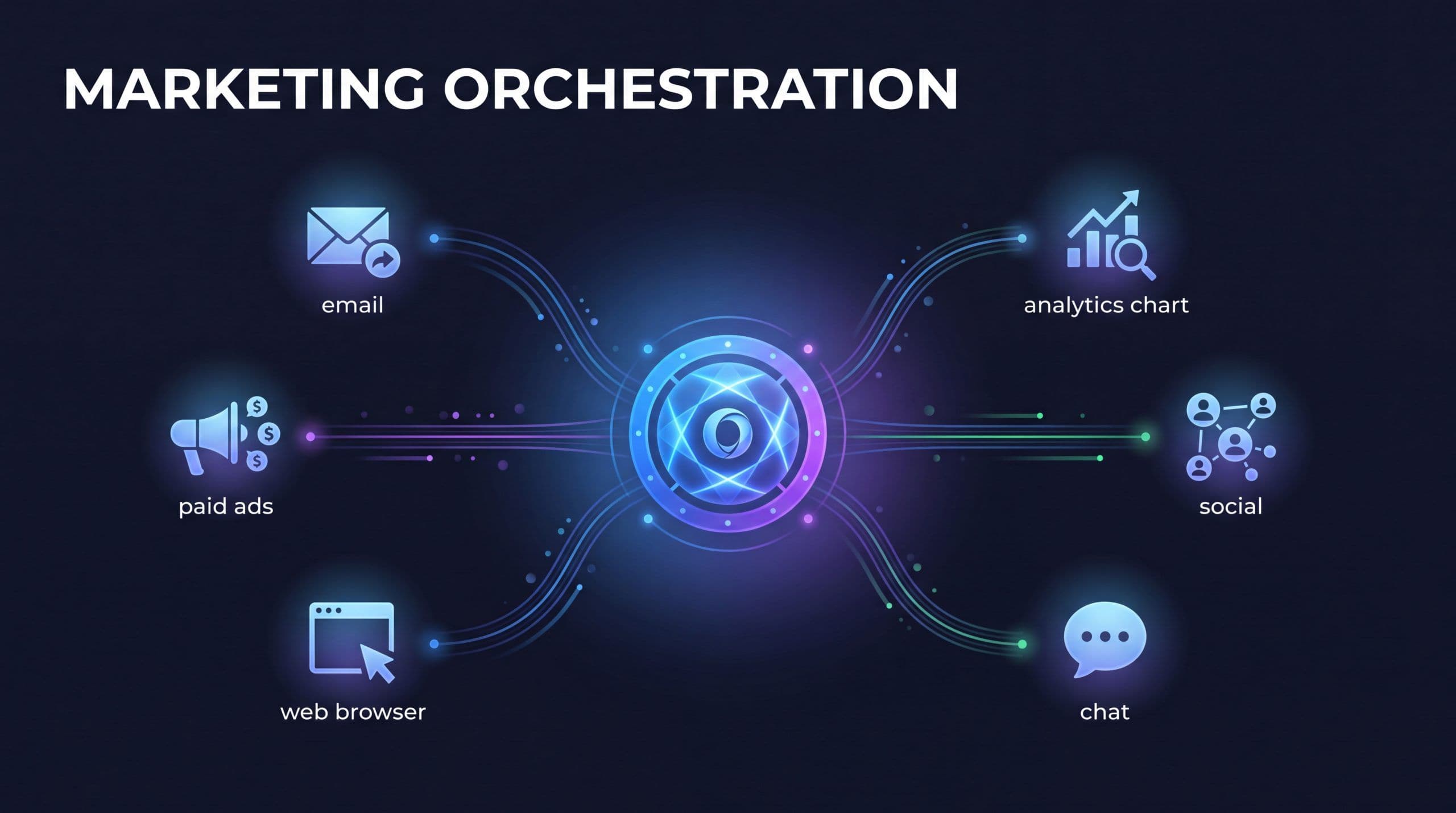
- Marketing orchestration is the coordination layer that connects every channel, tool, and team around a single customer journey, so your email, ads, web, sales, and product all act on the same intent and context instead of firing in isolation.
- It is not the same as marketing automation. Automation executes individual tasks. Orchestration decides the next best action across the whole journey, and AI-orchestrated campaigns outperform manually managed ones by roughly 52% on conversion and 45% on revenue per contact.
- The problem it solves is real: the average marketing team juggles dozens of disconnected tools, 65.7% of organizations name data integration as their top stack challenge, and companies with 20-plus tools waste close to 40% of their martech budget fixing integrations.
- A working orchestration system has four layers (data and identity, decisioning and AI, channel execution, and measurement) and follows a repeatable seven-step rollout.
- MarqOps replaces 7-plus disconnected tools with one brand-intelligent system that orchestrates creative, SEO, ads, and analytics from a single dashboard, so coordination is built in instead of bolted on.
Table of Contents
- What Is Marketing Orchestration?
- Marketing Orchestration vs. Marketing Automation
- Why Marketing Orchestration Matters in 2026
- The Four Layers of a Marketing Orchestration System
- How to Build a Marketing Orchestration Strategy in 7 Steps
- The Benefits and ROI of Marketing Orchestration
- Agentic AI and the Future of Orchestration
- Common Marketing Orchestration Mistakes to Avoid
- Frequently Asked Questions
What Is Marketing Orchestration?
Most marketing teams do not have a content problem or a channel problem. They have a coordination problem. The email team launches a nurture sequence, the paid media team runs a retargeting push, the web team ships a new landing page, and the sales team sends its own outreach, all to the same person, often in the same week, with no awareness of each other. The customer feels the friction even when no single campaign is bad. That gap between many good campaigns and one coherent experience is exactly what marketing orchestration closes.
Marketing orchestration is the layer that synchronizes channels, systems, and teams around a single customer journey. It shares identity, intent, and context across email, ads, web, sales, and product so the system can choose the next best action for each person rather than letting every tool act on its own. Where a traditional marketing operations setup keeps workflows running in parallel, orchestration makes them work toward the same goal. According to Gartner, roughly 80% of marketing processes are already automated or AI-augmented, which means the raw execution is mostly solved. The unsolved part is making all of that execution add up to one experience.
That distinction is becoming the dividing line between brands that grow and brands that stall. Customers are 3x more likely to stay loyal to companies that deliver consistent, personalized experiences across channels, and engagement is shifting away from channel-by-channel activity toward whole-journey performance. Orchestration is how you compete on the journey instead of the touchpoint.
Marketing Orchestration vs. Marketing Automation
The terms get used interchangeably, but they describe different jobs. Marketing automation uses rules and triggers to run specific tasks at scale without someone pressing a button each time: send the welcome email, move the lead to a list, fire the abandoned-cart reminder. Orchestration sits a level above that. It connects those isolated workflows so that instead of a pile of automations running in parallel, you have one system reading signals and deciding what should happen next across every channel.
Here is the cleanest way to see the difference. Automation answers “what should this one workflow do?” Orchestration answers “given everything we know about this person right now, what is the single best thing to do next, and on which channel?” The first is task execution. The second is journey decisioning. You need automation to make orchestration possible, but automation alone will never produce a coordinated experience. If you are still standardizing the execution layer, our guide to the best marketing automation tools in 2026 and the role of AI in marketing automation is the right place to start before you layer orchestration on top.
| Dimension | Marketing Automation | Marketing Orchestration |
|---|---|---|
| Core question | What should this workflow do? | What is the next best action across the whole journey? |
| Scope | Single channel or task | Cross-channel, cross-team, full lifecycle |
| Logic | Predefined rules and triggers | Real-time, signal-driven, often AI-decided |
| Data view | Per-tool, often siloed | Unified identity, intent, and context |
| Outcome | Tasks done efficiently | One coherent, adaptive customer experience |
Why Marketing Orchestration Matters in 2026
Two forces have made orchestration urgent: the channels multiplied, and the tools multiplied faster. The martech landscape now holds more than 15,500 products, and while the number of new tools is finally plateauing, the damage is done. The average B2B marketing team operates somewhere between 12 and 60 tools depending on how you count, and a meaningful share of teams report running 80 or more. Every one of those tools holds a slice of the customer that the others cannot see.
65.7%
of organizations name data integration as their single biggest martech stack challenge
The cost of that fragmentation is not abstract. Companies with 20 or more tools spend roughly 40% of their total martech budget just fixing integration problems, and 68% of teams say their data is still only partially unified across marketing, sales, customer, and analytics environments. When the data is split, the experience is split. A buyer who just requested a demo still gets the top-of-funnel awareness ad. A loyal customer gets the new-customer discount. Each tool is technically working, and the brand still looks disorganized.
The signal is loud and clear: 41% of enterprises are now actively planning to consolidate their app stacks for cost and workflow efficiency. The era of buying a new point tool for every problem is ending, and orchestration is the strategy replacing it.
At the same time, the payoff for getting coordination right has grown. Cross-channel automation adoption has reached 78.4% among mid-market and enterprise brands, up from 61% in 2024. Campaigns that deploy five or more coordinated channels achieve an average sales lift of 19.8%, compared with 14.6% for three-channel campaigns and just 3.1% for single-channel efforts. And brands using advanced generative AI for cross-channel orchestration report 41.3% higher engagement, 29.7% lower cost per acquisition, and 3.8x faster campaign launch cycles than brands relying only on rule-based automation. Orchestration has moved from a nice-to-have to a measurable growth lever. To pull it off, you need a clean, connected marketing tech stack rather than a wall of disconnected logos.
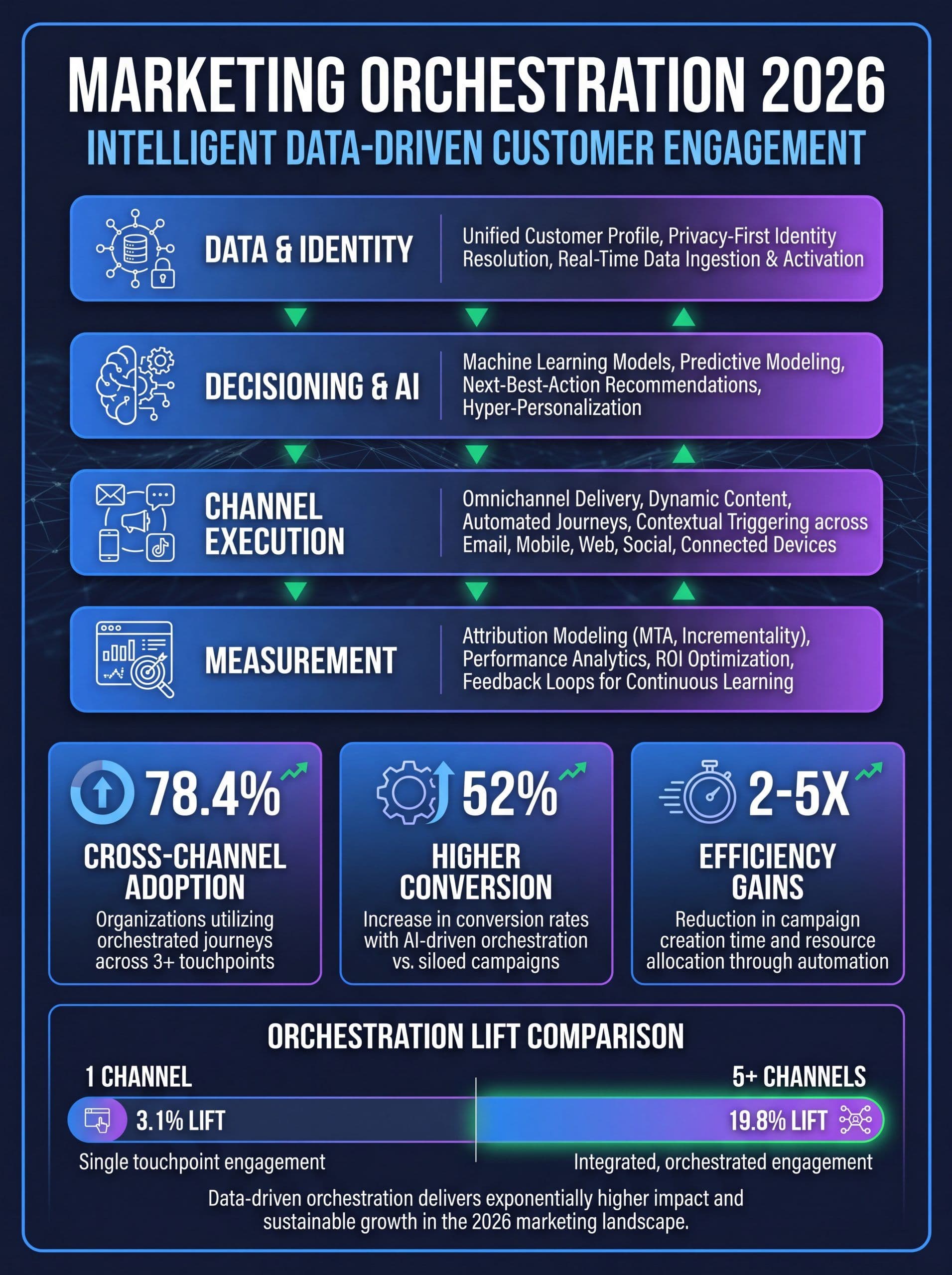
The marketing orchestration stack and the numbers driving its adoption in 2026.
The Four Layers of a Marketing Orchestration System
A working orchestration system is not a single tool you switch on. It is a stack of four cooperating layers. When one layer is weak, the whole thing degrades, so it helps to evaluate your current setup against all four.
1. Data and Identity Layer
Orchestration starts with knowing that the person who opened your email, clicked your ad, and visited your pricing page is one human, not three anonymous events. This layer resolves identity and unifies behavioral, transactional, and profile data into a single view, often through a customer data platform. Without it, every downstream decision is made on partial information. With privacy rules tightening, a strong first-party data foundation is now the bedrock of this layer.
2. Decisioning and AI Layer
This is the brain. It reads signals such as intent shifts, lifecycle stage, and recent behavior, then decides the next best action and the right channel to deliver it. This is where AI does the heavy lifting that rules-based logic cannot, predicting intent and personalizing in real time. It is also where AI personalization stops being a single-channel tactic and becomes a journey-wide capability.
3. Channel Execution Layer
Decisions are worthless if they cannot be delivered. This layer pushes the chosen action into email, paid media, the website, push, SMS, sales sequences, and product messaging. The closer this connects to your omnichannel marketing setup and your creative automation capabilities, the faster a decision becomes a live, on-brand message in front of the customer.
4. Measurement and Optimization Layer
Finally, orchestration needs a feedback loop that measures the journey, not just the channel. This is where AI marketing analytics and multi-touch attribution tell you which sequences actually moved revenue, so the decisioning layer can learn and improve. Without it, you are orchestrating blind.
How to Build a Marketing Orchestration Strategy in 7 Steps
You do not need to rebuild your entire stack to start orchestrating. Most teams that succeed follow a sequence like this.
- Map the real customer journey. Document the actual paths people take from first touch to purchase to renewal, including the messy cross-channel reality, not the tidy funnel on your slide. You cannot orchestrate a journey you have not mapped. A formal customer journey orchestration exercise is the right anchor here.
- Unify your data and identity. Consolidate sources into a single customer view and resolve identity across channels. This is the foundation everything else depends on.
- Define the next-best-action rules and signals. Decide which behaviors trigger which responses, and which channel takes priority in each scenario. Start simple and let AI refine it over time.
- Connect your channels to one decision engine. Wire email, ads, web, and sales so they all take direction from the same orchestration layer instead of running independent logic.
- Set journey-level measurement. Replace channel-only reporting with metrics that track whole-journey performance, so you can see whether coordination is actually improving outcomes.
- Pilot on one high-value journey. Pick a single lifecycle moment, such as onboarding or post-demo nurture, and orchestrate it end to end before scaling. Most teams see initial results within three to six months.
- Layer in AI and expand. Once the pilot proves out, hand more of the decisioning to AI and roll orchestration into more journeys. This is where agentic marketing begins to compound.
The Benefits and ROI of Marketing Orchestration
The return on orchestration shows up in three places at once: efficiency, performance, and customer experience.
Operational efficiency. Organizations that replace fragmented tool collections with orchestrated AI ecosystems report 2x to 5x improvements in operational efficiency and 30% to 70% reductions in technology costs. That is the consolidation payoff: fewer tools, fewer integrations to maintain, less manual stitching between teams.
Performance. AI-orchestrated multi-channel sequences outperform manually managed campaigns by an average of 52.3% on conversion rate and 44.7% on revenue per contact. Coordination is not a soft benefit; it directly lifts the numbers your CFO cares about.
Customer experience. When buyers see consistent, relevant communication instead of contradictory messages, trust and conversion both rise. One company using an experience-orchestration tool increased loan sales by 300% while eliminating overcommunication and compliance issues. Most businesses reach ROI payback in under six months.
Orchestration is one of the few marketing investments that lowers cost and raises performance at the same time, which is exactly why stack consolidation and orchestration are happening together rather than as competing priorities.
Agentic AI and the Future of Orchestration
The next phase is already taking shape. Agentic AI systems can now monitor customer signals across every touchpoint, detect intent shifts, and automatically trigger the right message in the right channel at the right moment, without a human assembling each step. Adoption of the underlying capability is widespread: 90.3% of marketing organizations already use AI agents somewhere in their stack. But true orchestration is still rare. Only about 8% of organizations run campaigns in which multiple agents operate autonomously, and just under a third have moved to genuinely agent-led workflows.
That gap is the opportunity. The bottleneck is not the AI; it is the fragmentation underneath it. When agents query three conflicting CRM instances, they produce confident, wrong answers, so fragmentation stops being a mere inefficiency and becomes a failure mode. This is the core reason orchestration and consolidation now go hand in hand. To put agents to work safely, the data and channels they act on need to live in one coordinated system. Our guides to AI agents for marketing and AI-powered marketing platforms go deeper on how to get there.
Common Marketing Orchestration Mistakes to Avoid
Orchestration fails for predictable reasons, and most of them are organizational rather than technical.
- Buying a tool before mapping the journey. An orchestration platform on top of an undefined journey just automates confusion faster. Map first, buy second.
- Treating data silos as a purely technical problem. The most common integration failures come from misaligned teams and missing shared definitions, not broken connectors. Agree on what a “qualified lead” or “active customer” means before you wire anything together.
- Chasing perfect data sync everywhere. You do not need every system perfectly synced. You need the signals that drive next-best-action decisions to be reliable. Start there.
- Measuring channels instead of journeys. If your reporting still rewards channel-level metrics, your teams will keep optimizing for their silo and undermining the very coordination you are trying to build.
- Adding orchestration as another disconnected layer. Bolting an orchestration tool onto seven other disconnected tools recreates the original problem. The cleaner path is a unified system where orchestration is native, not an eighth integration.
Orchestration Built In, Not Bolted On
This is the gap MarqOps was built to close. Instead of orchestrating across seven or more disconnected tools, MarqOps replaces them with one brand-intelligent system that handles creative production, SEO content, analytics, and paid advertising from a single, unified dashboard. Because the data, the brand context, and the channels live in the same place, coordination is the default rather than something you engineer integration by integration. Its Brand Intelligence DNA keeps every output on-brand from the first draft, and teams using the platform report producing content roughly 6x faster because there is no tab-switching, no re-briefing, and no reconciling conflicting data between tools. When the underlying system is already unified, orchestration stops being a project and becomes how the platform works by default.
Frequently Asked Questions
What is marketing orchestration in simple terms?
Marketing orchestration is the coordination layer that connects all your channels, tools, and teams around one customer journey. Instead of email, ads, web, and sales each acting on their own, orchestration shares identity, intent, and context so the system can choose the single best next action for each person across every channel.
How is marketing orchestration different from marketing automation?
Automation executes individual tasks within a single channel using predefined rules. Orchestration sits above automation and decides the next best action across the entire journey based on real-time signals. You need automation to make orchestration possible, but automation alone cannot produce a coordinated cross-channel experience.
What ROI can I expect from marketing orchestration?
AI-orchestrated multi-channel campaigns outperform manually managed ones by about 52% on conversion and 45% on revenue per contact, and organizations replacing fragmented tools with orchestrated AI ecosystems report 2x to 5x efficiency gains and 30% to 70% lower technology costs. Most teams reach ROI payback within six months.
Do I need a single platform to do marketing orchestration?
Not strictly, but it is far easier. You can orchestrate across separate tools if you build a strong data and identity layer plus a central decision engine. However, with the average team running dozens of tools and 40% of martech budgets going to integration fixes, many teams are consolidating onto unified platforms like MarqOps where orchestration is native rather than stitched together.
Where do AI agents fit into marketing orchestration?
AI agents are becoming the decisioning engine of orchestration, monitoring signals across touchpoints and triggering the right message at the right moment automatically. While 90% of marketing organizations already use AI agents somewhere, only about 8% run fully autonomous multi-agent campaigns, largely because fragmented data undermines agent decisions. Unifying data and channels first is what makes agentic orchestration reliable.
Keep following the signal