Pipeline Marketing in 2026: The Complete Guide to Measuring Marketing by Revenue, Not Leads
Pipeline marketing measures marketing by the dollar value of qualified pipeline it sources and influences, not lead volume. Learn the framework, benchmarks, the pipeline velocity formula, and how AI is reshaping it in 2026.
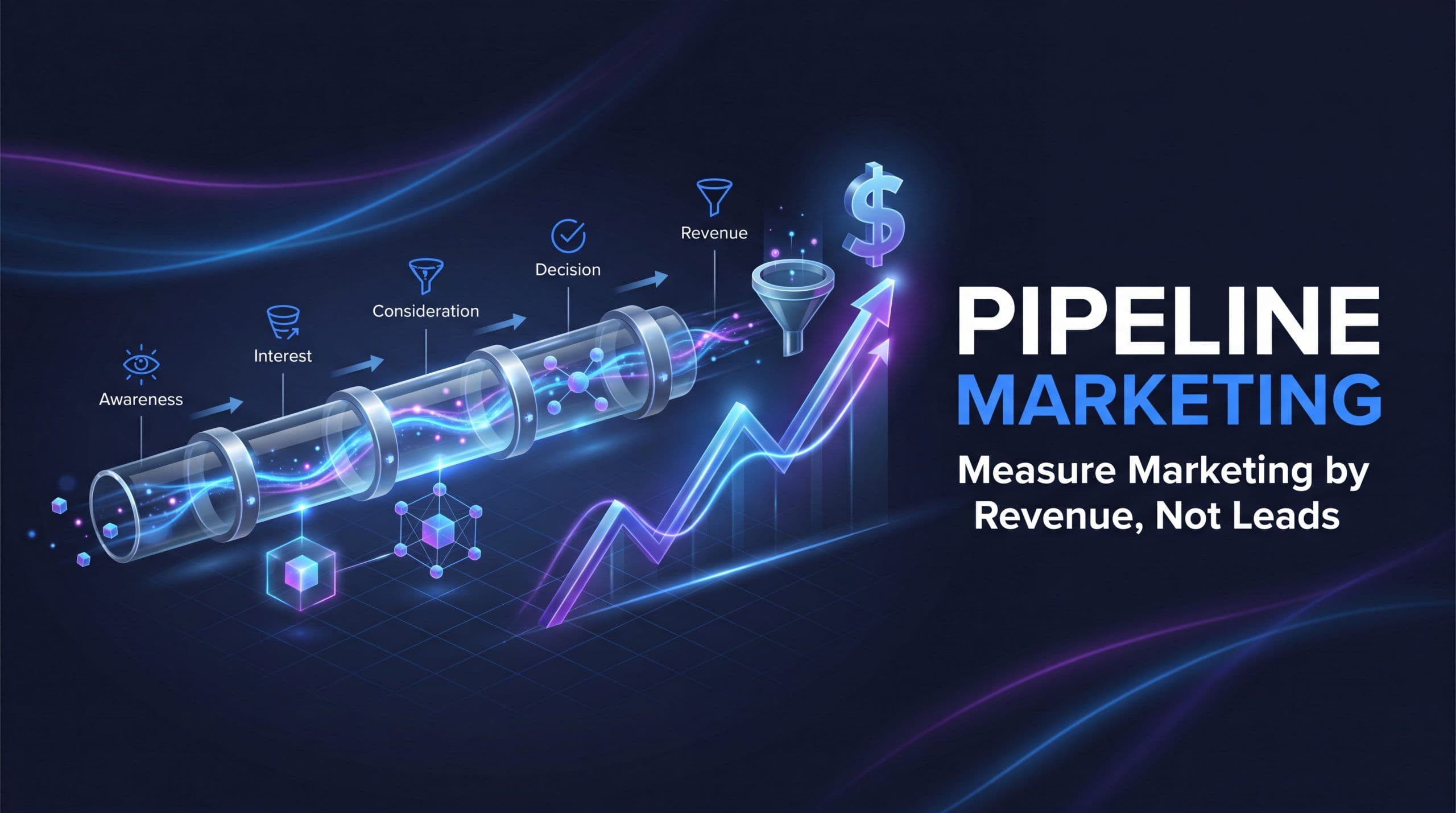
Pipeline Marketing in 2026: The Complete Guide to Measuring Marketing by Revenue, Not Leads
Lead counts feel productive, but they rarely tell your CFO anything useful. Pipeline marketing reframes the entire conversation around the one number that matters: how much qualified revenue your marketing actually creates and moves toward closed-won.
TL;DR
- Pipeline marketing measures success by the dollar value of qualified pipeline created and influenced, not by raw lead volume.
- Healthy B2B programs source 25 to 45 percent of total pipeline from marketing (median around 35 percent) and influence 60 to 85 percent of it.
- The core metric is pipeline velocity: (qualified opportunities x win rate x average deal size) divided by sales cycle length.
- By 2026, roughly 75 percent of top marketing teams use predictive models and 80 percent of marketing processes are automated or AI-augmented, making pipeline attribution far more accurate.
- A unified platform that connects content, ads, analytics, and attribution (like MarqOps) removes the data silos that make pipeline reporting unreliable.
Table of Contents
- What Is Pipeline Marketing?
- Pipeline Marketing vs Lead Generation
- Marketing-Sourced vs Marketing-Influenced Pipeline
- The Pipeline Marketing Stages Framework
- Pipeline Velocity: The Formula That Matters
- How AI Is Reshaping Pipeline Marketing
- How to Build a Pipeline Marketing Strategy
- The Metrics and KPIs to Track
- Frequently Asked Questions
What Is Pipeline Marketing?
Pipeline marketing is a strategy that measures marketing performance by the dollar value of sales pipeline it generates and influences, rather than by the number of leads it captures. Instead of stopping at a form fill or a downloaded ebook, it follows every prospect through the full buyer journey, from first touch to closed deal and beyond. Lead generation fills the top of the funnel. Pipeline marketing manages the entire length of it.
The distinction sounds subtle, but it changes how teams behave. When marketing is graded on lead count, the incentive is to drive volume, even when those leads never become opportunities. When marketing is graded on pipeline, the incentive shifts toward generating the right opportunities that sales actually wants to work and that have a realistic shot at closing. This is the same revenue-first mindset that underpins modern revenue operations (RevOps) and connects marketing directly to the metrics leadership cares about.
Pipeline marketing answers the question every CMO eventually faces in the boardroom: “How much revenue did marketing actually create this quarter?” Lead volume cannot answer that. Sourced and influenced pipeline can.
Pipeline Marketing vs Lead Generation
Lead generation is a tactic. Pipeline marketing is a whole strategy that happens to include that tactic. The difference is what you optimize for. A lead generation team celebrates 5,000 new contacts. A pipeline marketing team asks how many of those contacts turned into qualified opportunities worth pursuing, and how much revenue is now in motion as a result.
| Dimension | Lead Generation | Pipeline Marketing |
|---|---|---|
| Primary metric | Number of leads (MQLs) | Dollar value of qualified pipeline |
| Scope | Top of funnel only | Full funnel, first touch to closed-won |
| Success looks like | More volume, lower cost per lead | More revenue, faster velocity |
| Sales relationship | Hand off and move on | Shared ownership of revenue |
| Reporting | Lead dashboards | Pipeline and revenue attribution |
This does not mean lead generation is dead. You still need to fill the top of the funnel, and tactics like demand generation remain essential. The shift is one of measurement and accountability. Pipeline marketing keeps every top-of-funnel activity tied to a downstream revenue outcome, so you stop celebrating leads that go nowhere.
Marketing-Sourced vs Marketing-Influenced Pipeline
Pipeline marketing rests on two complementary metrics, and confusing them is one of the most common reporting mistakes B2B teams make.
Marketing-sourced pipeline credits opportunities where marketing generated the very first touch. The prospect found you through a search result, a paid ad, a webinar, or a content offer before sales ever got involved. Marketing-influenced pipeline uses multi-touch attribution to recognize marketing’s role at any stage of the journey, even when sales or an SDR sourced the initial contact. If a deal was sourced by outbound but accelerated by a case study, a retargeting campaign, and three nurture emails, that is influenced pipeline.
25 to 45%
of total pipeline is marketing-sourced in healthy B2B programs (median around 35%)
The benchmarks vary widely by business model. Product-led growth companies and SMB motions with smaller deal sizes often run 60 to 80 percent marketing-sourced pipeline, because the buyer self-educates and converts with little human involvement. Enterprise SaaS with heavy outbound and account-based marketing motions typically sees 5 to 20 percent sourced, because large deals start with a sales-led relationship. Neither is wrong. The right benchmark depends on your go-to-market motion.
Marketing-influenced pipeline tends to be much larger, often representing 50 to 70 percent of marketing’s true impact. In healthy programs, the sourced-to-influenced ratio sits around 1 to 2, meaning for every dollar of marketing-sourced pipeline, marketing influences roughly another dollar of sales-sourced pipeline. Tracking both numbers together is what lets sales and marketing avoid zero-sum attribution fights and rally around shared revenue goals instead of siloed credit.
A benchmark is meaningless without a documented attribution rule. Before you report a single pipeline number, define your model (first-touch, multi-touch, or a 90-day lookback window) and the specific activities that count as a marketing touch. Otherwise you are comparing apples to opinions.
The Pipeline Marketing Stages Framework
A pipeline marketing framework maps every prospect to a clearly defined stage, with explicit criteria for moving from one to the next. The stages will look familiar if you have built an AI marketing funnel, but the emphasis here is on revenue progression rather than awareness.
1. Awareness and capture
Top-of-funnel activity creates first touches: organic search, paid media, social, events, and content. The goal is not just volume but qualified attention from accounts that match your ideal customer profile.
2. Engagement and qualification
Prospects engage with nurture content, and you score them against fit and intent. A well-defined qualification process is the single biggest lever for accelerating pipeline. Frameworks like BANT (Budget, Authority, Need, Timeline) or MEDDICC keep reps focused on deals with a real shot at closing. This is where AI lead scoring earns its keep, surfacing accounts that show genuine buying signals instead of treating every form fill equally.
3. Opportunity creation (the handoff)
When a lead clears qualification, it converts from an MQL to an SQL and becomes a pipeline opportunity. This handoff is where most pipeline leaks. Getting sales and marketing to agree on a shared definition of a qualified opportunity is non-negotiable, and it is the moment marketing-sourced pipeline officially gets counted.
4. Acceleration and influence
Marketing does not stop at the handoff. Retargeting, sales enablement content, customer stories, and timely intent data signals all help move open deals forward. This is where marketing-influenced pipeline is built and where coordinated customer journey orchestration separates strong programs from average ones.
5. Closed-won and expansion
The deal closes, and the loop feeds back into reporting. Mature teams also track expansion pipeline, since existing customers are often the most efficient source of new revenue.
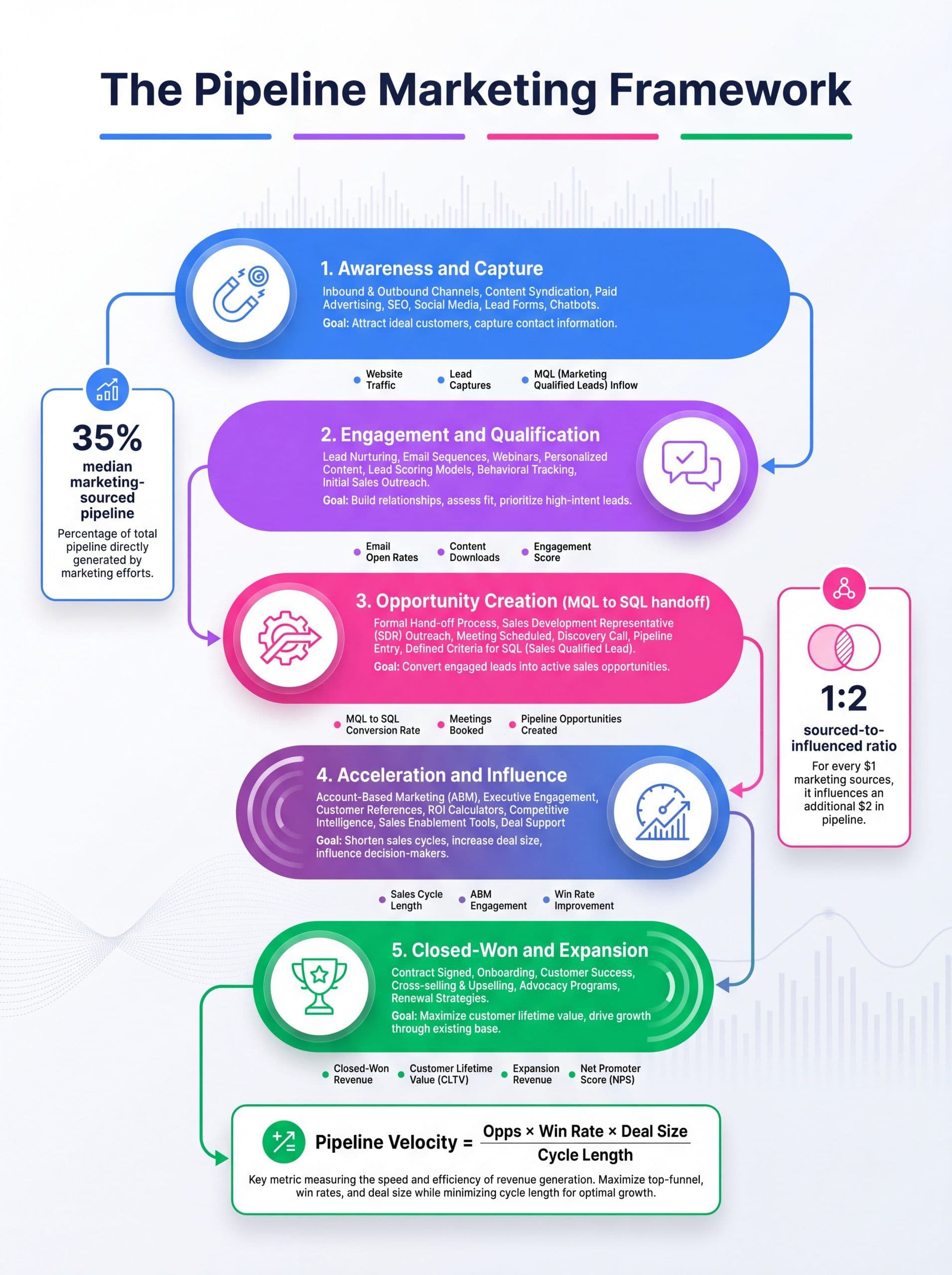
The five stages of a pipeline marketing framework, from first touch to closed-won and expansion.
Pipeline Velocity: The Formula That Matters
If pipeline marketing has one master metric, it is pipeline velocity. It tells you how much revenue is effectively flowing through your pipeline per day, which makes it the clearest signal of whether your marketing engine is speeding up or stalling.
Pipeline Velocity =
(Qualified Opportunities x Win Rate x Average Deal Size)
divided by
Sales Cycle Length
To raise velocity, you increase one of the numerators (more opportunities, higher win rate, larger deals) or shrink the denominator (a shorter sales cycle). Ideally both. Experienced RevOps teams recommend measuring velocity stage by stage rather than only overall, because that pinpoints exactly where deals slow down so you can take targeted action instead of guessing.
Quick win: tightening your qualification criteria so reps work only genuinely sales-ready opportunities often improves win rate and shortens cycle length at the same time, lifting velocity from two directions at once.
How AI Is Reshaping Pipeline Marketing
Pipeline marketing has always been limited by data. You cannot attribute what you cannot see, and most teams have spent years stitching together CRM exports, ad platforms, and analytics tools by hand. That is changing fast. By 2026, around 75 percent of top-performing marketing teams use predictive models to anticipate buyer behavior and accelerate pipeline velocity, according to Forrester, and Gartner estimates that 80 percent of marketing processes are already automated or AI-augmented.
The payoff is concrete. Workflow automation has been shown to cut operational marketing costs by about 12 percent and customer acquisition costs by 30 to 40 percent, while teams using AI save an average of 12 hours per week on repetitive tasks. The broader AI marketing market reached $47.3 billion in 2026 and is projected to hit $107.5 billion by 2028, a 36.6 percent compound annual growth rate. AI now powers three pipeline-critical jobs:
- Predictive scoring and prioritization. Models surface accounts showing real buying intent instead of forcing sales to chase every lead equally. Pair this with predictive marketing analytics and you can forecast which opportunities will actually close.
- Multi-touch attribution at scale. AI connects touchpoints across channels to produce trustworthy sourced and influenced numbers, the foundation of credible marketing ROI reporting.
- Automated acceleration. Perfectly timed content, retargeting, and nurture sequences move open deals forward without manual orchestration, a core capability of modern B2B marketing automation.
The catch is fragmentation. When your content tool, ad platform, analytics, and attribution all live in separate systems, your pipeline numbers are only as good as the manual joins between them. This is the gap MarqOps is built to close. By unifying creative production, SEO content, analytics, and paid advertising in one brand-intelligent platform, MarqOps replaces seven or more disconnected tools with a single dashboard, so the data behind your sourced and influenced pipeline is connected from the start rather than reconciled after the fact.
How to Build a Pipeline Marketing Strategy
Moving from lead-based to pipeline-based marketing is a process, not a switch. Here is a practical roadmap.
Step 1: Align on shared definitions
Get sales and marketing in the same room and agree on what counts as an MQL, an SQL, and a qualified opportunity. Without shared definitions, every pipeline number is contested. This alignment is the heart of GTM engineering and the foundation everything else rests on.
Step 2: Document your attribution model
Choose first-touch, multi-touch, or a lookback window, and write down which activities qualify as a marketing touch. Apply it consistently so your sourced and influenced numbers are comparable across quarters.
Step 3: Instrument the full funnel
Connect your channels, CRM, and analytics so every touch is captured. A unified marketing analytics layer is what makes accurate pipeline reporting possible. This is where consolidating onto one platform pays off most.
Step 4: Score for fit and intent
Layer in lead scoring and intent signals so reps spend time on accounts that are actually ready to buy. This protects pipeline quality and lifts win rates.
Step 5: Measure velocity and optimize the bottleneck
Track pipeline velocity stage by stage, find the stage where deals stall, and fix that one first. Repeat. Continuous, targeted optimization beats sweeping campaign overhauls every time.
The Metrics and KPIs to Track
| Metric | What it tells you |
|---|---|
| Marketing-sourced pipeline | Dollar value of opportunities marketing originated |
| Marketing-influenced pipeline | Dollar value of deals marketing touched at any stage |
| Pipeline velocity | Revenue moving through the pipeline per day |
| Stage conversion rates | Where prospects advance or drop off |
| Win rate | Percentage of opportunities that close |
| Sales cycle length | Average days from opportunity to close |
| Pipeline-to-revenue ratio | How much pipeline you need to hit a revenue target |
One nuance worth remembering: marketing-sourced pipeline of 35 percent often converts to closer to 30 percent of revenue, because marketing-sourced deals can close at slightly lower win rates than sales-prospected ones. Reporting pipeline and revenue side by side keeps your story honest and your forecasts credible.
Pipeline marketing only works when your data is unified. MarqOps brings creative, content, ads, and analytics under one roof with Brand Intelligence DNA, so teams ship campaigns up to 6x faster and report sourced and influenced pipeline from a single source of truth instead of seven stitched-together tools.
Common Pipeline Marketing Mistakes to Avoid
Even teams that buy into the philosophy stumble on execution. A few patterns show up again and again.
Reporting sourced pipeline without influenced pipeline. If you only count opportunities marketing originated, you systematically undersell marketing’s contribution to deals that sales started. You will lose budget arguments you should win. Always report both numbers together.
Changing the attribution model mid-year. Switching from first-touch to multi-touch in Q3 makes every quarter-over-quarter comparison meaningless. Pick a model, document it, and hold it steady for at least a full fiscal year before revisiting.
Optimizing for pipeline created instead of pipeline closed. It is easy to inflate pipeline by loosening qualification, but low-quality opportunities clog the funnel and drag down win rates. Quality of pipeline beats quantity every time, which is exactly why fit-and-intent scoring matters so much.
Treating attribution as a marketing-only project. Pipeline marketing is a shared sales-and-marketing system. If sales does not log activities consistently in the CRM, your influenced numbers will be wrong no matter how good your tooling is. Alignment, not software, is the hardest part, and it is also the part that compounds.
Avoiding these traps comes back to one theme that runs through this entire guide: pipeline marketing is only as trustworthy as the data feeding it. The teams that win are the ones that consolidate their stack, agree on definitions once, and let a connected system do the reconciliation automatically rather than rebuilding spreadsheets every Monday morning.
Frequently Asked Questions
What is pipeline marketing in simple terms?
Pipeline marketing is the practice of measuring marketing by the dollar value of sales pipeline it creates and influences, rather than by lead volume. It tracks prospects through the entire buyer journey, from first touch to closed deal, so marketing is accountable to revenue instead of vanity metrics.
What is a good marketing-sourced pipeline percentage?
In healthy B2B programs, marketing sources 25 to 45 percent of total pipeline, with a median around 35 percent. Product-led and SMB motions can reach 60 to 80 percent, while enterprise outbound and ABM motions often see 5 to 20 percent. The right benchmark depends on your go-to-market model.
What is the difference between marketing-sourced and marketing-influenced pipeline?
Marketing-sourced pipeline credits opportunities where marketing generated the first touch. Marketing-influenced pipeline uses multi-touch attribution to recognize marketing’s contribution at any stage, even when sales sourced the lead. Influenced pipeline is usually larger, often 50 to 70 percent of marketing’s true impact.
How do you calculate pipeline velocity?
Pipeline velocity equals the number of qualified opportunities multiplied by your win rate and average deal size, divided by the sales cycle length in days. The result is the dollar amount of revenue moving through your pipeline each day. Raise it by increasing opportunities, win rate, or deal size, or by shortening the cycle.
How does AI improve pipeline marketing?
AI powers predictive lead scoring, multi-touch attribution at scale, and automated deal acceleration. By 2026, roughly 75 percent of top marketing teams use predictive models, and automation cuts customer acquisition costs by 30 to 40 percent. A unified platform like MarqOps connects the underlying data so AI-driven pipeline reporting is accurate rather than fragmented.
Keep following the signal