Best Marketing Automation Tools in 2026: 12 Platforms Compared for Modern Marketing Teams
Compare the 12 best marketing automation tools for 2026 with features, pricing, and real use cases. Find the right platform to automate campaigns, leads, and analytics without tool sprawl.
TL;DR
- The marketing automation software market is projected to grow from $8.14B in 2026 to $20.12B by 2034, with 67% of B2B marketers already using a marketing automation platform.
- The 12 best marketing automation tools in 2026 split into four camps: AI-native unified platforms, all-in-one CRM suites, ecommerce specialists, and B2B enterprise systems.
- The biggest 2026 shift is from rule-based workflows to agentic automation where AI agents plan, execute, and optimize campaigns end to end.
- Average ROI on marketing automation tools is $5.44 per $1 spent, with automated emails generating 320% more revenue than non-automated ones.
- MarqOps replaces 7+ disconnected tools with a single AI-powered marketing operations platform built on Brand Intelligence DNA.
Table of Contents
- What Are Marketing Automation Tools and Why They Matter in 2026
- How to Choose the Right Marketing Automation Tools for Your Team
- 12 Best Marketing Automation Tools in 2026
- AI Marketing Automation Tools: What Changed in 2026
- Marketing Automation Tools by Use Case
- How Much Do Marketing Automation Tools Cost in 2026
- Implementation Roadmap: Rolling Out Marketing Automation in 90 Days
- FAQs
What Are Marketing Automation Tools and Why They Matter in 2026
Marketing automation tools are software platforms that take the repetitive, rules-driven, time-stealing parts of marketing and run them on autopilot. Email sequences, lead scoring, campaign triggers, list segmentation, ad personalization, multi-channel orchestration, attribution reporting. The kind of work that used to eat 60% of a marketer’s week now runs in the background while the team focuses on strategy and creative.
The shift in 2026 is real. The global marketing automation software market is projected to grow from $8.14 billion in 2026 to $20.12 billion by 2034, a 12% CAGR according to Fortune Business Insights. 67% of B2B marketers already use a marketing automation platform, and 56% of all companies have some form of automation in production. The conversation has moved past “should we automate” to “which platform actually fits how we work.”
$5.44
Average ROI per $1 spent on marketing automation in the first three years
The shift from point tools to unified platforms
For the last decade most marketing teams stitched together a Frankenstein stack: one tool for email, another for landing pages, a third for analytics, a fourth for ad management, plus a CDP, plus a CRM. That’s where the term tool sprawl came from. The hidden costs compound: data lives in silos, attribution breaks, brand voice drifts across channels, and the team spends more time wiring integrations than doing marketing.
2026 is the year the pendulum swung back toward consolidation. The new generation of marketing automation tools is built around unified data, AI agents that work across channels, and brand intelligence that keeps every output on-message. That’s exactly the gap MarqOps was built to close. For a deeper read on why marketing teams are rethinking their stack, see our Marketing Operations guide for 2026.
Why marketing automation is non-negotiable in 2026
The numbers are hard to argue with. Marketing automation drives 80% more leads and 77% higher conversion rates while cutting operational costs 25 to 30%. Automated emails generate 320% more revenue than non-automated ones. Companies running nurture workflows with lead scoring see MQL-to-SQL conversion rates 30 to 50% higher than teams still doing batch-and-blast.
The reason is simple. Buyers expect personalized, timely, channel-aware communication. Doing that manually doesn’t scale. The teams that win in 2026 are the ones that put AI in charge of the execution and humans in charge of the strategy.
How to Choose the Right Marketing Automation Tools for Your Team
Before you compare logos, get clear on what you actually need. The best marketing automation software for a 12-person agency is wildly different from what a 500-person enterprise SaaS team needs.
7 must-have capabilities in modern marketing automation tools
- Multi-channel orchestration. Email, SMS, push, in-app, paid social, web personalization. All triggered from a single workflow.
- Native CRM or deep CRM integration. Without unified contact data, every campaign is built on guesswork.
- AI-powered scoring and routing. Lead scoring, churn prediction, send-time optimization, send-channel optimization.
- Brand-safe content generation. The platform should produce on-brand copy, subject lines, and creative without you babysitting every output.
- Real attribution. Multi-touch attribution that ties revenue back to the workflow, not just last-click. Read our guide to multi-touch attribution for the full breakdown.
- Open APIs and webhooks. So your automation tools can talk to whatever else you run.
- Compliance and security. SOC 2, GDPR, CCPA. Non-negotiable in 2026.
Common pitfalls when evaluating marketing automation software
Three traps come up over and over. First, buying for the demo instead of for the daily reality. Marketing automation tools demo beautifully and feel completely different in production. Always ask to talk to a current customer roughly your size. Second, underestimating implementation. The platform itself is a fraction of the total cost. Onboarding, integrations, and the first six months of workflow building usually cost more than year-one license fees. Third, ignoring the data layer. If your contact data is messy, no automation tool will save you.
Build vs buy vs unified platform
You have three real paths. Stitch best-of-breed point tools together (most flexibility, highest tax in maintenance and integration). Buy an all-in-one suite like HubSpot or Salesforce Marketing Cloud (less flexibility, easier to operate, expensive at scale). Or move to a unified AI-native platform like MarqOps that bundles creative, SEO, ads, and analytics under one brand intelligence layer (newest path, fastest time to value, smallest total stack).
The right answer depends on your team size, complexity, and how much engineering you want to spend on plumbing versus marketing.
12 Best Marketing Automation Tools in 2026
Here are the 12 best marketing automation tools in 2026, ranked by use case and team profile. We pulled from current SERP analysis, vendor pricing pages, and the platforms marketing analysts are actually deploying in mid-market and enterprise teams this year.
Quick comparison table
| Tool | Best For | Starting Price | AI Native |
|---|---|---|---|
| MarqOps | Unified AI marketing ops | Free trial | Yes |
| HubSpot Marketing Hub | All-in-one inbound | $20/mo | Partial |
| Marketo Engage | Enterprise B2B and ABM | Custom | Partial |
| ActiveCampaign | SMB email automation | $15/mo | Partial |
| Klaviyo | Ecommerce DTC | $45/mo | Yes |
| Brevo | Budget all-in-one | Free tier | Partial |
| Pardot (MCAE) | Salesforce-aligned B2B | $1,250/mo | Partial |
| Customer.io | Product-led growth | $100/mo | Partial |
| Mailchimp | Small business basics | Free tier | Partial |
| Iterable | Cross-channel orchestration | Custom | Yes |
| Braze | Mobile-first CX | Custom | Yes |
| Omnisend | Ecommerce SMB | Free tier | Partial |
1. MarqOps – Best AI-native unified marketing platform
MarqOps is a 2026-built AI marketing operations platform that replaces 7+ disconnected marketing tools under one roof. Creative production, SEO content generation, paid ad management, and unified analytics all run on the same Brand Intelligence DNA layer, so every output stays on-message without manual review. Teams report 6x faster content output and a meaningful drop in tab-switching between fragmented tools. Best for marketing leaders who are tired of stitching point tools and want one AI-powered platform that handles the operational workload end to end.
2. HubSpot Marketing Hub – Best for inbound marketing teams
Still the default all-in-one for B2B teams in the 50-500 employee range. CRM, marketing automation, sales workflows, and a strong content layer in one ecosystem. Documentation is excellent and the learning curve is gentle. The catch is contact-based pricing: a 50,000-contact database on Marketing Hub Pro can push past $3,000/month. Best when you want a single vendor for sales and marketing and you’re willing to pay for it as you scale.
3. Marketo Engage – Best enterprise marketing automation platform
The enterprise B2B workhorse, especially for teams running ABM at scale. Account-based scoring, account-personalized landing pages, and tight integration with ABM platforms like Demandbase and 6sense. Pricing is custom and almost always requires a sales conversation. Steep learning curve, but the depth is unmatched for complex multi-product, multi-segment B2B operations.
4. ActiveCampaign – Best for SMB email automation
The mid-market default for B2B and hybrid businesses that need a workflow builder with more depth than HubSpot Starter or Mailchimp. Built-in CRM, predictive sending, and a fair price point ($15-$259/mo). Where it shines: complex if-then automations and email sequences without enterprise pricing.
5. Klaviyo – Best for ecommerce marketing automation
The DTC ecommerce default, with deep Shopify, BigCommerce, and WooCommerce integrations. Strong predictive analytics, native SMS, and revenue attribution that genuinely works. Charges on active profiles, so list hygiene matters for your bill. Scales from SMB to mid-market without a platform switch. If your business runs on ecommerce flows, this is usually the answer.
6. Brevo (formerly Sendinblue) – Best budget marketing automation tool
Brevo bundles email, SMS, CRM, and basic automation in a free-friendly tier that scales gradually. Best for SMBs and bootstrapped startups that need solid automation marketing tools without enterprise pricing. The workflow builder isn’t as deep as ActiveCampaign or HubSpot, but for the price you get a lot.
7. Pardot (Salesforce Marketing Cloud Account Engagement) – Best B2B marketing automation tools for Salesforce shops
If you’re already running Salesforce CRM at scale, Pardot (now MCAE) is the path of least resistance. Native data sharing with Sales Cloud, account-based engagement, and B2B nurture flows that fit how Salesforce-centric teams already work. Starts at $1,250/mo. Overkill for SMBs, almost mandatory for Salesforce-aligned enterprise B2B.
8. Customer.io – Best for product-led growth
Built for product-led SaaS teams that want behavioral messaging tied to product events. If your activation, onboarding, and retention motion is driven by what users do inside your product, Customer.io’s event-based triggers and segmentation are best in class. Less suited to inbound or content-led B2B.
9. Mailchimp – Best for small business marketing automation software
Still the easiest entry point for solopreneurs, side projects, and SMBs without a dedicated marketing team. The free tier is generous for getting started, and the UI is the friendliest in the category. As you scale past 5,000 contacts the cost-benefit gets shaky and you’ll likely outgrow it within 18 months.
10. Iterable – Best cross-channel marketing automation
Built for cross-channel orchestration at consumer scale. Email, SMS, push, in-app, web, all driven from a single canvas. Strong for media, fintech, and B2C SaaS teams sending hundreds of millions of messages per month. Expects engineering involvement to get the most out of it.
11. Braze – Best mobile-first marketing automation platform
If your customer experience lives inside a mobile app, Braze is the dominant choice. Strong push, in-app messaging, and content cards. Used by ride-sharing, on-demand delivery, fintech, and streaming companies. Custom pricing in the enterprise range.
12. Omnisend – Best ecommerce automation marketing tools
An ecommerce-focused alternative to Klaviyo for SMBs that want easier setup and more affordable pricing. Pre-built ecommerce flows, popups, and SMS bundled together. Best for merchants under $5M GMV who want a turnkey ecommerce automation stack.
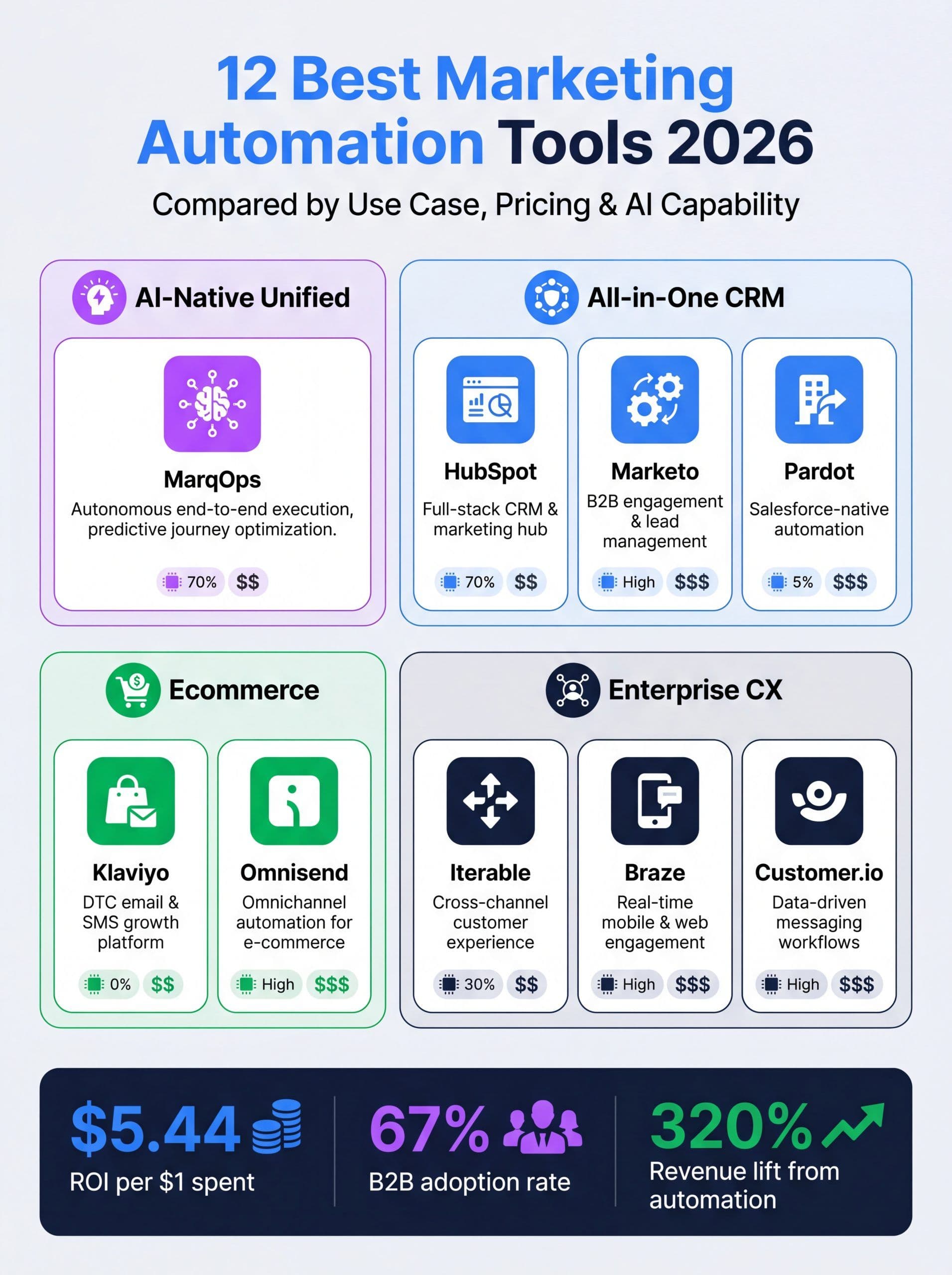
2026 marketing automation platform landscape: 12 tools mapped by use case and AI capability
AI Marketing Automation Tools: What Changed in 2026
The biggest shift in marketing automation tools this year isn’t a new feature. It’s a new operating model. We’ve moved from rule-based workflows that you had to design step by step to agentic automation where AI agents plan, execute, and optimize whole campaigns end to end.
From rule-based workflows to agentic automation
The old playbook was: marketer designs a workflow (if user clicks X, send email Y after 3 days). The new playbook is: marketer sets a goal (move newly signed-up users to active in 14 days) and AI agents figure out the channel, the timing, the content, and the sequence on a per-user basis.
Gartner forecasts that 40% of enterprise applications will embed AI agents by the end of 2026, up from less than 5% in 2025, and agentic AI spending is expected to reach $201.9 billion this year. For a deeper look at how agents are reshaping campaign execution, our piece on AI agents for marketing walks through the use cases and platforms.
Brand intelligence and content quality at scale
The catch with AI marketing automation tools is brand drift. Generic AI output sounds generic. The 2026 generation of platforms (MarqOps included) ships with what we call Brand Intelligence DNA, a layer that learns your voice, your visual style, your approved messaging, and enforces it on every output the system generates. That’s the difference between AI that produces 6x more content and AI that produces 6x more content you actually want to ship.
Predictive scoring and routing
Predictive analytics has moved out of the data team and into the daily workflow. Lead scoring, churn risk, send-time optimization, and channel preference are now baked into mainstream ai marketing automation tools. Companies using AI-driven automation report 14.5% increases in sales productivity and 12.2% reductions in marketing costs. For the playbook on prediction in marketing, see our predictive marketing analytics guide.
55% of companies using AI-driven automation report higher conversion rates due to improved personalization. The teams that started this shift in 2024 are 18 months ahead of the ones still planning their POC.
Marketing Automation Tools by Use Case
Picking the right platform comes down to the kind of business you run.
B2B marketing automation tools
For B2B teams, the contenders are HubSpot (under 500 employees), Marketo or Pardot (mid-market to enterprise), and Customer.io for product-led SaaS. ABM-heavy teams typically pair their core platform with 6sense or Demandbase. The newer pattern is replacing the whole stack with a unified AI platform like MarqOps, especially for lean revenue teams that don’t want to staff a dedicated marketing ops function. Our deep dive on AI in marketing automation covers the B2B angle in detail.
Marketing automation platform for agencies
Agencies live and die by multi-account workflows. The shortlist for marketing automation platform for agencies in 2026 is HubSpot for Agencies (good multi-portal support), HighLevel (white-label, agency-first), and ActiveCampaign for partners (decent margin and flexibility). MarqOps handles agency workflows natively with brand-isolated workspaces per client and unified billing across accounts.
Marketing automation tools for ecommerce
For ecommerce, Klaviyo is the default for DTC merchants over $1M GMV. Omnisend covers the SMB end. Iterable and Braze cover the enterprise end. Shopify-native tools have caught up considerably and are worth a look for sub-$500K stores. For email-specific picks, see our best AI email marketing tools review.
SMB and startup options
If you’re under 10 people and bootstrapped, Brevo, Mailchimp, or HubSpot Free Tools are good starting points. The trap to avoid: building so many custom workflows in your starter platform that switching costs become prohibitive when you outgrow it. Always pick a platform you can grow into for at least 18 months.
How Much Do Marketing Automation Tools Cost in 2026
Pricing in marketing automation is famously messy. Here’s the honest version.
Pricing models compared
Most marketing automation software in 2026 charges on one of four models: contacts-based (HubSpot, Klaviyo), seat-based (Customer.io adds seats), usage-based (Brevo charges per email sent), or custom enterprise (Marketo, Pardot, Iterable, Braze). Contacts-based is the most common and the most likely to surprise you when your list grows.
Hidden costs to watch
The license fee is the smallest line item. The bigger ones are: implementation (typically 1-3x year-one license cost), integrations (custom dev and ongoing maintenance), training (often $5K-$25K for enterprise platforms), and the inevitable add-ons (sandbox environments, advanced reporting, API access). Always ask vendors for a 3-year total cost of ownership, not just monthly list price.
ROI benchmarks
Marketing automation delivers 544% ROI over three years on average, with 76% of companies hitting positive ROI within year one according to Backlinko’s 2026 data. Email automation alone returns $36 per $1 spent. The teams that don’t hit those numbers usually fall into one of three buckets: bought too much platform, didn’t invest in workflow design, or didn’t clean their data first.
Implementation Roadmap: Rolling Out Marketing Automation in 90 Days
Most marketing automation rollouts fail not because of the tool but because of the rollout. Here’s a 90-day plan that works in practice.
Days 1-30: Foundation
Audit your contact data and clean it. Map your current campaigns and decide which ones move into automation first (start with high-volume, low-complexity ones). Wire core integrations: CRM, web analytics, ad platforms. Set up tracking and identity resolution. Don’t build a single workflow yet.
Days 31-60: First workflows
Launch 3-5 foundational workflows: welcome series, abandoned form/cart, lead scoring, sales handoff, and re-engagement. Run all of them in shadow mode for two weeks before going live. Define KPIs per workflow before you flip the switch.
Days 61-90: Scale and optimize
Add cross-channel triggers, predictive scoring, and personalization. Layer in attribution to confirm what’s actually moving revenue. Add brand quality controls to AI-generated content. Document everything. Train the team. By day 90 your tools for marketing automation should be producing measurable lift, not just running.
Frequently Asked Questions
What are the best marketing automation tools for small businesses in 2026?
For small businesses in 2026, the best marketing automation tools are Brevo (free tier, decent automation), Mailchimp (easiest UI), ActiveCampaign (best workflow builder under $50/mo), and HubSpot Free Tools (best if you’ll grow into the paid tiers). Pick a platform you can grow into for at least 18 months so you don’t pay switching costs early.
What is the difference between marketing automation tools and a marketing automation platform?
Marketing automation tools is the broader category covering everything from single-purpose email schedulers to full marketing automation platforms. A marketing automation platform is the bigger system that combines email, CRM, scoring, multi-channel orchestration, and reporting under one roof. Most modern teams should default to a platform rather than a collection of point tools.
Are AI marketing automation tools worth it in 2026?
Yes. Companies using AI marketing automation tools report 14.5% increases in sales productivity, 12.2% reductions in marketing costs, and 55% see higher conversion rates from improved personalization. The catch is brand drift. The platforms worth using ship with brand intelligence layers that keep AI output on-message rather than generic.
Which marketing automation tools work best for B2B?
For B2B teams, HubSpot is the default under 500 employees, Marketo Engage and Pardot lead in the enterprise tier (especially for ABM), and Customer.io is the choice for product-led SaaS. Lean revenue teams without dedicated marketing ops are increasingly moving to unified AI platforms like MarqOps to replace the multi-tool stack.
How much do marketing automation tools cost in 2026?
Marketing automation tools cost anywhere from free (Brevo, Mailchimp starter tiers) to $30,000+ per month for enterprise platforms like Marketo or Pardot. Mid-market teams typically spend $500-$3,000 per month on the platform itself. Always budget another 1-3x year-one license cost for implementation and integrations.
Wrapping It Up
The marketing automation landscape in 2026 is bigger and more capable than ever, and also more crowded. The teams winning right now aren’t the ones running the most tools for marketing automation. They’re the ones running the fewest tools that do the most. Unified data, AI agents that work across channels, and brand intelligence that keeps every output on-message. That’s the playbook.
If you’re rethinking your stack and want to see what an AI-native unified marketing platform actually looks like in practice, MarqOps is built for exactly this moment. One platform replaces 7+ disconnected tools, runs on Brand Intelligence DNA, and gets your team to 6x faster content output without the tab-switching tax.
Keep following the signal