Link Building in 2026: What Still Works Now That AI Search Counts Mentions
Google has spent a decade making links matter less, and the AI answer layer barely uses them at all. Ahrefs analyzed 75,000 brands and found web mentions correlate with AI Overview visibility at 0.664 against 0.218 for backlinks. This guide covers what that data actually supports, why backlink weight has fallen to roughly 13% of Google's algorithm, what Google's May 2026 spam policy rewrite means for guest posting and parasite SEO, the five tactics still worth their cost, real 2026 link pricing, and a 90 day plan for building a mention footprint rather than just a backlink profile.
For twenty years, link building had one job: accumulate authority signals that Google counts. That job description is now incomplete. Google has spent a decade quietly reducing how much links matter, and the AI answer layer that sits on top of search barely uses them at all. What it uses instead is how often, and how credibly, your brand gets talked about.
This is not the usual "links are dead" argument. Links still work. They are still the fastest way to make a new page competitive, and they still carry weight in a Google ranking system that indexes trillions of pages. But the honest 2026 position is narrower than the one most agencies sell: links are one input into a broader authority signal, they cost more than they used to, and a growing share of the visibility you are paying for now comes from mentions that carry no link at all. Here is what the data actually shows, what Google now penalizes, which tactics still return their cost, and how to run a program that earns both.
Table of Contents
- What Link Building Actually Means in 2026
- The Data: Mentions Correlate, Links Barely Do
- Backlinks Still Matter for Google, Just Less
- What Google Now Penalizes
- The Five Tactics Worth Your Budget
- What Links Actually Cost in 2026
- Building a Mention Footprint, Not Just a Backlink Profile
- Measuring a Program When Half the Value Is Invisible
- A 90 Day Plan
- Frequently Asked Questions
- The Bottom Line
What Link Building Actually Means in 2026
The mechanical definition has not changed. You are still trying to get other websites to reference yours. What changed is the scoreboard.
Until recently there was one consumer of your backlink profile: Google's ranking systems. Now there are several, and they read your profile differently. Google's classic index still passes authority through links. Google's AI Overviews and AI Mode select sources using a blend of relevance, entity recognition, and how frequently a brand appears across the corpus. ChatGPT, Perplexity, and Claude assemble answers from retrieval systems where a plain-text brand mention in a trusted source can be indistinguishable, functionally, from a hyperlink.
That last point is the one that breaks old playbooks. A link is a machine-readable vote. A mention is a semantic association. Classic search only counted the vote. The answer layer mostly counts the association. If your entire program is optimized to produce votes, you are buying the smaller half of the market. We broke down how these two systems diverge in GEO vs SEO, and how models decide which brands to name in AI visibility.
The Data: Mentions Correlate, Links Barely Do
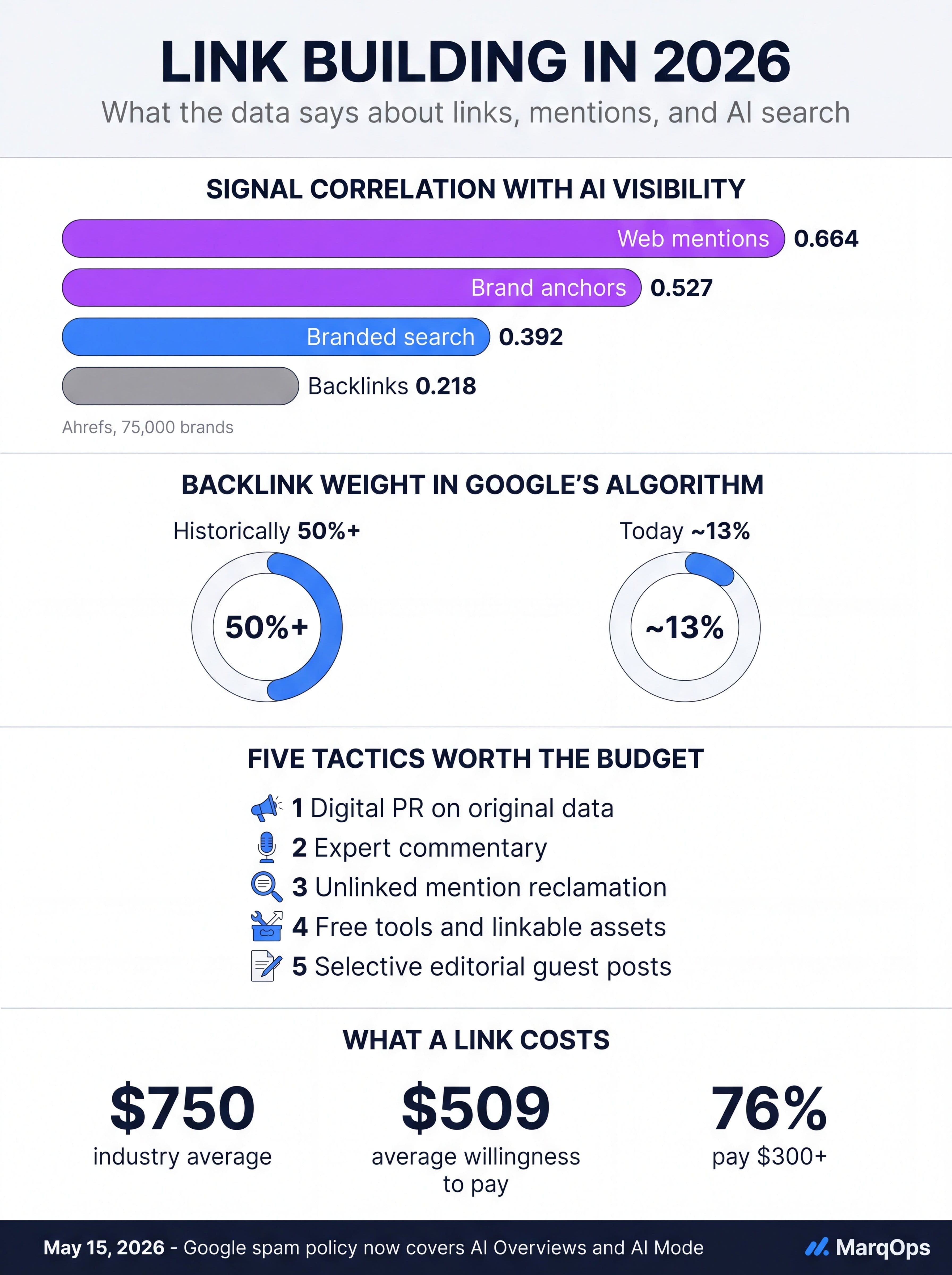
The most useful study on this is Ahrefs' analysis of 75,000 brands, which measured which off-site factors predicted appearance in Google AI Overviews. The correlations were not close.
| Signal | Correlation with AI visibility |
|---|---|
| Web mentions (brand named anywhere) | 0.664 |
| Brand anchors (brand name used as anchor text) | 0.527 |
| Branded search volume | 0.392 |
| Backlinks | 0.218 |
Every signal that outperformed backlinks is an off-site brand signal rather than a link graph metric. A follow-up analysis found YouTube mentions to be the single strongest individual correlate at roughly 0.737, which tells you something uncomfortable about how much of the answer layer is assembled from places most SEO teams do not own.
Two further numbers frame the strategic problem. 82% of AI citations are earned media, and 94% come from sources that are neither paid nor brand-owned. There is no self-serve path into the answer layer. Separately, Kalicube's study of 5,000 brand entities in Google's Knowledge Graph found that brands with dense, consistent unlinked mention patterns across authoritative domains were 3.4 times more likely to surface in AI-generated answers.
One caveat worth stating plainly, because most coverage of this study skips it: correlation is not causation, and mention volume is partly a proxy for brand size. Large brands get mentioned more and get cited more, and some of that relationship is simply "big brands are big." The actionable read is not that mentions cause citations. It is that a program producing only links is producing the weakest of the four measured signals.
Backlinks Still Matter for Google, Just Less
Google has been unusually direct about this. Gary Illyes said in 2023 that people overestimate the importance of links and that they had not been a top three ranking factor for some time. In 2024 he told a conference audience that Google needs "very few links" to rank pages and had spent years making links less important. In March 2024, Google quietly removed the word "important" from the link reference in its own spam policy documentation.
First Page Sage's ongoing analysis puts numbers on the drift: backlinks fell from historically over 50% of algorithmic weight to roughly 13% today. Treat that as a directional estimate rather than a leaked constant, but the direction is corroborated by everything Google has said and by the number of pages now ranking with thin link profiles.
What this means operationally is a change in sequencing, not abandonment. Links remain the fastest lever for a page that is otherwise competitive and stuck. They remain close to necessary in high-commercial-intent verticals where every competitor has them. They are a poor substitute for content that does not deserve to rank, and they are a very expensive substitute for the topical authority that comes from covering a subject completely. If you are choosing between one $2,000 link and four well-researched pages that close a coverage gap, the pages usually win now. They did not always.
Link building in 2026: what the correlation data shows, what links cost, and where Google's enforcement line now sits.
What Google Now Penalizes
Two enforcement shifts matter more than any tactic list.
Site reputation abuse went algorithmic. What Google calls site reputation abuse, and what the industry calls parasite SEO, is publishing third-party content on a strong domain with little or no first-party editorial oversight, primarily to borrow that domain's ranking signals. It launched in March 2024 as a manual-action-only policy. By the August 2025 spam update it was being enforced algorithmically, and the spam updates since have continued to tighten it. The March 2026 spam update completed in 19.5 hours, the fastest rollout on record, which is a reasonable signal that this enforcement is now routine rather than exceptional.
Manipulating AI answers is now explicitly spam. On May 15, 2026, Google rewrote its spam policy definitions to cover AI Overviews and AI Mode. Tactics aimed at gaming the answer layer now sit inside the same policy framework as classic search spam. This closes the loophole that a lot of 2025-era GEO advice was quietly built on.
The practical consequence for guest posting is that the tactic has split in two. A contributed article on a real, trafficked publication that genuinely covers your subject, edited by a human, is ordinary publishing and carries ordinary risk. High-volume placements on sites that accept nearly anything, with thin or unedited AI-generated copy, off-topic subject matter, and templated commercial anchors, are the exact pattern the policy describes. The distinguishing variables are editorial oversight, topical fit, and scale. If a site publishes 40 unrelated contributed posts a month, the host's authority is not really transferring anything to you except risk.
The Five Tactics Worth Your Budget
1. Digital PR built on original data. This is the highest-leverage tactic available to most teams, and the survey data backs it. Roughly 34% of SEOs now name digital PR their top-performing link method, nearly double guest posting at 18%. Over 90% of effective campaigns are built on data-led content or expert commentary. The mechanism is simple: journalists need statistics to cite, and if you publish the only public data on a subject, you become the source every subsequent article references. One digital PR specialist produces an average of about 15.6 links per month, and the same campaign generates unlinked mentions that feed the answer layer.
2. Expert commentary through journalist request platforms. In BuzzStream's 2026 survey, expert commentary was the single best-performing tactic at 35.3%, with original data campaigns at 29.9%. Together those two account for roughly 65% of best-performing results. HARO's shutdown fragmented this space, and the workable replacements now are Source of Sources, Featured, Qwoted, Help a B2B Writer, and ProfNet for tier-one financial media. The economics are good because the cost is response time rather than budget.
3. Unlinked mention reclamation, reframed. The old version of this tactic was chasing down mentions and asking for a link. Keep doing that where the site is worth it, but stop treating the unlinked mention as a failure state. Given the correlation data, a mention in a source that AI systems retrieve from can be worth as much as a followed link from a mid-authority domain. The higher-value version of this work is monitoring where you get mentioned, understanding which of those sources actually feed AI answers, and deliberately increasing frequency in the ones that do. AI brand monitoring covers the tooling side of this.
4. Free tools, calculators, and genuinely useful assets. Linkable assets that solve a recurring problem accumulate links passively for years, which is the only tactic on this list with a declining cost per link over time. The bar is higher than it was because there are more of them, but a tool that saves a specific audience twenty minutes still earns citations without outreach.
5. Selective, editorial guest contribution. Not dead, just narrowed. Real publications, relevant topics, human editors, your actual expertise, and a volume low enough that no pattern exists to detect. If you cannot describe why the publication's audience benefits, skip it.
What is worth noting about all five: every one of them produces mentions as a byproduct, and three of them produce more mentions than links. That is not a coincidence. It is what a program calibrated for 2026 looks like.
What Links Actually Cost in 2026
Pricing has hardened as supply quality has fallen. The industry-wide figure for an earned link sits around $750, with the average price SEOs report willingness to pay at roughly $509. 76% pay $300 or more per placement.
| Approach | Typical cost per link | What you get |
|---|---|---|
| Digital PR campaign | $1,000 to $1,667 | A $5,000 campaign returning three to five DR 70+ editorial placements, plus unlinked pickup |
| Digital PR, per-link pricing | $200 to $1,500 | Varies widely with scope and target tier |
| Paid placement / sponsored post | $300 to $800 | Faster, more predictable, higher policy risk |
| Expert commentary (SOS, Featured, Qwoted) | Time cost only | Lower volume, high credibility, strong entity signal |
| Linkable asset | Front-loaded build cost | Declining cost per link over a multi-year horizon |
Outreach economics have moved against volume plays. Instantly's 2026 benchmark across billions of emails puts the platform-wide cold email reply rate at 3.43%, down from about 7% in 2023 and 8.5% in 2019. Link-building and digital PR outreach averages around 13%, roughly four times generic cold email, because the pitch has something in it for the recipient. If your reply rate is sitting at 3%, the problem is the offer, not the sequence.
The supply side is also genuinely harder. BuzzStream's 2026 report found 68.2% of digital PR practitioners say PR is more effective than a year ago, while 75% say it has become more challenging. Roughly 3,000 journalist layoffs in 2025 alone, per Press Gazette, mean fewer people to pitch and staler media databases. Effectiveness is up and execution difficulty is up at the same time, which is a strong argument for fewer, better campaigns.
Building a Mention Footprint, Not Just a Backlink Profile
If mentions are the stronger signal, the program needs an explicit mention strategy rather than treating mentions as PR overflow. Four things make that concrete.
Fix your entity first. Models need to know what your brand is before they can decide when to name it. Consistent naming, a clear description repeated across profiles, and structured data that ties your entity together are prerequisites. Mentions accrue to an entity the machine can resolve. If your brand name is ambiguous or your descriptions conflict across sources, mentions get diluted across whatever the model thinks you are. Entity SEO and structured data both cover the mechanics.
Go where the citations come from. The retrieval corpora that feed AI answers are not the same as the link graph. Community platforms, video, review sites, and industry publications punch above their DR in AI answers. The YouTube correlation figure alone should redirect some budget.
Publish things that are citable. Original numbers, clear definitions, and specific claims get quoted. Generic overviews do not. This is the same discipline that wins in answer engine optimization: write the sentence you want a model to lift.
Feed branded search. Branded search volume correlated at 0.392, higher than backlinks. Anything that makes more people type your name into a search box, including paid brand campaigns and organic social, is now indirectly a search visibility investment. Share of search goes deeper on measuring that.
Measuring a Program When Half the Value Is Invisible
The reporting problem is real. Link counts and DR averages are easy to measure and increasingly incomplete. Mention footprint and AI citation share are what actually predict visibility and are harder to instrument.
A workable dashboard tracks five things: referring domains gained and lost, total web mentions including unlinked, branded search volume trend, citation share across ChatGPT, Google AI Mode, Perplexity, and AI Overviews, and organic visibility for the pages the program targeted. Expect lag. Meaningful AI citation movement typically trails ranking movement by three to six months, since a page has to rank, get crawled, get mentioned, and get absorbed into retrieval before it starts showing up in answers. Programs get killed at month four all the time for results that arrive in month six.
The operational annoyance is that these five metrics historically lived in five tools, which is exactly the fragmentation that makes authority programs hard to defend in a budget review. Pulling backlink data, mention monitoring, branded search, AI citation tracking, and rankings into a single view is one of the reasons teams consolidate onto a unified platform like MarqOps rather than reconciling exports by hand every month. Related reading on the reporting side: marketing KPIs and content audits built for AI citations rather than rankings alone.
A 90 Day Plan
Days 1 to 30, audit and fix the base. Pull your current backlink profile and your current mention footprint separately, and compare them. Most teams find far more mentions than they expected and far fewer that are being converted or reinforced. Fix entity consistency across your site, profiles, and structured data. Identify the ten sources that mention you most and the ten that mention your closest competitors but not you. Baseline your AI citation share so month six has something to compare against.
Days 31 to 60, ship one data asset. One original study, survey, or dataset that nobody else has published in your category. Not a roundup. Something with a number in the headline that a journalist can cite. Build the outreach list from people who have covered adjacent topics in the last six months, not from a purchased database. Keep the pitch under 200 words, because that is what journalists say they prefer and the reply rate reflects it.
Days 61 to 90, run the compounding tactics. Get on two or three journalist request platforms and answer queries consistently rather than in bursts. Work the unlinked mention list, converting where the site is worth it and increasing frequency where it is not. Start the linkable asset that will still be earning links in 2028. Then report on the full five-metric set, not just links.
The reason this order works is that the base fixes make everything after them count for more. Running digital PR before your entity is resolvable means paying for mentions that get attributed to an ambiguous brand.
Frequently Asked Questions
Do backlinks still matter for SEO in 2026?
Yes, but less than they did and less than most agencies imply. Google has said links have not been a top three ranking factor for years, and independent estimates put their algorithmic weight near 13%, down from over 50% historically. They still help competitive pages break through, and they still matter in high-commercial-intent verticals. They are no longer a substitute for content quality or topical coverage.
Are unlinked brand mentions actually valuable?
For AI search, very. Web mentions correlated with AI Overview visibility at 0.664 versus 0.218 for backlinks in Ahrefs' 75,000-brand study, and Kalicube found brands with dense unlinked mention patterns were 3.4 times more likely to appear in AI answers. For classic Google rankings the direct effect is weaker and less established. Convert mentions to links where the source is strong, but stop treating an unlinked mention as a wasted placement.
How much should a link cost?
Industry-wide the figure for an earned link is around $750, with SEOs reporting an average willingness to pay near $509 and 76% paying $300 or more. Digital PR effectively runs $1,000 to $1,667 per link when you divide a $5,000 campaign by three to five placements, but that math ignores the unlinked pickup, which is now a meaningful part of the return.
Is guest posting still safe after the site reputation abuse policy?
It depends entirely on execution. A contributed article on a genuinely relevant, human-edited publication is ordinary publishing. High-volume placements on sites that accept almost any submission, with thin AI-generated copy, off-topic subject matter, and templated commercial anchors, match the pattern Google's policy describes and enforcement has been algorithmic since the August 2025 update. Editorial oversight, topical fit, and scale are the variables that separate the two.
How long before link building shows results in AI search?
Longer than in classic search. Meaningful AI citation movement typically lags ranking movement by three to six months, because a page has to rank, be crawled, be referenced elsewhere, and be absorbed into the retrieval corpus before it starts appearing in answers. Plan a two-quarter evaluation window and baseline citation share at the start so you can actually see the change.
What replaced HARO for expert commentary links?
Source of Sources, launched by HARO's original founder, is the closest free equivalent. Featured is strong for B2B and SaaS experts, Qwoted is the most-cited paid successor, Help a B2B Writer covers narrower B2B queries, and ProfNet remains the premium option for tier-one financial media. Expert commentary was the top-performing tactic at 35.3% in BuzzStream's 2026 survey, so this channel is worth staffing properly.
The Bottom Line
Link building in 2026 is a smaller part of a bigger job. The link graph still functions and Google still reads it, but its influence has been shrinking for a decade and the answer layer that increasingly sits between your content and your buyer reads something else: how often your brand appears, in what company, described how consistently.
The programs that will look smart in two years are not the ones that bought the most links. They are the ones that published things worth citing, showed up in the sources models actually retrieve from, made their brand entity unambiguous, and measured mentions and citations alongside referring domains instead of after them. That work produces links too. It just stops treating them as the point.
If you are rebuilding a program this quarter, the cheapest useful change is measurement. Add mention footprint and citation share to the report before you change a single tactic. Most teams discover they have been winning in places they were not counting, and losing in places they never looked.
Keep following the signal