Data Clean Rooms Explained: The Privacy-First Way Marketers Win in 2026
A marketer’s guide to data clean rooms in 2026: what they are, how they work, the types, top use cases, costs, and how to turn clean-room insights into action.
Data Clean Rooms Explained: The Privacy-First Way Marketers Win in 2026
Third-party cookies are gone, privacy laws keep tightening, and yet your CMO still wants proof that every dollar of ad spend works. Data clean rooms are how modern marketing teams square that circle. Here is what they are, how they work, and how to put them to work without a data-science army.
TL;DR
- A data clean room is a secure, neutral environment where two or more parties combine first-party data to get audience and measurement insights without ever exposing raw, person-level records.
- Adoption jumped roughly 70% year over year, the market is projected to grow from $3.2B in 2025 to $18.6B by 2034, and around 50% of organizations now plan to implement one.
- There are two main flavors: walled-garden rooms (Amazon AMC, Google Ads Data Hub) and neutral, independent rooms (Snowflake, LiveRamp, InfoSum) that connect multiple partners.
- The highest-value use cases are audience overlap, privacy-safe activation, and closed-loop measurement including incrementality and multi-touch attribution.
- Clean rooms produce insights, not action. You still need a unified operations layer to turn those outputs into live campaigns, creative, and reporting.
Table of Contents
- What Is a Data Clean Room?
- Why Data Clean Rooms Matter More Than Ever in 2026
- How a Data Clean Room Actually Works
- The Three Types of Data Clean Rooms
- The Marketing Use Cases That Drive ROI
- The Hidden Challenges Marketers Underestimate
- A Practical Roadmap to Get Started
- Where MarqOps Fits
- Frequently Asked Questions
What Is a Data Clean Room?
A data clean room is a secure digital environment where multiple parties combine their first-party data to generate audience and campaign insights without exposing raw, person-level records to each other. Think of it as a locked vault with a one-way mirror. A brand and a retailer both put their customer data inside, the room finds where those audiences overlap, and each side walks out with aggregated answers. Neither side walks out with the other party’s actual customer list.
That single design choice is what makes clean rooms the defining data infrastructure of the privacy-first era. For years, marketers leaned on third-party cookies and shared raw audience files to target and measure campaigns. Both of those tactics are now either technically broken or legally radioactive. Clean rooms let collaboration continue, but under strict mathematical and contractual controls that keep regulators, legal teams, and customers comfortable.
If you already invested in a first-party data strategy, a clean room is the logical next step. It is the mechanism that lets your first-party data create value with partners without ever leaving your control. The same goes for the consented, declared signals you collect through a zero-party data program.
The one-line definition: A data clean room lets you answer “who and how many” questions about combined datasets without anyone seeing the underlying “who exactly.” Insights come out. Raw data never does.
Why Data Clean Rooms Matter More Than Ever in 2026
The shift is not theoretical. Data clean room adoption grew by roughly 70% year over year, and about two-thirds of organizations now report adopting them in some form. The global market was valued at $3.2 billion in 2025 and is projected to reach $18.6 billion by 2034, with North America accounting for around 45% of revenue. Surveys show close to 50% of organizations are planning to implement a clean room even though only about 15% are actively using one today. That gap between intent and execution is exactly where competitive advantage lives right now.
$3.2B → $18.6B
Projected data clean room market growth, 2025 to 2034
Three forces are driving this surge at once. First, third-party cookie deprecation and mobile identifier restrictions removed the cross-site tracking that powered a decade of digital advertising. Second, privacy regulation keeps expanding, so legal teams now veto the casual data sharing that used to be routine. Third, and most importantly for marketers, the demand for proof has never been higher. After years of opaque attribution, finance leaders want deterministic evidence that ad spend produces sales.
This is also why first-party data became the strategic asset of the decade. Around 80% of marketers now prioritize first-party data over third-party alternatives, and 91% describe it as the most reliable data type they have. Retail media networks powered by first-party data grew by an estimated $45 billion globally in 2025. A clean room is simply the safest, most defensible way to make that first-party asset collaborate with partners, publishers, and retailers.
Retail media is the single biggest accelerant. As brands pour budget into retail media networks, they need to prove those dollars drive sales, and clean rooms are the only privacy-durable way to connect ad exposure to purchase. Yet fewer than half of US retail media networks currently offer clean room capabilities, which means there is real white space for both networks and the brands that use them. Early movers get cleaner measurement and better targeting while competitors are still negotiating data-sharing agreements the old way. The marketers who win the next two years will be the ones who treat privacy-safe collaboration as a capability to build now, not a compliance problem to handle later.
How a Data Clean Room Actually Works
You do not need to be a data engineer to understand the mechanics. A typical workflow looks like this:
1. Each party uploads data securely. A brand uploads hashed customer identifiers, usually email addresses run through a one-way encryption function. A publisher or retailer uploads their own hashed audience. Raw emails are never visible to anyone, including the clean room vendor.
2. The room matches records privately. The system finds where the two hashed lists overlap, building a shared audience of verified, consented users without revealing individual identities to either side.
3. Queries run under strict controls. Marketers ask aggregate questions: how big is the overlap, what is the optimal frequency, which segments convert best. Results return only when they meet a minimum threshold, so no answer can be traced back to a single person.
4. Privacy math protects everyone. The two core safeguards are encryption and differential privacy. Encryption keeps data scrambled while it sits on the server and while it moves. Differential privacy adds a small amount of statistical noise to the output, so you can see the big-picture pattern but cannot isolate any individual from the results.
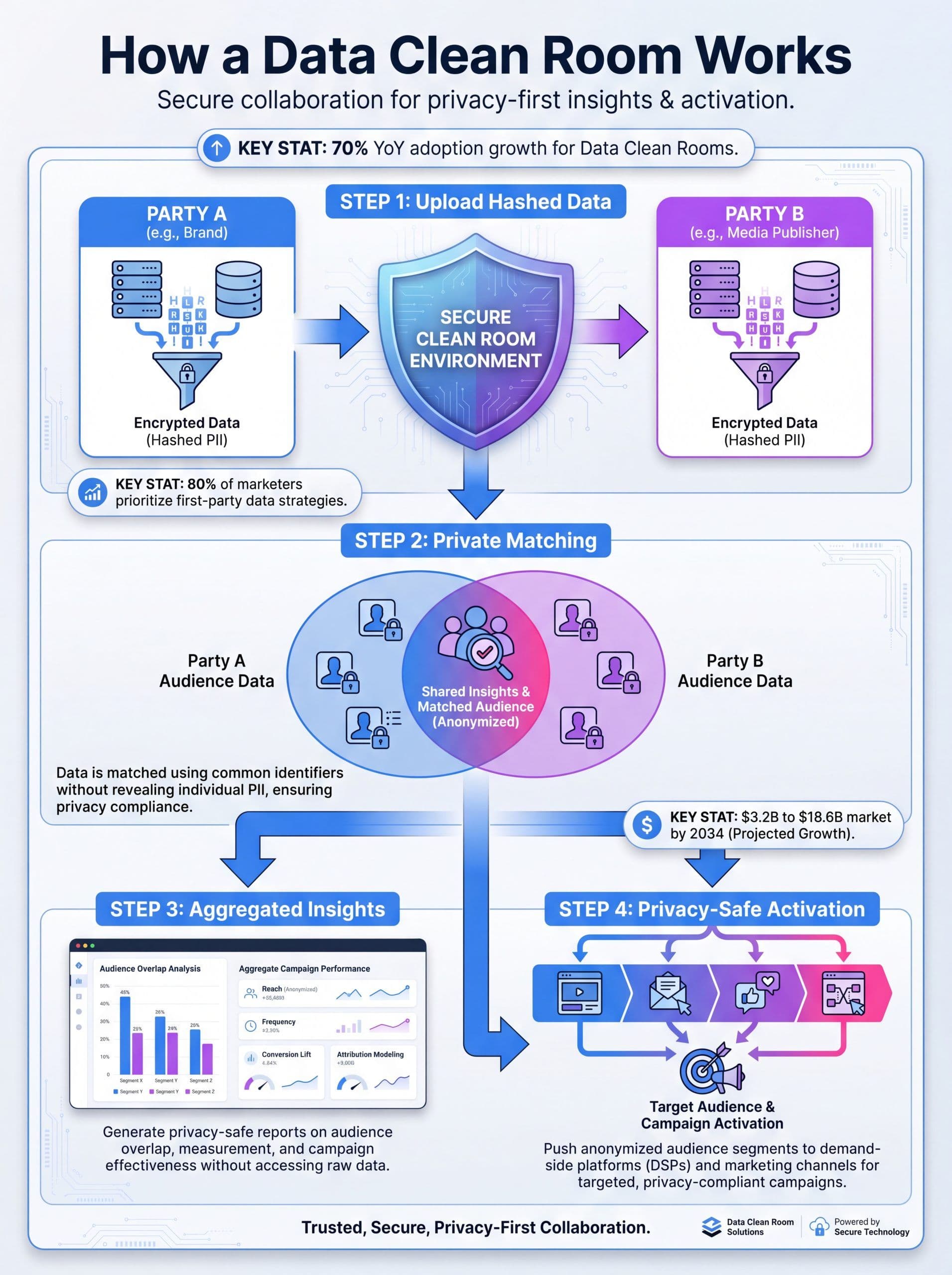
The data clean room workflow: raw data goes in, only aggregated, privacy-safe insights come out.
The output of all this is insight, not raw records. That insight then feeds the rest of your stack: audience segments for AI customer segmentation, signals for personalization, and clean measurement data for your marketing analytics workflows.
The Three Types of Data Clean Rooms
Not all clean rooms are built for the same job. Choosing the wrong type is the most common early mistake, so it helps to know the categories before you talk to any vendor.
| Type | Examples | Best For |
|---|---|---|
| Walled garden | Amazon Marketing Cloud, Google Ads Data Hub, Disney, NBCUniversal, Instacart | Measuring and optimizing campaigns inside one platform’s inventory and audiences |
| Neutral / independent | Snowflake, LiveRamp, InfoSum, Decentriq, Habu | Collaboration across multiple partners, retailers, or publishers on neutral ground |
| Cloud-native | AWS Clean Rooms, BigQuery, Databricks | Teams already standardized on a cloud data warehouse who want collaboration built in |
Walled-garden clean rooms are run by the big platforms and media owners. They are powerful for measuring activity inside that platform, but they typically limit analysis to the platform’s own inventory and audiences. The big shift here: Amazon expanded access to Amazon Marketing Cloud in September 2025, making it free for all Sponsored Ads advertisers and removing a cost barrier that once locked smaller brands out.
Neutral or independent clean rooms are designed as a meeting place between parties: advertiser plus publisher, brand plus retailer, or an agency working across many media partners. They are the right call when you need to collaborate across boundaries rather than inside a single ecosystem. Cloud-native clean rooms sit on top of the warehouse you already use, which keeps data movement to a minimum.
The Marketing Use Cases That Drive ROI
Audience overlap and measurement are the most common starting points, but the value compounds as teams mature. Here is the progression most marketing organizations follow.
Audience overlap and insights. Before spending a dollar with a partner, you can see how much of their audience already overlaps with your customers. That tells you whether a media buy reaches net-new prospects or just re-touches people you already have. It is the simplest use case and often the fastest to deliver value.
Privacy-safe audience activation. Brands match first-party data with a publisher’s audience to target consented users without exposing customer records. Industry protocols like PAIR, updated to version 1.1 in July 2025, standardize how this privacy-safe matching happens across partners.
Closed-loop measurement. This is the use case finance leaders care about most. Retail media networks use clean rooms to link ad exposure to actual purchases, including in-store transactions that traditional digital measurement could never see. That deterministic connection is the proof marketers have been chasing for a decade. It also strengthens your multi-touch attribution by grounding it in verified outcomes rather than modeled guesses.
Incrementality and causal testing. The most advanced teams run holdout and geo-split experiments entirely inside the clean room to isolate the true causal effect of a campaign. Combined with marketing mix modeling and predictive marketing analytics, this gives you the confidence to shift budget based on evidence instead of last-click bias.
The payoff: Clean rooms turn fragmented, privacy-restricted data into deterministic measurement and net-new reach. That is how teams justify budget, find incremental audiences, and protect customer trust at the same time.
All of these use cases feed naturally into broader strategies like omnichannel marketing and AI programmatic advertising, where privacy-safe audiences and clean measurement are the raw fuel.
The Hidden Challenges Marketers Underestimate
Clean rooms are powerful, but they are not plug and play. Three realities catch teams off guard.
Cost and complexity. The average enterprise spends around $879,000 on a clean room implementation, and 48% of non-adopters cite budget as the primary blocker. Free tiers from the walled gardens lower the entry point, but staffing the analysts to run queries and interpret results is a real, ongoing expense.
Insight is not action. This is the trap. A clean room tells you that an audience overlaps 22% or that a campaign drove 4,000 incremental conversions. It does not build the creative, launch the campaign, or update the dashboard your CMO checks every morning. Adoption alone does not create operational impact. Teams have to turn clean-room outputs into usable workflows across planning, activation, and reporting, and that connective tissue is where most programs stall.
Fragmented infrastructure. If your clean room sits in one silo, your customer data platform in another, your ad accounts in a third, and your reporting in a fourth, you have simply added one more disconnected tool. The insight has to flow back into a single operating layer to matter.
A Practical Roadmap to Get Started
You do not need a seven-figure budget or a dedicated data-science team to begin. Follow this sequence.
Step 1: Strengthen your first-party data foundation. A clean room is only as valuable as the data you bring to it. Audit your consented customer data, fix collection gaps, and make sure governance is solid before you collaborate with anyone.
Step 2: Pick one high-value question. Do not boil the ocean. Start with a single use case, usually audience overlap with one key retail or media partner, and prove value there.
Step 3: Match the room type to the job. Use a walled-garden room when you live inside one platform. Use a neutral room when you need to collaborate across partners. Use a cloud-native room when you already standardized on a warehouse.
Step 4: Build the activation loop. Decide upfront how insights will flow into live campaigns, creative, and reporting. This is the step teams skip, and it is the step that separates a science project from a revenue driver.
Step 5: Measure, then scale. Start with measurement and overlap, then graduate to activation and incrementality testing as your team builds confidence. Connect outputs to a marketing intelligence platform so the whole organization can act on what the clean room reveals.
Where MarqOps Fits
A data clean room solves the data-collaboration problem. It does not solve the operations problem of turning those insights into on-brand creative, published content, optimized campaigns, and a dashboard your whole team trusts. That is the gap MarqOps was built to close.
MarqOps unifies creative production, SEO content, marketing analytics, and advertising in one brand-intelligent platform, which means the audience insights and measurement signals coming out of a clean room land somewhere they can actually be used. Instead of exporting a clean-room result into a spreadsheet and emailing it around, your team feeds it straight into a unified dashboard that brings Google Search Console, GA4, and ad data together, then acts on it with AI that already knows your brand. One platform replaces seven or more disconnected tools, and the Brand Intelligence DNA keeps every output on-brand from the first draft.
The result is the activation loop most clean-room programs are missing. Privacy-safe insight comes in, brand-perfect creative and content go out up to six times faster, and performance flows back into one place for the next decision. That is how you make a clean-room investment pay off instead of stalling at the insight stage.
Start Free – No Card RequiredSee How MarqOps Works
Frequently Asked Questions
What is a data clean room in simple terms?
It is a secure environment where two or more companies combine their customer data to get shared insights, like audience overlap or campaign measurement, without ever showing each other the actual underlying records. Insights come out, raw personal data does not.
Are data clean rooms GDPR and privacy compliant?
Clean rooms are specifically designed for privacy compliance. They use encryption, hashed identifiers, aggregation thresholds, and differential privacy so no individual can be isolated from the results. That said, compliance still depends on having proper consent and governance for the first-party data you bring in, so legal review remains essential.
How much does a data clean room cost?
It varies widely. Large enterprise implementations average around $879,000 including staffing and integration, which is why budget is the top blocker for non-adopters. However, walled-garden options have lowered the barrier. Amazon Marketing Cloud became free for all Sponsored Ads advertisers in September 2025, so smaller teams can now start with little or no platform fee.
What is the difference between a data clean room and a customer data platform?
A customer data platform unifies and activates your own first-party data internally. A data clean room is built for collaboration between parties, letting you combine your data with a partner’s data securely. They are complementary: your CDP organizes your data, and the clean room lets that data create value with others without exposing it.
Do I need a data-science team to use a data clean room?
Not necessarily to start. Walled-garden rooms offer guided reporting that marketing teams can use directly. The harder part is turning clean-room outputs into live campaigns and reporting, which is an operations challenge more than a data-science one. A unified platform like MarqOps closes that gap by connecting insight to action without manual handoffs.
Keep following the signal