Conversational Marketing in 2026: The Complete Guide to AI-Driven Customer Conversations
Conversational marketing in 2026 uses AI agents to engage, qualify, and convert buyers in real time. See the stats, channels, examples, and strategy that work.
TL;DR
- Conversational marketing uses real-time, two-way conversations – powered by AI agents, chat, and messaging – to engage, qualify, and convert buyers the moment intent appears.
- The conversational AI market sits around $16-18 billion in 2026 and is growing at roughly 21-23% per year, heading toward $68-82 billion by the early 2030s.
- Businesses using next-generation AI chatbots have reported average sales lifts near 78% and a 43% drop in cost per qualified lead, with returns averaging about $8 for every $1 invested.
- The 2026 shift is agentic: AI agents now qualify leads, book meetings, and personalize journeys across web chat, WhatsApp, SMS, social DMs, and voice – 24/7, with humans supervising.
- The winners run conversational marketing as one connected system, not a bolted-on chatbot. A unified, brand-aware platform like MarqOps keeps every conversation on-brand and tied to analytics.
Table of Contents
- What Is Conversational Marketing in 2026?
- Why Conversational Marketing Matters Right Now
- How AI Agents Changed the Game
- Core Channels and Tactics
- Real-World Conversational Marketing Examples
- Building a Conversational Marketing Strategy
- Metrics and KPIs That Matter
- Common Pitfalls to Avoid
- Choosing the Right Platform
- Frequently Asked Questions
What Is Conversational Marketing in 2026?
Conversational marketing is the practice of engaging prospects and customers through real-time, two-way conversations instead of one-way forms, emails, and static landing pages. Rather than making a buyer fill out a form and wait, you meet them in the moment with a chat window, a messaging thread, or a voice assistant that answers questions, qualifies intent, and moves them forward – often without a human lifting a finger.
For years that meant rules-based chatbots that followed rigid decision trees. In 2026 the definition has changed. Today’s conversational marketing is driven by generative AI agents that understand context, pull from your customer data, and personalize every reply. The era of purely text-based, scripted chat is fading fast. Modern systems are multimodal, handling text, voice, images, and even video, and they qualify leads around the clock without forcing a human handoff. That evolution is closely tied to the rise of AI agents for marketing, which can plan and execute multi-step tasks on their own.
In plain terms: conversational marketing replaces “fill out this form and we’ll get back to you in 2-3 business days” with “let’s talk right now.” The faster you respond to intent, the more deals you close – and AI lets you respond instantly, at any hour, at any scale.
Why Conversational Marketing Matters Right Now
The momentum behind conversational marketing is not hype – it shows up clearly in adoption, customer preference, and revenue data. The conversational AI market is valued at roughly $16-18 billion in 2026 and is projected to grow at a compound annual rate of about 21-23%, reaching somewhere between $68 billion and $82 billion by the early 2030s. That is the kind of curve that reshapes how entire categories of marketing get done.
82%
of customers now prefer interacting with a chatbot rather than waiting in a queue for a human – up 20 percentage points since 2022
Customer attitudes have flipped. Satisfaction with AI chatbot interactions has climbed to around 87% globally in 2026, up from 73% in 2023, and 71% of consumers now expect companies to deliver personalized interactions as a baseline. Buyers are not tolerating conversational experiences – they are demanding them. When 80% of WhatsApp messages are read within the first five minutes, the contrast with an email that sits unopened for days could not be sharper.
The business case is just as strong. An IBM Institute for Business Value study found that companies using next-generation AI chatbots saw average sales increases near 78%, with retail and financial services leading the pack. HubSpot reported that AI-powered lead qualification chatbots cut the cost per qualified lead by 43% – from about $198 to $113 – while lifting lead-to-opportunity conversion by 38%. Across the chatbot lifecycle, businesses report an average return of roughly $8 for every $1 invested, and Gartner has projected $80 billion in contact center labor savings by 2026.
This is the same efficiency story driving the broader move toward AI in marketing automation: do more, faster, with less manual overhead, while keeping quality high.
How AI Agents Changed the Game
The single biggest shift in conversational marketing is the move from chatbots that answer questions to agents that get things done. Agentic AI has evolved into something closer to an autonomous digital coworker – capable of managing end-to-end processes with limited human intervention. Instead of just replying with a canned answer, a modern agent can qualify a lead, look up account history, recommend the right product, book a meeting on a rep’s calendar, and trigger a follow-up sequence, all inside one conversation.
That changes the operating model for marketing teams. If you still run marketing like a relay race – handing leads between specialized teams and tools – you will be outpaced by organizations that run it like a control room overseeing coordinated AI workflows. Humans set strategy and supervise; agents execute and optimize.
The practical upside: AI agents qualify and route leads 24/7, so high-intent buyers reach sales while they are still hot – and low-fit traffic flows into nurture instead of clogging your pipeline. This is conversational marketing and AI lead scoring working as one motion.
Crucially, agents are only as good as the data and brand rules behind them. An agent that does not know your products, pricing, or tone will produce generic, off-brand replies that erode trust. The best implementations connect agents to a unified customer view – the kind delivered by an AI customer data platform – so every conversation is grounded in real context.
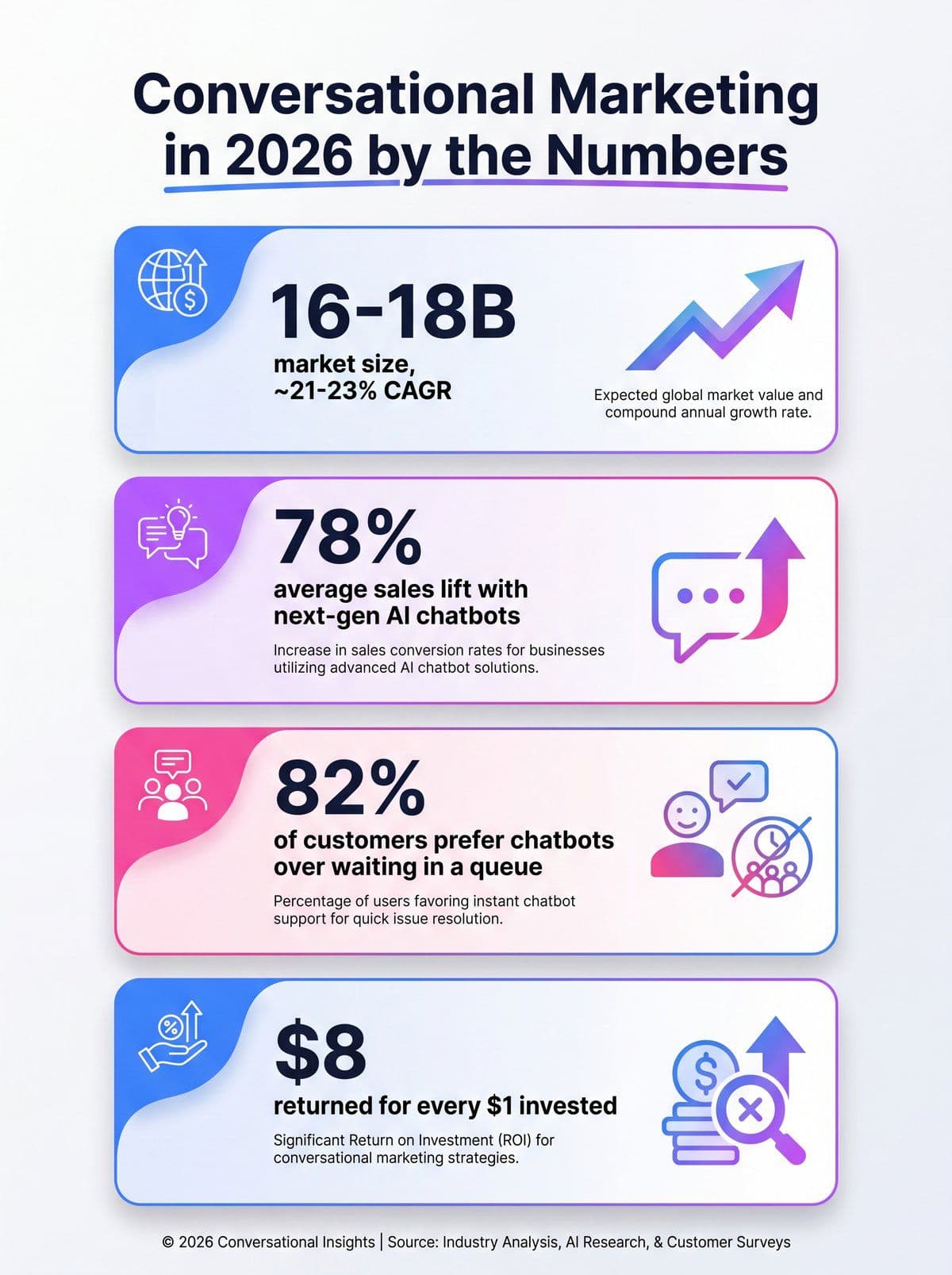
Conversational marketing by the numbers: market growth, conversion impact, and ROI in 2026.
Core Channels and Tactics
Conversational marketing is not a single channel – it is a way of operating across every place your buyers already talk. The most effective channels in 2026 share one trait: they enable tailored, two-way engagement in real time.
Real-time website chat
Your highest-intent visitors are already on your site. A proactive chat experience – triggered by behavior like pricing-page visits or repeat sessions – turns anonymous traffic into qualified conversations. Where static forms convert at 2-5%, conversational experiences often double or triple that by removing friction and answering objections instantly.
Messaging: WhatsApp and SMS
Messaging apps have become serious revenue channels. With 80% of WhatsApp messages read within five minutes and 70% of consumers more likely to buy from a brand they can message directly, click-to-message ads and WhatsApp flows are now standard B2C and B2B plays. A short flow that asks three or four questions about budget, timeline, and team size can qualify a lead faster than any form.
Social DMs and in-app messaging
Direct messages on social platforms let brands continue conversations where attention already lives. Pairing this with strong AI-powered social media management means responses stay fast, on-brand, and consistent even at high volume.
Voice assistants
Voice AI has crossed an economic threshold. At roughly $0.40 per automated call versus $7-12 for a human agent, voice cuts per-interaction cost by 90-95% while handling routine qualification and support. Multimodal agents now blend voice, text, and visuals in a single experience.
Real-World Conversational Marketing Examples
Abstract benefits land better with concrete examples. Here is what conversational marketing looks like in practice:
B2B lead qualification via WhatsApp. A field study with more than 16,000 participants found that WhatsApp-based chatbots generated significantly more leads – and higher-quality ones – than traditional landing pages. Instead of a long contact form, a click-to-WhatsApp ad routes prospects into a flow that asks about budget, timeline, industry, and team size, then automatically forwards qualified leads to sales and pushes the rest into nurture.
Proactive website concierge. A SaaS brand detects when a visitor lands on the pricing page twice in a week and opens a chat: “Looking for the right plan? I can compare options based on your team size.” The agent answers, captures intent, and books a demo – shrinking the path from interest to meeting from days to minutes.
Post-purchase upsell and retention. After a customer buys, an agent follows up in-app to confirm setup, suggest a complementary product, and flag accounts at risk of churning. This connects naturally to customer journey orchestration, where conversations adapt to each lifecycle stage.
The pattern across all three: meet the buyer in their channel, ask the right questions, and act on the answers immediately. Conversational marketing is less about the chat widget and more about closing the gap between intent and action.
Building a Conversational Marketing Strategy
You do not need to boil the ocean. A focused rollout beats a sprawling one. Here is a practical roadmap:
1. Map your highest-intent moments
Identify where buyers signal intent – pricing pages, demo requests, cart pages, high-value ad clicks. Start conversations there first, where the payoff is clearest. Tie this to your AI marketing funnel so conversations reinforce each stage.
2. Define qualification logic
Decide the three to five questions that separate a sales-ready lead from a nurture candidate. Keep it short – conversational qualification works because it feels human, not like an interrogation.
3. Ground agents in brand and data
Feed your agent product details, pricing, FAQs, and tone guidelines. This is where brand-aware AI matters: outputs must sound like you and respect your guidelines every time. Connect it to a unified customer view so replies are personalized, not generic – the same principle behind effective AI personalization and AI customer segmentation.
4. Design clean human handoffs
Agents should know when to escalate. Define the triggers – high deal value, frustration signals, complex requests – and route seamlessly to a rep with full conversation context, which strengthens AI sales enablement.
5. Measure, learn, and expand
Launch on one or two channels, track results against clear KPIs, then expand to messaging, social, and voice. Conversational marketing compounds: each conversation generates data that makes the next one smarter.
Metrics and KPIs That Matter
Conversational marketing earns its keep when you measure the right things. Vanity metrics like total chats started tell you little. Focus on outcomes:
- Conversation-to-lead rate: the share of conversations that produce a qualified lead.
- Cost per qualified lead: often down 40%+ once AI handles first-touch qualification.
- Lead-to-opportunity conversion: the real test of lead quality, not just quantity.
- Response and resolution time: speed is the whole point – track how fast intent gets answered.
- Booked meetings and pipeline influenced: the metrics your CRO actually cares about.
- CSAT on conversational interactions: protect experience while you scale.
The catch is attribution. Conversations span channels, so you need a unified view to connect a WhatsApp thread, a website chat, and a closed deal. That is far easier when conversational data flows into the same system as the rest of your AI marketing analytics rather than living in a siloed chatbot tool.
Common Pitfalls to Avoid
Conversational marketing fails in predictable ways. Avoid these:
Bolting a chatbot onto a broken process. If your qualification logic and follow-up are weak, automating them just produces bad outcomes faster. Fix the motion first.
Generic, off-brand replies. An agent that does not know your brand voice or products erodes trust instantly. Grounding in brand intelligence and real customer data is non-negotiable.
No human escape hatch. Customers forgive automation when they can reach a person for complex or high-stakes issues. Trapping them in a bot loop is the fastest way to lose a deal.
Tool sprawl and disconnected data. Running a separate chat tool, a separate messaging tool, and a separate analytics stack recreates the fragmentation conversational marketing was supposed to solve. Many teams still juggle 7+ disconnected tools – the opposite of an efficient operation. This is exactly the problem modern demand generation teams are trying to escape.
Choosing the Right Platform
Most conversational marketing tools handle the chat layer well but stop there. The 2026 reality is that conversations are only valuable when they connect to the rest of your marketing operation – your content, your analytics, your ad campaigns, and your brand rules. A standalone chatbot leaves that value on the table.
This is where a unified, brand-aware platform changes the equation. MarqOps brings creative production, SEO content, analytics, and advertising into one brand-intelligent system – so the same Brand Intelligence DNA that keeps your blog posts and ad creative on-brand also governs how AI engages in conversation. Instead of stitching together seven tools, one platform replaces them, with a unified dashboard that ties conversations to outcomes. Teams running this way report up to 6x faster content output and far less time lost to tab-switching.
$8 : $1
average return reported across the AI chatbot lifecycle – but only when conversations connect to a real strategy and clean data
When you evaluate platforms, look for three things: brand-aware AI that enforces your guidelines automatically, a multi-model pipeline so you get the best output instead of vendor lock-in, and a unified data layer that connects conversations to analytics. Enterprise security – SOC 2 compliance and GDPR readiness – should be table stakes given the customer data involved. If you want to see how a unified AI marketing assistant ties these threads together, that is the model to aim for.
Frequently Asked Questions
What is conversational marketing in simple terms?
Conversational marketing is engaging buyers through real-time, two-way conversations – via chat, messaging apps, or voice – instead of static forms and one-way emails. In 2026 these conversations are largely powered by AI agents that answer questions, qualify leads, and book meetings instantly, around the clock.
How is conversational marketing different from a regular chatbot?
A traditional chatbot follows a rigid script and answers FAQs. Conversational marketing in 2026 uses generative AI agents that understand context, pull from your customer data, personalize replies, and take action – like routing a hot lead to sales or triggering a nurture sequence. It is a strategy, not just a widget.
Does conversational marketing actually improve conversions?
Yes. Static landing pages typically convert at 2-5%, while conversational experiences often double or triple that. Businesses using next-generation AI chatbots have reported average sales lifts near 78% and a 43% reduction in cost per qualified lead, with returns averaging about $8 for every $1 invested.
Which channels work best for conversational marketing?
The strongest channels in 2026 are real-time website chat, WhatsApp and SMS, social DMs, in-app messaging, and voice assistants. Each supports tailored, two-way engagement. Messaging is especially powerful – 80% of WhatsApp messages are read within five minutes – while voice AI cuts per-call cost by 90-95% versus human agents.
How do I get started with conversational marketing?
Start where intent is highest – pricing pages, demo requests, high-value ad clicks. Define three to five qualification questions, ground your AI agent in your brand and product data, design clean human handoffs, then measure and expand to new channels. Using a unified, brand-aware platform like MarqOps keeps every conversation on-brand and connected to your analytics from day one.
Keep following the signal
Related field notes
Marketing
Brand Asset Management in 2026: How to Run It Without Adding Another Tool
14 min readMarketing Operations
Marketing Project Management Software in 2026: How to Choose Without Adding Tool #122
11 min readMarketing Analytics