AI Marketing Funnel in 2026: The Complete Guide to Stages, Examples, and Smarter Conversion at Every Step
A practical 2026 playbook for building an AI-powered marketing funnel that wins more leads, lifts conversion 25 to 35 percent, and unifies your stack under one brand-intelligent platform.
AI Marketing Funnel in 2026: The Complete Guide to Stages, Examples, and Smarter Conversion at Every Step
A practical playbook for building an AI-powered marketing funnel that wins more leads, lifts conversions 25 to 35 percent, and replaces seven point tools with one unified, brand-intelligent stack.
TL;DR
- The AI marketing funnel uses machine learning, agents, and generative models across awareness, consideration, conversion, and retention to qualify leads 40 percent more accurately and lift conversions 25 to 35 percent.
- 86.4 percent of marketers now use AI tools, and teams that deploy AI correctly report a 20 percent ROI increase and 19 percent cost reduction, per Salesforce 2026 data.
- Gartner predicts one in five purchases will be completed by an AI agent in 2026, which is rewriting how funnels are built and measured.
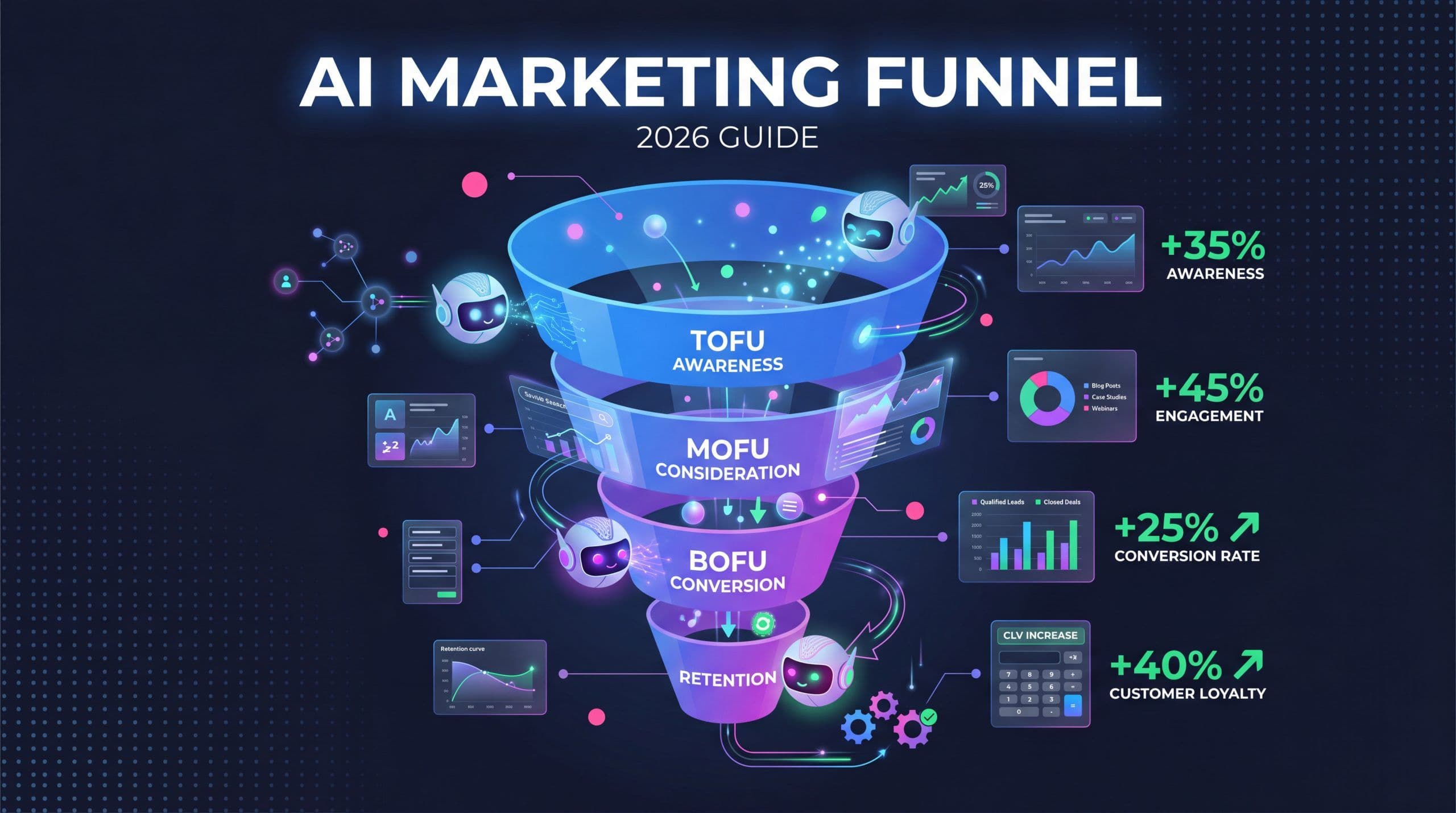
- The TOFU, MOFU, BOFU framework still works in 2026, but smart teams now layer AI on every stage: intent detection at TOFU, dynamic nurture at MOFU, predictive conversion timing at BOFU.
- Stitching seven point tools rarely works. Unified platforms like MarqOps consolidate creative, SEO, ads, analytics, and brand intelligence so the same data and brand DNA power every funnel stage.
Table of Contents
- What is an AI marketing funnel?
- Why traditional funnels broke in 2026
- The four stages, mapped to AI use cases
- TOFU: AI for awareness and demand creation
- MOFU: AI for consideration and nurture
- BOFU: AI for conversion and decision
- Post-funnel: AI for retention and expansion
- 2026 funnel conversion benchmarks
- AI marketing funnel tools by stage
- How to build your AI marketing funnel in 10 steps
- AI marketing funnel examples
- Metrics to track at every stage
- Common mistakes (and how to avoid them)
- Unifying the funnel with MarqOps
- FAQs
What is an AI marketing funnel?
An AI marketing funnel is the end-to-end buyer journey, from first touch to repeat purchase, where machine learning, generative AI, and AI agents do the heavy lifting at every stage. Traditional funnels relied on segmenting audiences once, broadcasting the same content, and waiting for prospects to self-identify. An AI funnel is dynamic. It learns from every interaction, scores intent in real time, personalizes the next touch automatically, and routes high-value buyers to the right channel without a human pulling the lever.
Think of it this way. A traditional funnel is a static pipe. Your blog post drips visitors into a generic newsletter. Your nurture sequence sends the same five emails to every MQL. Sales follows up when a form is filled. An AI marketing funnel is a network of feedback loops. The blog post is dynamically generated for the visitor’s industry. The newsletter swaps its hero offer based on what the lead clicked. Sales gets pinged the moment a buying signal lands, with a brief explaining why this account just crossed the threshold.
The shift matters because buyers no longer move through a clean five-step journey. They circle. They jump back. They bring in three colleagues to vet a decision. AI is the only practical way to keep up with that nonlinear pattern at scale.
Why traditional funnels broke in 2026
Three forces collided in the last 18 months to make the old funnel feel obsolete.
One, search behavior shifted. Gartner predicts traditional search volume will drop 25 percent by the end of 2026 as buyers move queries to ChatGPT, Perplexity, Claude, and Gemini. AI search referral traffic is now converting at 3.49 percent compared to 2.86 percent for traditional organic, a 22 percent uplift, but it lands deeper in the funnel because the buyer has already done research with an LLM before they click. Your TOFU content has to work harder to get cited at all.
Two, AI agents are entering the buying process. Gartner expects one in five purchases to be completed by an AI agent in 2026, and projects that by 2028 about 60 percent of brands will use agentic AI for one-to-one interactions. That number is staggering because it means part of your funnel is now negotiating with software, not humans. Machine readability of your product content matters as much as persuasion.
Three, tool sprawl reached a breaking point. The average marketing team now juggles content tools, SEO platforms, ad managers, CRMs, attribution software, personalization engines, and a handful of point AI tools. Companies that consolidated their stacks around unified, AI-capable platforms reported 50 to 77 percent reductions in technology costs and dramatic ROI improvements. The funnel cannot run on disconnected systems if AI needs continuous data to learn.
The 2026 buyer expects the funnel to feel like one continuous, personalized conversation. Anything less and they go to a competitor who figured it out.
The four stages, mapped to AI use cases
The TOFU, MOFU, BOFU framework still works as a mental model in 2026. What has changed is what gets layered on top. Here is how the funnel maps to AI workloads.
| Stage | Buyer state | AI workload | Primary metric |
|---|---|---|---|
| TOFU (Awareness) | Problem aware, brand unaware | AI SEO, AEO, generative content, intent signals, programmatic ads | Qualified traffic, AI search citations |
| MOFU (Consideration) | Evaluating options | Lead scoring, personalized nurture, dynamic content, chatbots | MQL volume, engagement depth |
| BOFU (Decision) | Comparing vendors | Predictive timing, AI demo agents, dynamic pricing, sales enablement | SQL to opportunity rate, win rate |
| Retention | Customer, candidate to expand | Churn prediction, next-best-offer, AI onboarding, advocacy triggers | NRR, LTV, expansion rate |
TOFU: AI for awareness and demand creation
The top of the funnel is no longer about pumping volume. It is about getting cited by the systems your buyer trusts, and turning anonymous visits into addressable signals.
1. AI SEO and answer engine optimization
Generative engines now mediate a growing share of discovery. Buyers ask Perplexity for vendor shortlists. Sales teams ask Claude to summarize three options. Your TOFU job is to be the source those models cite. That means structured content, clear schema, factual claims with sources, and topical depth. Single keyword pages do not get picked up the way comprehensive cluster content does. See our deep dive on answer engine optimization and the closely related practice of AI search visibility for the playbook.
2. Generative content at programmatic scale
Marketing teams using AI for content creation produce six times the volume at roughly the same headcount, but only when the system is fed brand voice, audience data, and a clear editorial framework. The mistake teams make is generating volume without governance. The win is treating generative AI as a production system, not a magic wand. Our AI content strategy guide walks through how to operationalize this without losing the voice that made your brand work.
3. Programmatic and AI-powered paid media
Google Performance Max and Meta’s Advantage+ campaigns now do bid management, creative rotation, and audience optimization automatically. The new marketing skill is feeding those algorithms with the right creative assets and brand-aligned signals. Get this wrong and you spend efficiently on the wrong people. Our guides on AI for Google Ads and AI dynamic creative optimization show how to brief these systems for high-intent demand.
4. Intent data and zero-party signal capture
By the time someone fills a form, they have already done most of their research. AI funnels read earlier signals: tools opened in their tech stack, accounts visiting your pricing page, third-party intent data, social listening pulses. That converts a top-of-funnel page view into a scoreable, addressable account days earlier.
22%
higher conversion rate from AI search referral traffic vs traditional organic
MOFU: AI for consideration and nurture
The middle is where AI delivers the biggest visible lift, because nurture has historically been the most under-automated part of marketing. Most teams stop at trigger-based drips. AI takes nurture from rules to reasoning.
1. Predictive lead scoring
Static scoring models add five points for a webinar attended and ten points for a demo. AI scoring looks at hundreds of features: similarity to your best customers, engagement velocity, account-level activity, third-party signals, even what content competitors are pushing. Companies using AI lead scoring report a 40 percent improvement in qualification accuracy. The full mechanics, including how to avoid the bias trap, are in our AI lead scoring playbook.
2. Dynamic personalization
The 2026 standard is content that reshapes itself for the visitor. Industry-specific hero sections. Case studies pulled from the same vertical. Email subject lines generated for the lead’s role. AI personalization platforms can run thousands of variants simultaneously and route the highest-performing combination to similar visitors in real time. Our AI personalization guide covers the data plumbing required to make this work at scale.
3. Conversational AI and qualification chatbots
An AI chatbot embedded in the funnel can qualify leads 24/7, answer common objections, route demos, and prevent the response-time drop-off that kills MQL conversion. The honest version is that bad chatbots still annoy buyers. Good ones, briefed with your sales playbook and brand voice, can lift demo bookings 30 to 50 percent. The differentiator is brand consistency.
4. AI-driven nurture orchestration
Generic email cadences are dead. AI nurture systems pick the next message, channel, and timing based on what a specific lead just did. Visited the pricing page twice in a week? They skip the educational track and jump to a comparison piece and a soft demo offer. This is where customer journey orchestration becomes operational, not theoretical.
BOFU: AI for conversion and decision
Bottom-of-funnel is where most teams still rely on humans, and rightly so. But AI now does the heavy work behind the scenes so reps focus on the conversation.
1. Predictive conversion timing
AI models predict when a buyer is most likely to convert. That informs offer timing, sales outreach, and even ad re-engagement. Teams using predictive timing report 25 to 35 percent uplifts in conversion rates because they stop wasting outreach on accounts that are still mid-evaluation and double down on the ones that are ready.
2. Sales enablement at the moment of need
When a deal hits BOFU, sales needs a battle card, a tailored ROI calculation, a comparison sheet, and a brand-perfect proposal in minutes. AI sales enablement systems pull from your case study library, build the assets, and brief the rep. Our AI sales enablement guide shows how marketing can support sales without becoming an asset-request bottleneck.
3. AI demo agents and product tours
Self-serve buyers are 60 to 70 percent of B2B research now. AI demo agents let prospects explore your product, ask questions in natural language, and get answers that match your sales narrative. That removes the booked-demo bottleneck and serves the buyer who prefers software to a sales call.
4. AI-driven retargeting
Retargeting is no longer “show the same ad 30 more times.” AI shifts creative, channel, and offer based on where the buyer left off. Visited pricing? Show ROI calculator. Watched the demo video? Show a customer story in their industry. Combined with dynamic creative optimization, retargeting moves from interruption to relevance.
50%
average lift in qualified leads for teams using AI across the funnel
Post-funnel: AI for retention and expansion
The funnel does not end at first purchase. Modern AI funnels treat retention and expansion as the same engine, scored and personalized like the acquisition flow. Three workloads matter here.
Churn prediction. AI models flag at-risk accounts 30 to 90 days before they leave, using product usage, support ticket patterns, executive turnover, and engagement signals. That gives CS and marketing time to intervene. Our customer churn prediction guide walks through the data and modeling steps.
Next-best-offer and expansion. Once a customer is healthy, AI predicts what they need next based on lookalike accounts, feature adoption, and stated goals. Marketing fires the right educational sequence. Sales arrives with the right pitch. CS celebrates the right milestone.
AI-led advocacy. Loyal customers are the cheapest TOFU you have. AI identifies the right moment to ask for a review, referral, or case study, based on NPS, usage, and team sentiment.
2026 funnel conversion benchmarks
Benchmarks vary by industry, motion, and price point, but these give a useful baseline for setting goals or diagnosing leaks.
| Funnel step | Median rate | Top quartile | AI lift potential |
|---|---|---|---|
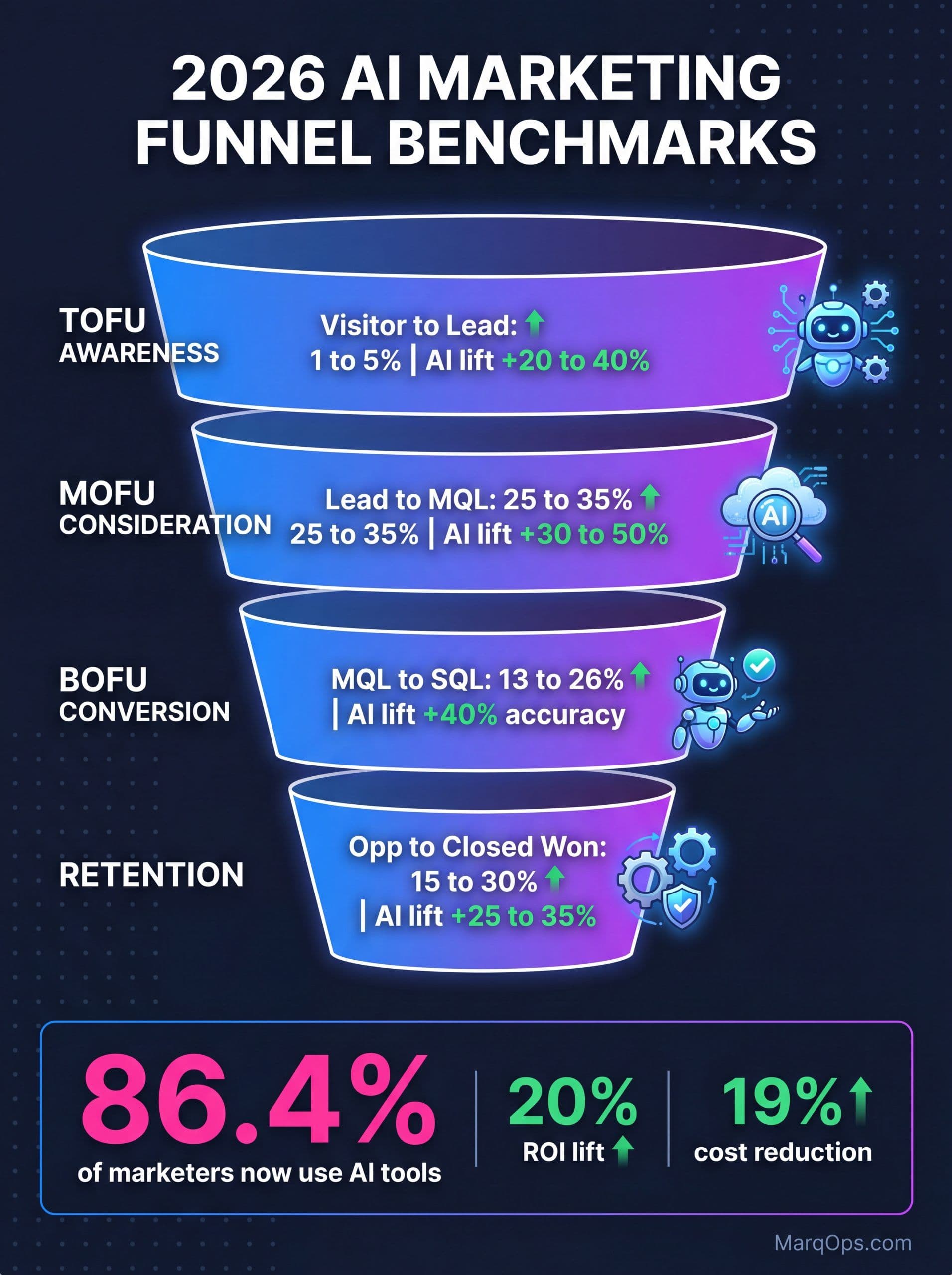
| Visitor to lead | 1 to 5% | 10%+ | +20 to 40% |
| Lead to MQL | 25 to 35% | 50%+ | +30 to 50% |
| MQL to SQL | 13 to 26% | 40%+ | +40% accuracy |
| SQL to opportunity | 50 to 62% | 75%+ | +15 to 25% |
| Opportunity to closed-won | 15 to 30% | 40%+ | +25 to 35% |
| Overall (visitor to customer, B2B) | 1 to 5% | 11%+ | Up to 2 to 3x |
The honest takeaway: AI does not magically double every step. It compounds. A modest lift at each stage produces an outsized lift on overall funnel conversion, which is why a unified AI funnel routinely outperforms a stack of point AI tools.
2026 marketing funnel benchmarks with AI lift potential at each stage
AI marketing funnel tools by stage
You can build a respectable AI funnel from point tools. Most teams start that way. The downside is integration debt: every tool needs a connector, every audience has to sync, every brand asset has to live in seven places. Here is the typical 2026 stack, organized by stage.
TOFU tools. Surfer, Clearscope, and MarqOps for AI SEO and AEO. Jasper, Copy.ai, and MarqOps for generative content. Google Performance Max, Meta Advantage+, and TikTok Smart+ for AI-driven paid. 6sense, Demandbase, and Bombora for intent data. Our roundup of best AI marketing tools in 2026 compares the major categories.
MOFU tools. HubSpot, Marketo, Customer.io, and ActiveCampaign for AI nurture. Drift, Intercom, and Lindy for conversational AI. Mutiny and Optimizely for AI personalization. Pecan AI for predictive scoring. See the marketing automation tools roundup for tradeoffs.
BOFU tools. Gong, Chorus, and Clari for conversation intelligence. Highspot, Seismic, and MarqOps for sales enablement. Walnut and Reprise for AI product tours. Common Room and Pocus for product-led signals.
Retention tools. Gainsight, ChurnZero, and Catalyst for CS. Pendo and Heap for in-product AI. UserGems and Champify for advocacy. The churn prediction guide covers how to instrument this part of the funnel.
One realistic constraint: every tool above is best-in-class for one slice. Stitch seven of them together and you get integration debt, conflicting brand voice, and analytics that never reconcile. The 2026 alternative is a unified, AI-native platform that handles creative production, SEO, ads, analytics, and brand intelligence under one roof. That is exactly the gap MarqOps fills, and we cover the consolidation logic in the AI-powered marketing platforms guide.
How to build your AI marketing funnel in 10 steps
This is the practical sequence, ordered the way successful teams actually roll it out.
Step 1. Map the current funnel. Diagram every stage, every channel feeding it, every tool, every handoff. Mark the leaks. You cannot improve what you cannot see.
Step 2. Codify your brand DNA. Before any AI generates content, document tone, voice, audience segments, value propositions, and visual style in a structure AI systems can consume. This is the single biggest determinant of whether AI output feels on-brand.
Step 3. Unify your data. AI funnels run on clean, joined data: web behavior, CRM activity, product usage, billing. If your data lives in five disconnected systems, the AI models will hallucinate or, worse, mislead.
Step 4. Pick your AI scoring model. Start with predictive lead scoring. It produces fast, measurable wins and trains the rest of the funnel on what good looks like.
Step 5. Layer in AI content production. Generate TOFU and MOFU content from briefs that include the codified brand DNA. Hold a human editor in the loop until the system earns trust.
Step 6. Deploy personalization. Start with the highest-traffic landing pages and the highest-volume nurture sequences. Add channel-specific personalization once the web and email lifts prove out.
Step 7. Add conversational AI. Deploy a chatbot trained on your sales playbook for high-intent pages. Measure demo book rate and response time. Iterate the script weekly.
Step 8. Connect retention and expansion. Feed product usage data back to marketing. That is what turns a one-time customer into a cohort you can grow.
Step 9. Instrument unified measurement. A funnel running on AI demands unified attribution. Layer multi-touch attribution and marketing mix modeling so every AI decision can be back-tested. See our multi-touch attribution guide and marketing mix modeling playbook.
Step 10. Review, retrain, repeat. AI models drift. Re-evaluate scoring accuracy, personalization lift, and chatbot conversion every quarter at minimum. Decommission what is not pulling its weight.
AI marketing funnel examples
Example 1: SaaS company with a content-heavy TOFU and weak MOFU
The before: high blog traffic, lots of ebooks downloaded, very few MQLs. The team had no structured nurture and no predictive scoring. The after: they clustered content into TOFU, MOFU, and BOFU buckets, added AI-personalized nurture triggered by engagement depth, and deployed predictive scoring to surface highest-intent leads. The result was a 3x increase in MQL volume without growing traffic, because the existing audience was finally being routed correctly.
Example 2: Ecommerce brand running Performance Max with stagnant ROAS
The before: blanket creative, generic landing pages, no segmentation. The after: a generative creative pipeline produced 40 ad variants weekly, each tied to a specific audience segment and dynamic landing page. AI-driven retargeting moved from “show the cart again” to “show the next product the buyer is statistically most likely to want.” ROAS lifted 35 percent in 60 days.
Example 3: B2B services firm replacing seven tools with one
The before: a CMS, an SEO tool, three content tools, two analytics platforms, and a separate ad manager. Outputs were inconsistent. Brand drifted. The after: a unified AI marketing platform handled creative, SEO, ads, analytics, and brand intelligence. Tool spend dropped 60 percent. Content velocity rose 6x. Most important, the brand voice held across every channel because one system enforced it.
Metrics to track at every stage
An AI funnel deserves better measurement than the old one. Here is what to instrument.
TOFU metrics. Qualified traffic by channel, AI search citations, branded search lift, MQL contribution by content piece, cost per qualified visitor. The classic “sessions” metric still appears, but only as input to the qualified rate.
MOFU metrics. MQL volume, MQL to SQL conversion, time in stage, content-attributed pipeline, chatbot conversion to demo, nurture engagement velocity.
BOFU metrics. SQL to opportunity rate, opportunity to closed-won rate, win rate by source, sales cycle length, deal size by lead source.
Retention metrics. Net revenue retention, gross retention, expansion rate, advocacy volume, churn prediction accuracy.
System metrics. AI model accuracy, prediction confidence, personalization lift, attribution coverage. Track these so you know which AI workload is actually paying off, and which is dead weight. See the AI marketing ROI guide for the measurement stack.
Common mistakes (and how to avoid them)
Mistake 1. Bolting AI onto a broken funnel. AI cannot fix bad positioning, weak content, or poor product-market fit. Diagnose first. Automate second.
Mistake 2. Treating AI as a content factory. Volume without strategy creates noise. AI works when it amplifies a clear plan, not when it substitutes for one.
Mistake 3. Ignoring brand drift. Every AI system has a voice. If you have not codified yours, the AI will average toward a generic one. Brand DNA inputs are non-negotiable.
Mistake 4. Disconnected data. AI predictions are only as good as the inputs. Siloed data produces siloed insights, which produce no real lift.
Mistake 5. Over-buying point tools. Seven AI tools that do not talk to each other is worse than three that do. Consolidation usually beats stitching.
Mistake 6. No human in the loop. AI handles scale. Humans handle judgment, edge cases, and brand stewardship. The teams getting the biggest lifts pair both, not either-or.
Mistake 7. Skipping the measurement layer. If you cannot prove AI is lifting funnel conversion, leadership will pull the budget. Build attribution from day one.
Unifying the funnel with MarqOps
The honest reason most AI marketing funnels underperform is not the AI. It is the stitching. Brand voice drifts across tools. Audience data lives in one place, creative in another, analytics in a third. The funnel runs, but every handoff loses signal.
MarqOps is built to fix that. One platform powers creative production, SEO and AEO content, paid ads orchestration, marketing analytics, and brand intelligence, with Brand DNA enforced at every step. The same system that generates a TOFU blog post knows the brand voice the MOFU email needs to match. The same dashboard that proves ROI also tells you which AI workload is paying off. That is what lets a small team replace seven or more disconnected tools and run an AI marketing funnel that compounds at every stage.
If you are weighing whether to assemble point tools or run on one unified system, the marketing tech stack guide walks through the tradeoffs in detail, and our AI-powered marketing platforms piece compares the unified-stack model directly against the stitched approach.
FAQs
What is an AI marketing funnel?
An AI marketing funnel is the buyer journey from awareness to retention, with machine learning, generative AI, and AI agents automating decisions at every stage. It dynamically scores intent, personalizes content, and routes high-intent buyers in real time instead of relying on static rules.
What are the stages of an AI marketing funnel?
The four core stages are awareness (TOFU), consideration (MOFU), conversion (BOFU), and retention. AI workloads are layered onto each stage: AI SEO and intent detection at TOFU, predictive scoring and dynamic nurture at MOFU, predictive conversion timing and sales enablement at BOFU, and churn prediction and next-best-offer in retention.
How is an AI marketing funnel different from a traditional marketing funnel?
A traditional funnel uses static segmentation and rules-based nurture. An AI funnel ingests signals continuously, makes real-time decisions on next-best content, channel, and timing, and learns from outcomes. Conversions typically improve 25 to 35 percent because each stage is personalized instead of generic.
What ROI can I expect from an AI marketing funnel?
Salesforce reports marketers deploying AI correctly see a 20 percent ROI lift and 19 percent cost reduction. 60 percent of marketers tracking AI ROI report at least 2x returns. Companies that also consolidate their tech stack around a unified AI platform often report 50 to 77 percent technology cost reductions on top of conversion gains.
What tools do I need to build an AI marketing funnel?
You need capabilities, not necessarily separate tools. Generative content, AI SEO and AEO, intent and signal data, predictive lead scoring, dynamic personalization, conversational AI, sales enablement, and unified attribution. These can come from seven separate platforms or, more practically, from a unified AI marketing platform like MarqOps that runs all of these under one Brand Intelligence DNA.
Will AI agents replace the marketing funnel?
Not entirely, but they will reshape it. Gartner predicts one in five purchases will be completed by an AI agent in 2026, and 60 percent of brands will use agentic AI for one-to-one interactions by 2028. Marketers should optimize content for machine-readability and agent engagement, while preserving the human touchpoints buyers still value at high-stakes decisions.
How long does it take to build an AI marketing funnel?
Most teams see meaningful wins in 30 to 90 days when they start with one high-impact layer (usually predictive lead scoring or AI nurture) and expand from there. A full transformation across all four stages typically takes 6 to 12 months, depending on data hygiene and how much existing tech debt needs unwinding.
How do I measure success of an AI marketing funnel?
Track funnel-stage conversion rates (visitor to lead, lead to MQL, MQL to SQL, SQL to closed-won), AI lift versus a control cohort, brand consistency scores, pipeline velocity, customer acquisition cost, and net revenue retention. Layer multi-touch attribution and marketing mix modeling so AI decisions can be back-tested over time.
Keep following the signal
Related field notes
Marketing Operations
Marketing Project Management Software in 2026: How to Choose Without Adding Tool #122
11 min readMarketing Analytics
Marketing Attribution Software in 2026: The Buyer's Guide for a Stack That Won't Stop Growing
11 min readMarketing Operations