Brand Management in 2026: The Complete Guide to Governance, Consistency, and AI-Scale Output
Brand management in 2026 is no longer about defending a style guide. It is about running a system that produces brand-correct output at a volume no review queue could ever clear. Here are the frameworks, metrics, and stack that make it work.

Brand Management in 2026: The Complete Guide to Governance, Consistency, and AI-Scale Output
Brand management used to be a quarterly exercise. You wrote the guidelines, you shipped the PDF, you policed the logo. A few people made most of the assets, and a small review team could realistically look at everything before it went out.
That model is dead. Not because brand stopped mattering, but because the volume of brand-carrying output exploded. Every marketer on your team now has a content generator on their desktop. Sales writes its own decks. Support writes its own macros. And a growing share of the audience never sees your site at all, because an AI assistant reads about you and summarizes you to the buyer in three sentences you did not write.
So brand management in 2026 is no longer about defending a style guide. It is about operating a system that produces brand-correct output by default, at a volume no human review queue could ever clear, across channels you do not own.
This guide covers what brand management actually is now, the frameworks that hold up under AI-scale volume, the metrics that matter, the tooling stack, and a 90-day plan to get from brand chaos to brand control.
TL;DR
- Brand management is now an operations discipline, not a design one. The job is running the system that produces brand-correct output, not reviewing output after the fact.
- Consistency pays. Consistent brand presentation is associated with revenue lifts in the 10 to 20 percent range, and roughly a third of companies report gains at the high end.
- Guidelines alone do not work. Around 95 percent of organizations have brand guidelines. Only a quarter to a third actively use them, and most teams still ship off-brand content anyway.
- AI broke the review queue. Output scaled faster than governance. The fix is machine-readable brand rules enforced at generation time, not a bigger approval bottleneck.
- Brand is now a search ranking input. Branded web mentions correlate with AI search citations at roughly 0.66. Brand consistency across independent sources is what makes an LLM confident enough to recommend you.
- Track four things: consistency rate, time to brand-approved asset, share of model, and brand-driven pipeline.
- MarqOps encodes your brand once as Brand Intelligence DNA, then applies it to every asset the platform generates, so consistency is a property of the system rather than a rule someone has to remember.
Table of Contents
- What Is Brand Management? A 2026 Definition
- Why the Old Brand Management Model Broke
- The Business Case: What Consistency Is Actually Worth
- The Five Pillars of Modern Brand Management
- Brand Governance: Guardrails Instead of Gatekeepers
- Brand Management for AI Search
- The Metrics That Actually Matter
- The Brand Management Tech Stack
- A 90-Day Brand Management Plan
- Seven Mistakes That Quietly Destroy Brands
- Frequently Asked Questions
What Is Brand Management? A 2026 Definition
Brand management is the practice of building and protecting how a market perceives your company, by controlling the signals that shape that perception across every channel, asset, and conversation.
The classic definition stopped at visual identity and messaging. That was fine when your brand touched the world through a handful of controlled surfaces. The modern definition has to account for three changes:
- Volume. Generative tools mean a five-person team can now ship the asset volume of a fifty-person team. The bottleneck moved from production to quality control.
- Distribution. Buyers form impressions inside ChatGPT, Gemini, Perplexity, and Google AI Overviews before they ever hit your site. Your brand gets summarized by a machine that never read your guidelines.
- Authorship. The people making brand-carrying assets are no longer the brand team. They are sellers, CSMs, partners, and AI agents.
Put those together and brand management becomes an operations problem. You are not curating a small number of assets. You are governing a high-throughput system, most of whose operators do not report to you and some of whom are not people.
The reframe: Brand management is no longer “does this asset match the guidelines?” It is “does our system make it hard to produce an asset that does not match the guidelines?” The first question scales linearly with headcount. The second one scales with software.
Brand management vs. branding vs. marketing
These get used interchangeably and it causes real confusion in planning meetings, so it is worth being precise:
- Branding is the act of defining the identity: positioning, name, visual system, voice, values. It is largely a project. You do it, then you revisit it every few years.
- Brand management is the ongoing operation of that identity: enforcing it, adapting it per channel, measuring its health, and defending it. It is a process, not a project.
- Marketing is the demand engine that uses the brand to drive awareness, pipeline, and revenue.
Branding writes the constitution. Brand management is the judiciary. Marketing is everything that happens in the economy underneath.
Why the Old Brand Management Model Broke
The traditional model relied on a chokepoint. Everything funneled through a small brand or creative team that reviewed assets before release. That worked because throughput was low enough for humans to inspect every item.
Generative AI removed the throughput ceiling without removing the review ceiling. The result is a queue that grows faster than it drains. Three failure modes follow.
1. The guidelines gap
Nearly every organization has brand guidelines. Very few organizations use them. Industry surveys consistently put guideline adoption at roughly 95 percent while active, day-to-day usage sits closer to 25 to 30 percent. The overwhelming majority of teams with documented guidelines still report shipping off-brand content.
The reason is mundane. A 60-page PDF is not a usable interface at the moment of creation. When a rep is building a deck at 11pm before a customer call, the guidelines lose to the deadline every single time. If your brand rules live in a document that someone has to remember to open, your brand rules are decorative.
2. Tone drift at scale
Large language models are trained to sound like the average of the internet, which is exactly the voice your brand is trying not to have. Left unconstrained, AI-generated copy converges on the same competent, forgettable register across every company in your category. You end up with output that is technically on-message and completely undifferentiated.
Tone drift is insidious because no single asset looks broken. Each one is fine. It is only when you read fifty of them together that you notice your brand has quietly dissolved into generic B2B mush. Solving this requires encoding voice as an explicit, machine-readable constraint. Our guide to building an AI brand voice that scales covers how to do that in practice.
3. The rework tax
The real cost of off-brand AI output is not the bad asset. It is the rework. Someone catches it, sends it back, it gets regenerated, it gets reviewed again. Teams that measure this find that the time saved on generation gets eaten by the time lost to correction, and the net productivity gain from AI approaches zero.
Worse, it corrodes trust. Once a team stops believing AI output is usable without heavy editing, they stop using it, and the investment strands. This is the quiet way AI marketing programs die.
The modern brand management stack: from static guidelines to an operating system that enforces brand at generation time.
The Business Case: What Consistency Is Actually Worth
Brand teams have historically struggled to defend budget because the value felt soft. It is measurably less soft than it used to be.
10 to 20%
Typical revenue lift attributed to consistent brand presentation, with a meaningful share of companies reporting gains above 30%
The most-cited research on this, originally from Lucidpress and repeatedly re-tested since, puts the average revenue increase from consistent brand presentation in the 10 to 20 percent band, with an upper bound around a third. Companies with documented, actively-enforced brand frameworks report year-over-year revenue growth in that range at more than double the rate of companies without them.
The mechanism is not mysterious. Consistency reduces the cognitive cost of recognizing you. A buyer who encounters the same voice, the same claims, and the same visual identity across an ad, a review site, a sales deck, and an AI answer builds confidence faster than one who encounters four different companies wearing the same logo. Recognition compounds. Inconsistency resets the counter.
Meanwhile, the C-suite has noticed. Marketing leaders now rank brand consistency as critical or highly important to growth at rates well above where they did a few years ago, and it repeatedly shows up as a top long-horizon ROI investment among CMOs at large enterprises.
The AI budget reality
Gartner’s 2026 CMO Spend Survey puts AI at 15.3 percent of the average marketing budget, rising to 21.3 percent among organizations Gartner classifies as AI-ready. But only about 30 percent of CMOs report mature AI readiness, while 70 percent say becoming an AI leader is a critical goal.
That gap is a brand management gap as much as a technology gap. Most teams are not blocked on model access. They are blocked on the governance layer that would let them trust the output enough to ship it without a human in the loop on every asset. If you want to see how that ties back to revenue reporting, our breakdown of measuring AI marketing ROI walks through the attribution side.
The Five Pillars of Modern Brand Management
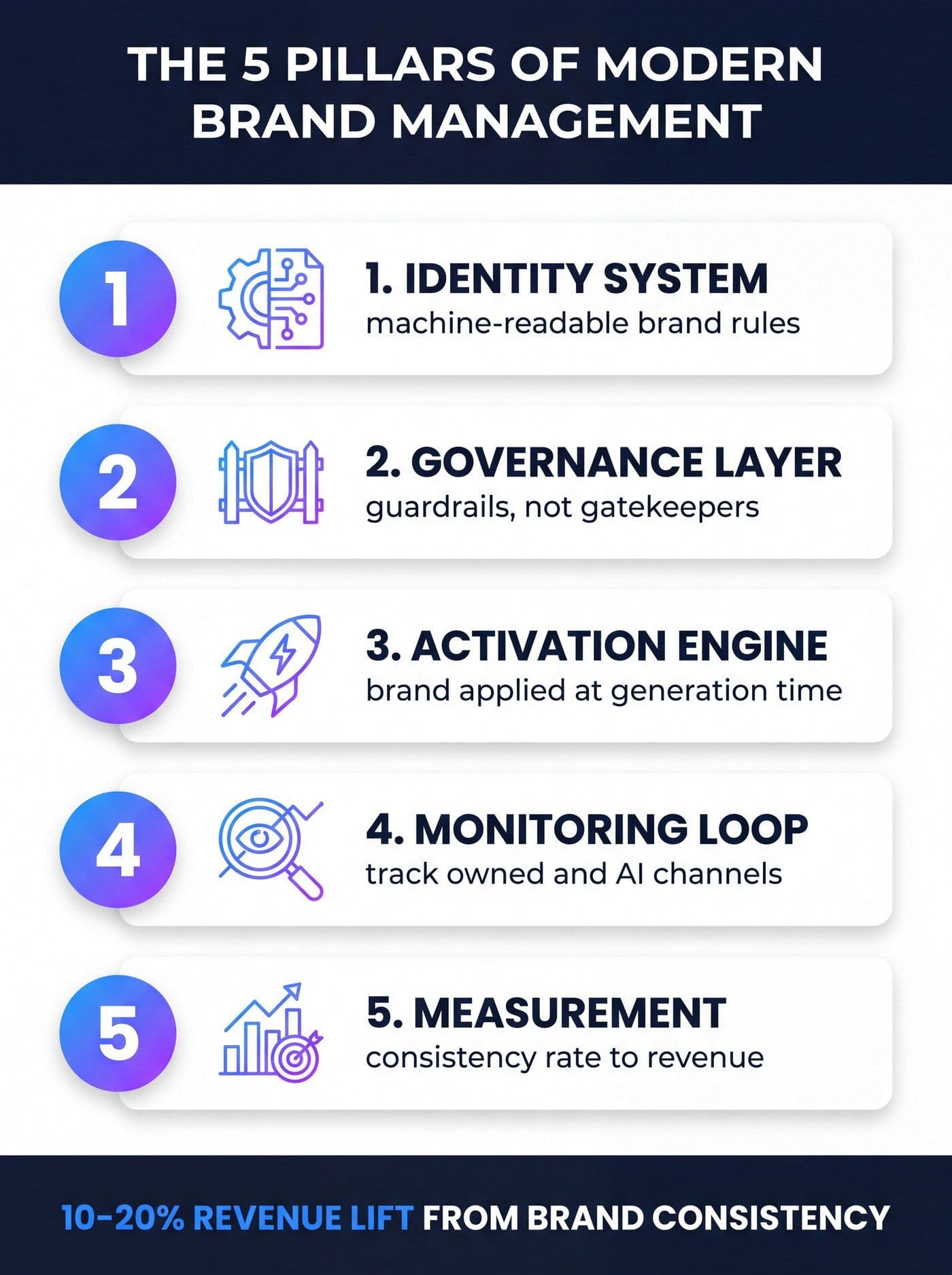
A brand management system that survives AI-scale volume rests on five pillars. Miss any one and the whole thing degrades.
Pillar 1: The identity system
This is the substrate: positioning, messaging hierarchy, voice attributes, visual system, and the claims you are and are not allowed to make. Nothing new in principle, but the format matters enormously now.
The rule for 2026 is that your identity system must be machine-readable. A PDF is a document. What you need is structured, queryable brand data: voice attributes with explicit do and do-not examples, approved and forbidden terminology, tone parameters per channel, hex values, logo rules with clearance space as numbers rather than pictures. If an AI system cannot parse it, it cannot enforce it. Start from a structured brand guidelines template built for this purpose rather than retrofitting a design deck.
Pillar 2: The governance layer
Governance is the set of rules that determine what can ship, who can ship it, and what gets checked automatically versus by a human. We will go deep on this below, because it is where most programs fail.
Pillar 3: The activation engine
This is what actually produces assets: content, creative, ads, sales collateral, social. The critical design decision is whether brand rules are applied during generation or after it.
Applying them after generation is a review queue, and review queues do not scale. Applying them during generation means the model is constrained by your brand before it writes the first word, which is the only approach that survives volume. This is precisely the problem creative automation is built to solve on the visual side, and the same logic applies to copy.
Pillar 4: The monitoring loop
You cannot manage what you cannot see. Monitoring covers both owned channels (is what we shipped on brand?) and unowned ones (what is the market, and what are the models, saying about us?). Traditional social listening tools handle the human side. The machine side needs AI brand monitoring that tracks how you are represented inside LLM answers.
Pillar 5: Measurement
Brand health has to connect to a number a CFO recognizes. Covered in the metrics section below.
Brand Governance: Guardrails Instead of Gatekeepers
Brand governance is the framework that decides how brand rules get enforced. The strategic choice is between two models, and most companies are still running the wrong one.
The gatekeeper model (broken)
A central team reviews assets before release. Quality is high. Throughput is low. As volume rises, the queue lengthens, teams start routing around it, and shadow content proliferates. The gatekeeper model does not prevent off-brand content at scale. It just makes off-brand content invisible to the brand team.
The guardrail model (works)
Brand rules are encoded into the tools people use, so that producing an off-brand asset requires deliberate effort. Humans review the high-stakes exceptions. Everything else is enforced automatically.
Concretely, a guardrail system does four things:
- Constrains generation. Brand voice, terminology, and visual rules are injected into every prompt and every template, so the first draft is already close to correct.
- Validates automatically. Before an asset ships, it is checked against brand rules: forbidden terms, off-palette colors, tone drift, unapproved claims, logo misuse.
- Tiers approval by risk. A social reply does not need the same review as a category-defining campaign. Route by consequence, not by habit.
- Learns from corrections. Every human edit is a training signal. If reviewers keep fixing the same thing, the rule was wrong or missing, and the system should absorb it.
The payoff: Teams that move from gatekeeping to guardrails typically report dramatically faster approval cycles, because the majority of assets stop needing a human approval step at all. The review team’s job shifts from inspecting everything to handling exceptions and improving the rules.
Where brand governance usually goes wrong
Two failure patterns dominate. The first is governance theater: a beautiful framework document that nobody operationalizes, which is just the guidelines gap wearing a new hat. The second is over-locking: rules so rigid that teams cannot adapt to channel context, so they abandon the system entirely and go rogue.
The calibration test is simple. If your brand system makes the right thing the easy thing, it is working. If doing it right takes longer than doing it wrong, your team will do it wrong, and no amount of policy will change that.
Brand Management for AI Search
This is the newest and least understood part of the discipline, and it is quietly becoming the most important.
When a buyer asks an AI assistant to recommend a vendor in your category, the model synthesizes an answer from what it has read about you across the open web. You do not control that answer. But you heavily influence it, and the levers are brand levers, not just SEO levers.
Brand signals drive AI citations
Analysis of AI search citation factors across tens of thousands of brands has found that the strongest correlations with AI visibility are off-site brand signals rather than classic on-page SEO factors. Branded web mentions correlate at roughly 0.66, branded anchor text around 0.53, and brand search volume in the 0.33 to 0.39 range. Mentions on high-authority video platforms correlate even more strongly.
Read that carefully, because it inverts a decade of assumptions. The thing that gets you cited by an LLM is not primarily how well you optimized your page. It is how often and how consistently the rest of the internet talks about you in a way the model can corroborate.
Why consistency is a ranking input: An LLM builds confidence by corroboration. When it finds the same description of you on your site, on review platforms, in press coverage, and in third-party roundups, that agreement reads as reliability, and it is more willing to state your claim as fact. When your positioning contradicts itself across sources, the model hedges, or picks the competitor whose story is coherent.
What to actually do about it
- Standardize your boilerplate everywhere. One canonical description of what you do, what category you are in, and who you serve. Same on your site, your directory listings, your press releases, your partner pages, your executives’ bios.
- Earn mentions, not just links. An unlinked brand mention in a credible source still feeds the model. Digital PR is now a brand management channel.
- Structure your content for extraction. Clear headings, direct answers, and schema markup make you easier to quote. Our guides to answer engine optimization and how GEO differs from SEO break this down.
- Monitor continuously, not annually. Roughly two-thirds of cited sources churn between observations, so a one-time audit is stale almost immediately. Track your AI visibility as a live metric.
The Metrics That Actually Matter
Most brand dashboards measure activity. Measure these four instead.
1. Brand consistency rate
The percentage of shipped assets that pass automated brand validation on the first attempt. This is your single best leading indicator, because it tells you whether the system is working or whether humans are just catching things downstream. If it is below 80 percent, your guardrails are too weak or your rules are too vague.
2. Time to brand-approved asset
Median hours from request to approved, shippable asset. This is the number that proves brand management is an accelerator rather than a tax. When governance is done well, this number drops sharply, because most assets stop needing review at all.
3. Share of model
How often your brand appears as the recommended answer in AI-generated responses for your category’s key prompts. Share of model is the successor to share of voice. Share of voice measured mentions across media. Share of model measures recommendation across the systems buyers now actually ask.
4. Brand-driven pipeline
Pipeline sourced from branded search, direct, and AI-assistant referral, as distinct from paid acquisition. This is the metric that survives contact with a CFO, because it isolates the demand your brand generates rather than the demand you rented.
0.66
Correlation between branded web mentions and AI search visibility, the strongest single signal studied
The Brand Management Tech Stack
The category has historically been fragmented across tools that each own one slice:
- Digital asset management (DAM): stores and serves approved assets. Solves retrieval, not creation.
- Brand portals: publish the guidelines. Solves distribution of rules, not enforcement.
- Templating tools: lock layouts so non-designers cannot break them. Solves visual drift, not voice drift.
- Content generation tools: produce copy fast. Usually brand-blind unless heavily prompted.
- Monitoring tools: tell you what people say. Usually disconnected from what you produce.
The problem with assembling these separately is that your brand definition ends up duplicated across five systems that do not agree with each other, and every update means five migrations. This is the same tool-sprawl trap we mapped in the marketing tech stack guide, and brand is where it hurts most, because brand is precisely the layer that is supposed to be shared.
The unified alternative
The architecture that works is one where the brand is defined once, centrally, and every downstream system reads from that definition rather than keeping its own copy.
This is the premise behind MarqOps. You encode your brand once as Brand Intelligence DNA: voice, tone, terminology, visual rules, positioning, forbidden claims. That definition then governs every asset the platform produces, whether it is a blog post, an ad variant, a landing page, or a sales one-pager. Consistency becomes a property of the system rather than a rule someone has to remember at 11pm. In practice, this is what replaces seven disconnected tools with a single brand-aware layer, and it is why teams using it report content output several times faster without the usual rework tax.
A 90-Day Brand Management Plan
If you are starting from brand chaos, here is the sequence that gets you to control fastest.
Days 1 to 30: Audit and encode
- Run a consistency audit. Pull the last 50 assets your company shipped across every team. Score each against your current guidelines. The number will be worse than you expect, and that number is your baseline.
- Find the shadow content. Ask sales and CS what they actually send customers. This is where brands rot invisibly.
- Convert guidelines into structured data. Rewrite your brand rules as explicit, machine-readable constraints with concrete examples of correct and incorrect usage. This is the single highest-leverage week of the whole plan.
- Standardize your boilerplate and push it to every third-party surface you control.
Days 31 to 60: Guardrail and activate
- Wire brand rules into the generation layer so first drafts start on-brand rather than getting corrected into it.
- Build automated validation for the checks that do not need judgment: terminology, palette, claims, logo, tone.
- Tier your approvals by risk and explicitly release the low-risk tier from human review.
- Arm the teams outside marketing. Sales is the biggest source of off-brand output in most companies and the easiest to fix. See AI sales enablement for the mechanics.
Days 61 to 90: Monitor and prove
- Instrument the four metrics above and set a baseline for each.
- Turn on AI visibility monitoring so you can see how models describe you, and catch it when they get you wrong.
- Scale output deliberately. With guardrails in place, volume is now safe to increase. This is the point where content repurposing becomes a multiplier instead of a liability.
- Report consistency rate and brand-driven pipeline to the exec team. Prove the system is an accelerator.
Seven Mistakes That Quietly Destroy Brands
- Treating guidelines as the deliverable. The document is not the system. Adoption is the system.
- Reviewing everything. Universal review guarantees a backlog and trains your team to route around you.
- Ignoring what sales sends. The highest-stakes brand assets in most companies are decks the brand team has never seen.
- Letting AI write unconstrained. Unconstrained models converge on generic. Generic is the opposite of a brand.
- Optimizing pages while ignoring mentions. In AI search, off-site brand signals outweigh on-page tuning. Do both, but do not confuse effort with impact.
- Measuring activity instead of consistency. Assets shipped is a vanity metric. Assets shipped correctly is a real one.
- Duplicating the brand definition across tools. Five copies of your brand means five brands. Define it once and let everything read from it.
The bottom line: Brand management in 2026 is won by the teams who stop trying to inspect their way to consistency and start engineering it in. The brands that get recommended by AI, recognized by buyers, and trusted at scale will be the ones whose brand rules live inside their production system rather than inside a PDF nobody opens.
Frequently Asked Questions
What is brand management in simple terms?
Brand management is the ongoing work of shaping and protecting how people perceive your company. It covers defining your identity (voice, visuals, positioning), enforcing it consistently everywhere your brand shows up, monitoring how the market and AI systems describe you, and measuring whether all of that is driving recognition and revenue.
What is the difference between branding and brand management?
Branding is the project of defining the identity: the name, positioning, voice, and visual system. Brand management is the ongoing operation of that identity: enforcing it across teams and channels, adapting it per context, monitoring it, and measuring its health. Branding is what you build. Brand management is how you run it.
Does brand consistency actually increase revenue?
The research consistently points to a revenue lift in the 10 to 20 percent range for companies with consistent brand presentation, with a meaningful share reporting gains above 30 percent. The mechanism is recognition: consistent signals lower the cognitive cost of identifying and trusting you, which compounds across every touchpoint in a buying cycle.
How does AI change brand management?
In two ways. First, it removes the ceiling on content production, which breaks any brand system that depends on humans reviewing every asset. Second, it inserts itself between you and the buyer: assistants like ChatGPT and Gemini now summarize your brand to prospects who never visit your site. Both changes push brand management from a review discipline toward an engineering one, where rules are enforced at generation time and brand signals are optimized for machine corroboration.
What is brand governance?
Brand governance is the framework that determines how brand rules get enforced: what can ship, who can ship it, what gets checked automatically, and what needs human judgment. Modern governance favors guardrails (rules encoded into the tools people use) over gatekeepers (a central team reviewing everything), because only guardrails scale with AI-era output volume.
What tools do you need for brand management?
Traditionally: a DAM for assets, a brand portal for guidelines, templating tools for layouts, generation tools for content, and monitoring tools for reputation. The problem is that stitching them together duplicates your brand definition across five systems that drift apart. The better architecture defines the brand once and has every downstream system read from that single definition, which is the approach MarqOps takes with Brand Intelligence DNA.
How do you measure brand management performance?
Track four metrics: brand consistency rate (percentage of assets passing brand validation on first attempt), time to brand-approved asset (proving governance accelerates rather than blocks), share of model (how often AI assistants recommend you for category prompts), and brand-driven pipeline (revenue from branded search, direct, and AI referral). Together they connect brand work to a number the CFO recognizes.
Why do brand guidelines fail?
Because a PDF is not an interface. Roughly 95 percent of organizations have guidelines but only a quarter to a third actively use them. At the moment of creation, under deadline, nobody opens a 60-page document. Guidelines only work when they are converted into machine-readable rules enforced inside the tools where assets are actually made.
Run Your Brand as a System, Not a Style Guide
The teams winning at brand management in 2026 are not the ones with the most beautiful guidelines. They are the ones whose brand is impossible to get wrong, because the system will not let you.
MarqOps encodes your brand once and applies it to everything: content, creative, ads, and SEO, in one unified platform with a marketing operations layer that replaces the tool sprawl underneath. Brand-perfect output from the first draft, not the fifth revision.
Keep following the signal
Related field notes
Marketing Operations
Marketing Project Management Software in 2026: How to Choose Without Adding Tool #122
11 min readMarketing Analytics
Marketing Attribution Software in 2026: The Buyer's Guide for a Stack That Won't Stop Growing
11 min readMarketing Operations