Marketing Calendar 2026: How to Build One That Survives the Year
Most marketing calendars are abandoned by Q2, and the cause is structural rather than a lack of discipline. Teams plan publish dates instead of production runways, leave the 4.8-day approval cycle invisible, and book capacity to 100% with no slack for reactive work. This guide covers the three planning horizons, the eight fields every calendar row needs, how to choose between a spreadsheet and a platform, where AI agents genuinely help, and the four operational metrics that tell you whether the calendar itself is working.
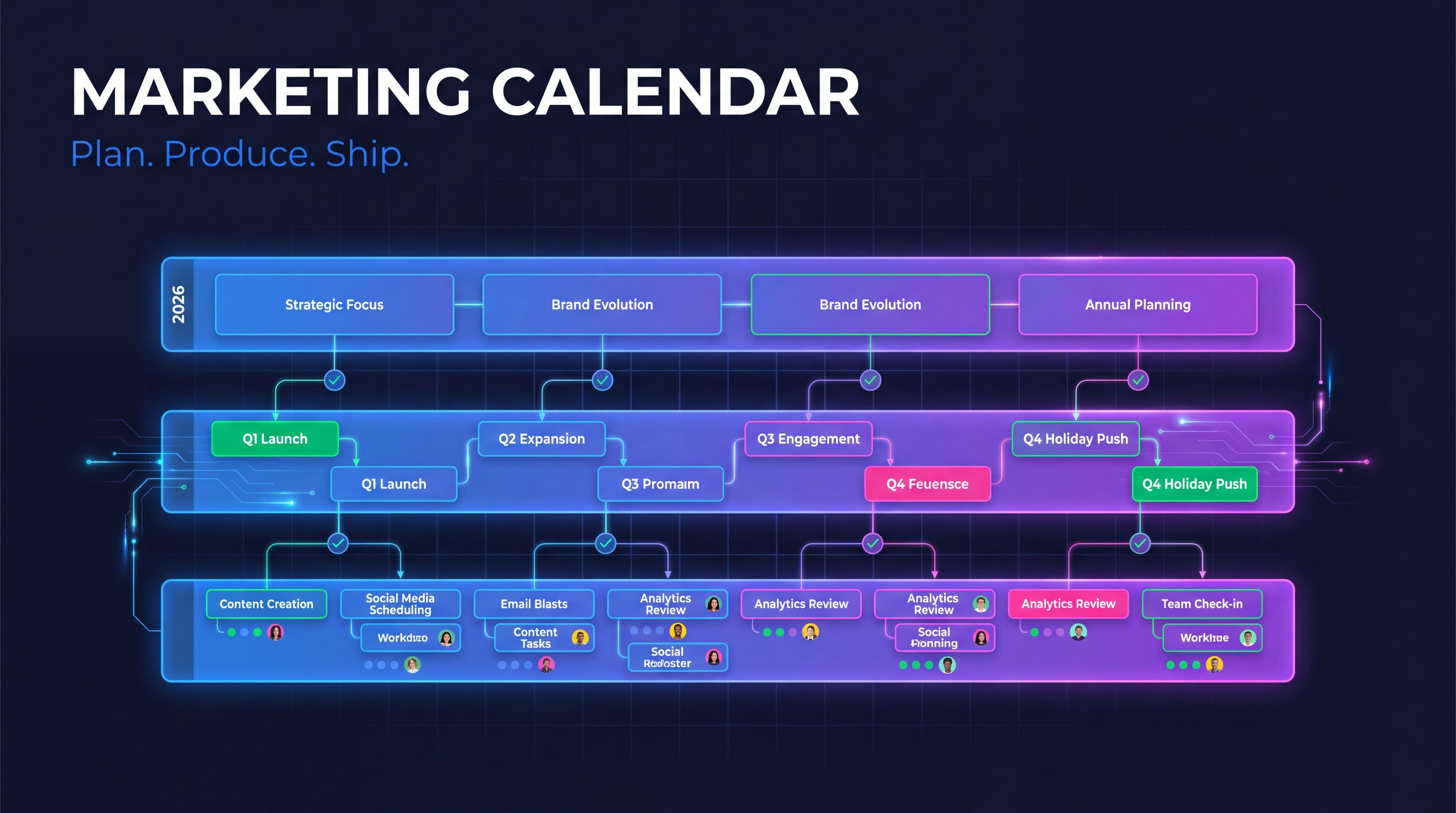
Almost every marketing team has a calendar. Far fewer have one they are still using in October. The pattern is so consistent it has become a running joke in marketing operations: a beautifully built annual plan gets approved in December, survives contact with Q1, starts drifting in March, and by summer the real schedule lives in three Slack threads, someone's Notion page, and a shared inbox.
The numbers behind that drift are worse than most leaders realize. A 2026 Sopro study found 41% of marketers report campaign cycles taking 30 days or longer, a figure that has gone up rather than down despite near-universal AI adoption. The average campaign now takes five to eight weeks and roughly 47 discrete steps to get out the door. Meanwhile Gartner's marketing technology research puts stack utilization at 33% of purchased capability, down from 42% in 2022 and 58% in 2020. Teams are not short of tools or intent. They are short of a single place where the plan, the work, and the outcome are the same object. That is what a marketing calendar is supposed to be, and it is why the format matters far more than the template you download.
Table of Contents
- What a Marketing Calendar Actually Is
- Why Most Marketing Calendars Are Abandoned by Q2
- The Anatomy of a Calendar That Holds Up
- The Three Planning Horizons
- Format: Spreadsheet, Project Tool, or Platform
- Building Your Marketing Calendar in 30 Days
- Setting Cadence Without Burning the Team
- Where AI and Agents Actually Fit
- Measuring Whether the Calendar Is Working
- Mistakes That Kill Calendars
- Frequently Asked Questions
- The Bottom Line
What a Marketing Calendar Actually Is
Ask ten marketers to define a marketing calendar and you will get two different answers. One group describes a publishing schedule: dates, channels, and what goes out when. The other describes a planning artifact: campaigns, budgets, and the themes the year is organized around. Both are partially right, and the gap between them is where most calendars quietly fail.
A marketing calendar is best understood as a commitment ledger. It records what the team has promised to ship, who owns each promise, what that promise depends on, and what it is expected to produce. The dates are the least interesting part. A calendar that only holds dates is a schedule, and schedules do not survive changes in priority because they carry no information about trade-offs. When something urgent arrives, nobody can see what it displaces.
The distinction matters practically. A content marketing calendar that lists "blog post, Tuesday" tells you nothing about whether it can move. The same row with an owner, a dependency on a product screenshot, a target keyword cluster, and a link to the quarter's pipeline goal tells you exactly what happens if it slips. This is the difference between a marketing calendar and a marketing plan on a grid, and it is why calendars built inside a broader marketing operations practice tend to outlive the ones built in isolation.
Why Most Marketing Calendars Are Abandoned by Q2
Calendar abandonment is rarely a discipline problem. It is usually a design problem, and the same four causes show up repeatedly.
The calendar plans publish dates instead of production runways. If the average campaign takes five to eight weeks and 47 steps to launch, then a calendar entry that says "campaign live March 12" is describing the last day of a process it does not model. The moment one upstream step slips, the date becomes fiction, and once a few dates are fiction the whole artifact loses authority. Teams stop trusting it, and a calendar nobody trusts is a calendar nobody updates.
Approvals are invisible. This is the most underrated cause. Creative approval cycles average 4.8 business days per campaign, and 64% of media buyers report that launches slip past deadline because of manual approval steps rather than platform limitations or creative delays. A further 42% of delays trace back to stakeholder feedback that arrives late or contradicts earlier feedback. None of that appears on a typical calendar, which means the calendar is systematically optimistic by about a week per campaign. Modeling approval as a real step with a real owner is one of the highest-leverage changes a team can make, and it pairs naturally with marketing workflow automation that routes reviews rather than waiting on someone to chase them.
The plan has no slack. Channel performance decays inside roughly 90 days, which means any annual plan booked to 100% capacity is guaranteeing that every genuinely good idea arriving in March has to displace something by force. Teams that reserve 15 to 20% of calendar space and budget for opportunistic work absorb change without renegotiating the whole quarter.
The calendar lives apart from the work. When the plan sits in one tool and the execution sits in five others, updating the plan is unpaid administrative overhead, and unpaid overhead gets skipped. This is the fragmentation problem in miniature. The average enterprise now runs 91 martech tools and actively uses fewer than 40% of them, while 65.7% of organizations name data integration as their single biggest stack challenge, far ahead of cost at 18.4% or skills gaps at 12.9%. Every additional handoff between systems is another place the calendar goes stale.
That last figure is the one worth sitting with. The advantage of a consolidated marketing tech stack is not licence savings. It is that the plan and the work stop being separate objects that someone has to reconcile by hand.
The Anatomy of a Calendar That Holds Up
Most marketing calendar templates give you date, title, channel, and status. That is enough to look organized and not enough to make decisions. The fields below are the ones that earn their place, tested against the question of whether they help you re-plan under pressure.
| Field | Why it earns a column | Common failure without it |
|---|---|---|
| Single named owner | Accountability concentrates decisions and unblocks faster | Shared ownership becomes no ownership |
| Go-live date and start date | Exposes the production runway, not just the deadline | Every slip is discovered in the final week |
| Approval owner and SLA | Makes the 4.8-day review cycle visible and plannable | Silent buffer erosion on every campaign |
| Dependencies | Shows what a change costs before you make it | Pulling one item forward quietly breaks three others |
| Channel and asset list | Reveals when one designer is the bottleneck for six items | Capacity is planned per campaign, not per person |
| Linked goal or KPI | Ties activity to the outcome it is meant to move | Busy quarters that produce nothing measurable |
| Priority tier | Pre-agrees what gets cut when capacity drops | Cuts get made by whoever shouts loudest |
| Status and last-updated | Signals staleness before the team stops trusting it | The calendar rots invisibly |
Two of these deserve emphasis. Priority tier is the field teams most often skip and most often regret, because it converts a painful mid-quarter negotiation into a decision that was already made calmly in advance. And linking each row to a specific goal is what keeps a calendar honest. If you cannot connect a campaign to a number you track in your marketing dashboard, that is worth knowing before you build the assets rather than after.
The Three Planning Horizons
The single most common structural mistake is trying to run one calendar at one level of detail. Annual plans are too coarse to execute against and weekly plans are too fine to steer with. The CMO Survey's 2026 data found that 71% of marketing leaders consider agility key to success, but scored their organizations only 4.8 out of 7 on building the capabilities that actually enable it. The gap is usually structural, and separating horizons closes a good part of it.
| Horizon | Timeframe | What it holds | Review cadence |
|---|---|---|---|
| Theme layer | 12 months | Strategic themes, launches, fixed dates, budget envelopes | Quarterly re-forecast |
| Committed layer | Next quarter | Named campaigns, owners, budgets, target metrics | Monthly |
| Production layer | 2 to 6 weeks | Assets, approvals, dependencies, publish slots | Weekly |
Notice that only the theme layer is annual, and it is deliberately thin. It holds the things that genuinely cannot move, such as a product launch, a conference, a fiscal deadline, plus the themes each quarter is organized around. Everything else stays uncommitted until the quarter opens.
The research on planning cadence is interestingly counterintuitive here. Top-performing teams tend to hold an annual plan and re-forecast quarterly, while average performers are more likely to run continuous rolling quarterly objectives. Constant replanning feels agile and often is not, because it removes the stable reference point that makes trade-offs legible. Agility comes from having reserved capacity and clear priority tiers inside a stable frame, not from having no frame. Teams running deliberate marketing orchestration across channels usually land on some version of this three-layer split independently.
Practical timing: draft the annual theme layer eight to ten weeks before your fiscal year starts, and lock approval before the year opens. Trying to get an annual plan approved in January costs you most of Q1.
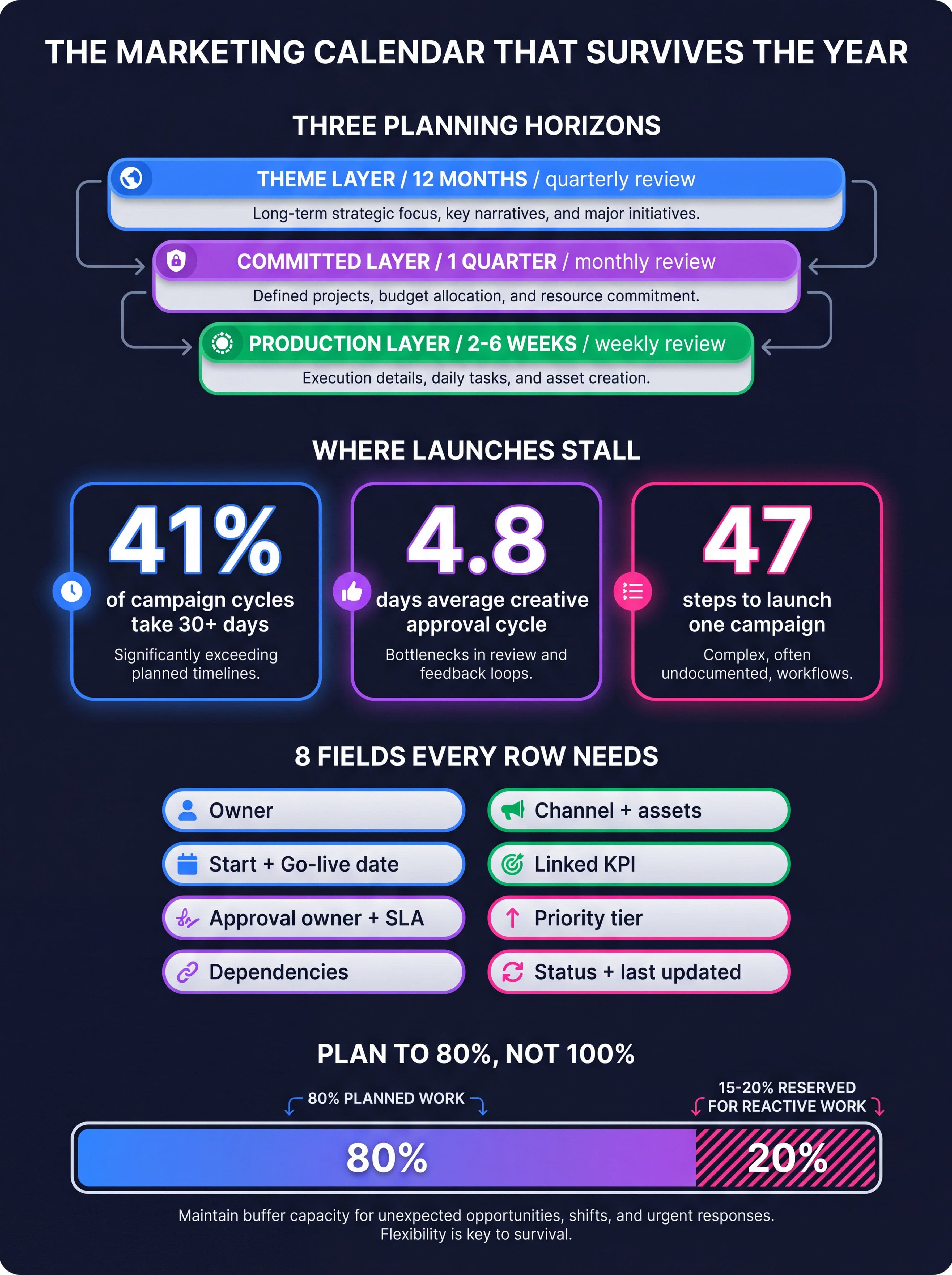
The three-horizon marketing calendar model and the execution bottlenecks it is designed to expose.
Format: Spreadsheet, Project Tool, or Platform
The marketing calendar format question generates more debate than it deserves, largely because the honest answer depends on team size and how much of your execution already lives in one place. All three formats work. They fail differently.
| Format | Works well when | Breaks when |
|---|---|---|
| Spreadsheet (Excel or Sheets) | Under 5 marketers, few channels, planning is mostly sequencing | Dependencies matter, or more than three people edit weekly |
| Project management tool | Work is already tracked there and approvals route through it | Campaign performance data lives somewhere else entirely |
| Dedicated marketing calendar software | Multiple channels and stakeholders need one shared view | It becomes an eleventh tool nobody updates |
| Unified marketing platform | Planning, production and reporting can share one system of record | The team is too small to justify consolidation |
A marketing calendar Excel template is genuinely fine for a small team, and there is no virtue in outgrowing it early. The signal that you have outgrown it is specific: when someone has to manually reconcile the calendar against what actually shipped, you are now paying a recurring tax that a connected system removes. That reconciliation cost is exactly where fragmentation bites, since roughly 45% of content production time already goes to information retrieval, context reconstruction and administrative overhead rather than creative work or review.
This is the problem MarqOps was built around. When planning, creative production, SEO content, ads and analytics run on one system with shared brand context, the calendar stops being a separate document that describes the work and becomes the interface to the work itself. There is nothing to reconcile because there is only one record. Whether you get there through consolidation or through disciplined integration matters less than getting there, but the reconciliation tax is real and it compounds quietly.
Building Your Marketing Calendar in 30 Days
You do not need a quarter to stand this up. A focused month is enough, and starting mid-year is fine.
Week 1: Establish the fixed points and the baseline
List everything that genuinely cannot move over the next 12 months. Product launches, funding announcements, conferences, seasonal peaks, fiscal deadlines, compliance dates. This is usually a much shorter list than people expect, which is the point. Then run a quick content audit so you know what already exists, what is performing, and what can be refreshed rather than rebuilt. Refreshing an existing asset is consistently cheaper than commissioning a new one, and it belongs on the calendar as real planned work rather than filler.
Week 2: Set the goals each quarter has to move
Attach each quarter to one or two outcomes, not eight. Pipeline contribution, qualified demand, share of search, retention, whichever genuinely matters this year. Then define how you will know, using the marketing KPIs you already report on rather than inventing new ones for the calendar. If a proposed campaign cannot be tied to one of these, it goes in a parking lot rather than the calendar.
Week 3: Map real capacity, including approvals
Count the working days available per person, subtract holidays and known leave, and subtract a realistic allowance for the unplanned work that arrives every quarter. Then add approval steps as explicit line items with named owners and agreed turnaround times. Most teams discover here that they have been planning about 130% of their actual capacity, which explains a great deal about how the last two years went.
Week 4: Load the quarter, reserve the slack, publish the view
Fill the committed layer for the coming quarter only, to about 80 to 85% of capacity. Assign a priority tier to every item so the cut list already exists. Leave the remaining months at theme level. Then make the calendar visible to everyone who touches marketing, including sales and product, and agree a single weekly moment where it gets updated. A calendar that is updated in one place at one time stays alive. One that depends on everyone updating it continuously does not.
Setting Cadence Without Burning the Team
Cadence is where ambition meets arithmetic. The instinct when building a marketing content calendar is to fill every slot, because empty slots look like underperformance. They are not. They are the capacity that lets you respond to a competitor launch or a search algorithm change without canceling something you promised.
The evidence on frequency is fairly consistent and mildly deflating: publishing twice a week sustainably produces better long-term results than publishing five times a week in bursts. Consistency compounds because it builds the topical depth and audience expectation that both search engines and readers reward. Volume without consistency mostly produces a spike and a gap. If you are working toward topical authority in a subject area, the steady cadence is doing more work than the peak output.
Three rules that hold up in practice:
- Plan to 80% of capacity, never 100%. The final 20% is not spare, it is the thing that makes the other 80% deliverable.
- Batch by production type, not by campaign. Writing four pieces in one block is faster than writing four pieces across four contexts, because context reconstruction is the hidden cost in that 45% overhead figure.
- Give every recurring slot a standing owner. Rotating ownership on recurring work reliably produces the lowest-quality output on the calendar.
A well-run content supply chain makes cadence a property of the system rather than a test of individual willpower, which matters more as the team grows.
Where AI and Agents Actually Fit
The temptation is to point AI at the calendar and ask it to plan the quarter. That is close to the least useful application. Planning is a judgement task with heavy internal context, and the quality ceiling is set by knowing your market rather than by generation speed.
The seams are where AI pays. Drafting variants once a concept is approved. Assembling briefs from existing research. Localizing and resizing assets across channels. Summarizing performance into the review meeting so the meeting starts with a shared picture rather than building one. These are all coordination and production tasks, and coordination is roughly 25% of total production time.
The current adoption data suggests most teams are only using part of this. 91% of marketing teams now use AI somewhere in their workflow, but only 26% apply it to governance and oversight, which is precisely where calendars drift. Gartner expects 40% of enterprise applications to embed task-specific agents by the end of 2026, an eightfold increase on 2025, and roughly 34% of enterprise teams currently run autonomous agents in production while another 56% are piloting without deploying.
The failure data is instructive if you are considering AI agents for marketing. Around 29% of attempted agent deployments are abandoned inside 90 days, and the top causes are unclear success criteria at 41% of failures, poor tool or data access at 33%, and brand-voice drift leaking into customer-facing output at 19%. All three are calendar-adjacent problems. An agent without a defined success criterion is an agent without a linked KPI. An agent without data access is an agent that cannot see the plan. And brand-voice drift is what happens when generation is disconnected from the brand system, which is why grounding automated production in explicit brand rules rather than prompt instructions is not a nice-to-have. Teams using creative automation with a defined brand layer see markedly less of this than teams generating asset by asset.
Measuring Whether the Calendar Is Working
Campaign performance tells you whether the marketing worked. It does not tell you whether the calendar worked. Those are separate questions and conflating them is why calendar quality rarely improves.
Four operational measures are enough:
- Plan adherence. The share of committed items that shipped in the quarter they were committed to. Below 70% means the calendar is aspirational rather than operational.
- Cycle time. Days from brief approved to live. This is the number that shows whether process changes are working, and against a 5 to 8 week baseline there is usually a lot of room.
- Approval latency. Days spent waiting in review. Tracked separately because it is the largest controllable delay and the easiest to fix once it is visible.
- Reactive ratio. The share of shipped work that was not on the plan. Near zero suggests the team is rigid. Above 40% suggests planning is not being taken seriously. Somewhere in between is healthy.
Review these quarterly alongside outcome metrics. Plan adherence rising while pipeline stays flat is a useful signal that the team is executing well against the wrong plan, and that is a much easier problem to fix than not knowing which one you have. Pairing operational measures with marketing analytics on the outcome side is what makes that diagnosis possible.
Mistakes That Kill Calendars
Building 12 months of detail. Detail past the current quarter is nearly always wasted, because it will be rewritten before it is executed. Keep the outer months thematic.
Treating the calendar as a status report. If its main function is to show leadership that the team is busy, it will optimize for looking full rather than being accurate, and accuracy is the entire value.
Planning channels in isolation. Separate calendars for content, email, paid and social guarantee that four teams compete for the same design resource in the same week and nobody sees it until it happens.
Ignoring the approval layer. Worth repeating because it is the most common single cause of slippage. If approvals are not on the calendar with named owners and turnaround times, every campaign carries a hidden week.
No cut list. Capacity will drop at some point every quarter. Deciding in advance what gets cut, via priority tiers, converts a stressful negotiation into a routine one.
Letting the calendar drift from the work. The moment updating the plan becomes separate manual admin, it stops happening. Whatever tooling you choose, the update has to be a byproduct of doing the work rather than an additional task.
Frequently Asked Questions
What should be in a marketing calendar?
At minimum: a single named owner, both a start date and a go-live date, channel, required assets, dependencies, an approval owner with a turnaround time, a linked goal or KPI, a priority tier, and a status with a last-updated stamp. The date-only version looks organized but cannot support decisions when priorities change.
How far ahead should a marketing calendar be planned?
Use three horizons. Twelve months at theme level covering only fixed dates and strategic themes, one quarter at committed level with owners and budgets, and two to six weeks at production level with assets and approvals. Draft the annual theme layer eight to ten weeks before the fiscal year begins so it is approved before the year opens.
What is the difference between a marketing calendar and a content calendar?
A content calendar covers what gets published and when, usually across owned channels. A marketing calendar is broader, covering campaigns, paid media, events, launches, email and budget alongside content. Most teams need both, with the content calendar as a view inside the marketing calendar rather than a separate document.
Is a marketing calendar Excel template good enough?
For a team of fewer than five marketers with a small number of channels, yes. Spreadsheets break down when dependencies matter, when more than three people edit weekly, or when someone has to manually reconcile the plan against what actually shipped. That reconciliation work is the signal it is time to move.
How much of the calendar should be left empty?
Reserve 15 to 20% of both calendar space and budget for reactive work. Channel performance decays within about 90 days, so a fully booked plan cannot respond to competitor moves, algorithm changes or unexpected opportunities without breaking existing commitments.
How often should the marketing calendar be reviewed?
Weekly for the production layer, monthly for the committed quarter, and quarterly for the annual theme layer. Top-performing teams hold the annual plan and re-forecast quarterly rather than replanning continuously, because a stable reference point is what makes trade-offs legible.
Why do marketing calendars stop being used?
Four causes dominate: the calendar plans publish dates without modeling the production runway behind them, approval time is invisible so every estimate is optimistic by roughly a week, there is no reserved slack so any new priority breaks existing commitments, and the calendar lives apart from the execution tools so updating it is unpaid admin that gets skipped.
How do you measure whether a marketing calendar is working?
Track four operational metrics separately from campaign results: plan adherence (target above 70%), cycle time from approved brief to live, approval latency measured on its own, and reactive ratio, which is healthy somewhere between zero and 40% of shipped work being unplanned.
The Bottom Line
The marketing calendar problem is not a template problem. Every template on the first page of Google will give you a usable grid, and none of them will stop the drift, because drift comes from three structural gaps: planning dates rather than runways, hiding the approval layer, and booking capacity to 100%. Fix those three and a plain spreadsheet will outperform expensive software. Leave them unfixed and no tool will save the plan.
What has changed in 2026 is the cost of the fragmentation underneath. When the average enterprise runs 91 tools at under 40% utilization and only a third of purchased capability is actually used, the calendar's real job is to be the one place where planning, production and outcome stay connected. That is increasingly hard to achieve by wiring separate systems together, and it is the reason consolidation keeps showing up in the pipeline-per-headcount data. MarqOps exists for that specific reason: when creative production, content, ads and analytics share one brand-aware system, the calendar stops describing the work and starts being it.
Start smaller than feels right. Three horizons, eight fields, 80% capacity, named approval owners, and one weekly review. That is a calendar that will still be in use in October, which is a higher bar than it sounds and the only one that counts.
Keep following the signal