AI ABM Platforms in 2026: The Complete Guide to AI-Powered Account-Based Marketing
Compare the top AI ABM platforms in 2026 – 6sense, Demandbase, RollWorks, Terminus, and MarqOps. Learn how AI-powered account-based marketing drives 208% pipeline growth.
TL;DR
- ✓ The ABM market is projected to grow from $5.48B in 2025 to $6.36B in 2026 (16.1% CAGR), and 79% of companies say AI in ABM has lifted revenue.
- ✓ AI-powered ABM platforms unify intent data, predictive scoring, multi-channel orchestration, and personalized creative under one roof, replacing 5 to 8 point tools.
- ✓ Mature ABM programs hit 22.33% MQA conversion vs 14.19% for less mature teams, and buying-group ABM delivers 2x to 3x higher win rates.
- ✓ Top platforms (6sense, Demandbase, RollWorks, Terminus, MarqOps) split into AI-prediction-first, orchestration-first, and ad-first camps. Pick based on team size, budget, and pipeline maturity.
- ✓ The 48 to 72 hour buying window is the new ABM battleground. Real-time signal orchestration and AI agents win deals before competitors even see the account.
Table of Contents
- What Are AI ABM Platforms (and Why 2026 Is Different)
- The 2026 ABM Market Snapshot
- 8 Core Capabilities of Modern AI ABM Platforms
- Top AI ABM Platforms Compared
- The 48-72 Hour Buying Window
- How to Choose the Right ABM Platform
- Your 90-Day ABM Implementation Roadmap
- Measuring ABM Success: The Metrics That Actually Matter
- Frequently Asked Questions
What Are AI ABM Platforms (and Why 2026 Is Different)
Account-based marketing has always been about precision: pick the accounts most likely to buy, then engage the right people at those accounts with relevant messages. The problem is that doing this well used to require an army of analysts, a stack of stitched-together tools, and weeks of manual research per account. AI ABM platforms collapse that entire workflow into a single, signal-driven engine that surfaces in-market accounts in real time, scores buyer intent automatically, generates personalized creative for each tier, and orchestrates outreach across ads, email, sales, and the website.
The shift in 2026 is not incremental. AI-generated content adoption inside ABM programs jumped from 11% in Q1 2024 to 38% in Q1 2026. Eighty-four percent of marketers now use AI plus intent data to power their account personalization, and 79% of companies say AI in their ABM strategy has directly increased revenue. This is the year ABM stops being a separate discipline and becomes the default operating system for B2B marketing teams, especially as B2B marketing automation and ABM converge into one workflow.
The new definition: an AI ABM platform is a unified system that identifies in-market accounts using intent signals, scores them with predictive models, personalizes outreach at scale, orchestrates campaigns across channels, and measures pipeline impact, all from one interface.
The 2026 ABM Market Snapshot
The numbers explain why every B2B marketing leader is moving budget into AI ABM right now.
$6.36B Global ABM market size in 2026 (up from $5.48B in 2025)
79% of companies say AI in ABM has increased revenue
208% pipeline revenue growth with full sales/marketing alignment
5x higher engagement on AI-powered ABM vs traditional
Roughly 70% of B2B companies now use a dedicated ABM platform, and around 97% of marketers say ABM yields higher ROI than any other marketing strategy. Predictive ABM analytics are expected to be in use at 75% of programs by the end of 2026. The takeaway is simple: if your team is still running ABM on spreadsheets, lists, and three tabs of LinkedIn Sales Navigator, you are already behind.
Budget allocation is shifting fast too. Nearly 50% of organizations plan to increase their ABM budget this year, and almost half cite ABM as their highest source of marketing ROI. The pressure to consolidate spending on platforms that actually move pipeline is real, which is why unified marketing intelligence platforms are pulling ahead of single-purpose ABM tools.
8 Core Capabilities of Modern AI ABM Platforms
When evaluating any ABM platform in 2026, these are the capabilities you cannot skip. Tools that do not check at least seven of these are point solutions, not platforms.
1. Account Identification and ICP Scoring
The platform should ingest your CRM data, scrape firmographics and technographics from public data sets, and rank every account in your total addressable market against your ideal customer profile. The best systems do this continuously and rescore accounts as new signals come in. This is where AI customer segmentation meets account-level intelligence.
2. Multi-Source Intent Data
First-party intent (your site, your content), second-party intent (review sites, communities), and third-party intent (B2B publisher networks) all matter. In 2026, a growing share of buyer intent comes from unstructured sources like private community discussions, dark social, and AI-driven conversational research. Platforms that can pull signal from all three tiers and reconcile it into a single account view win.
3. Predictive Lead and Account Scoring
Predictive models should answer two questions automatically: which accounts are in-market right now, and which buying-stage are they in. The output drives every downstream action, from ad spend to sales priority. Pair this with AI lead scoring at the contact level for a complete view.
4. Buying-Group Mapping
Modern B2B deals involve 6 to 10 stakeholders. The platform must identify the buying group at each account: economic buyer, technical evaluator, end users, champions, blockers. Organizations that track 3 to 4 buying groups see 48.5% higher win rates than those targeting individuals.
5. AI-Generated Personalized Creative
This is where 2026 platforms separate from legacy tools. Generative AI should produce ad creative, landing pages, sales emails, and one-to-one microsites tailored to each tier-1 account, automatically. Brand consistency is non-negotiable, which is why creative automation with brand intelligence guardrails has become a core requirement, not a nice-to-have.
6. Multi-Channel Orchestration
Display ads, LinkedIn ads, programmatic, email, direct mail, sales sequences, and website personalization all need to fire from one playbook. Teams that treat each channel as a silo lose to teams that orchestrate the whole sequence from a single platform. Tight integration with your marketing tech stack is what makes orchestration real.
7. AI Agents for Always-On Execution
Autonomous AI agents now handle the boring work: pulling target lists, building lookalike audiences, drafting outreach, scheduling follow-up, and updating CRM records. This is the same shift you see across AI agents for marketing in general, applied specifically to account-level execution.
8. Closed-Loop Reporting
Every touch, signal, and outcome should roll up to one dashboard with attribution from first signal to closed-won. Without this, you cannot calculate program ROI, and the C-suite will cut your ABM budget at the next planning cycle. A unified marketing dashboard beats six exported PDFs every time.
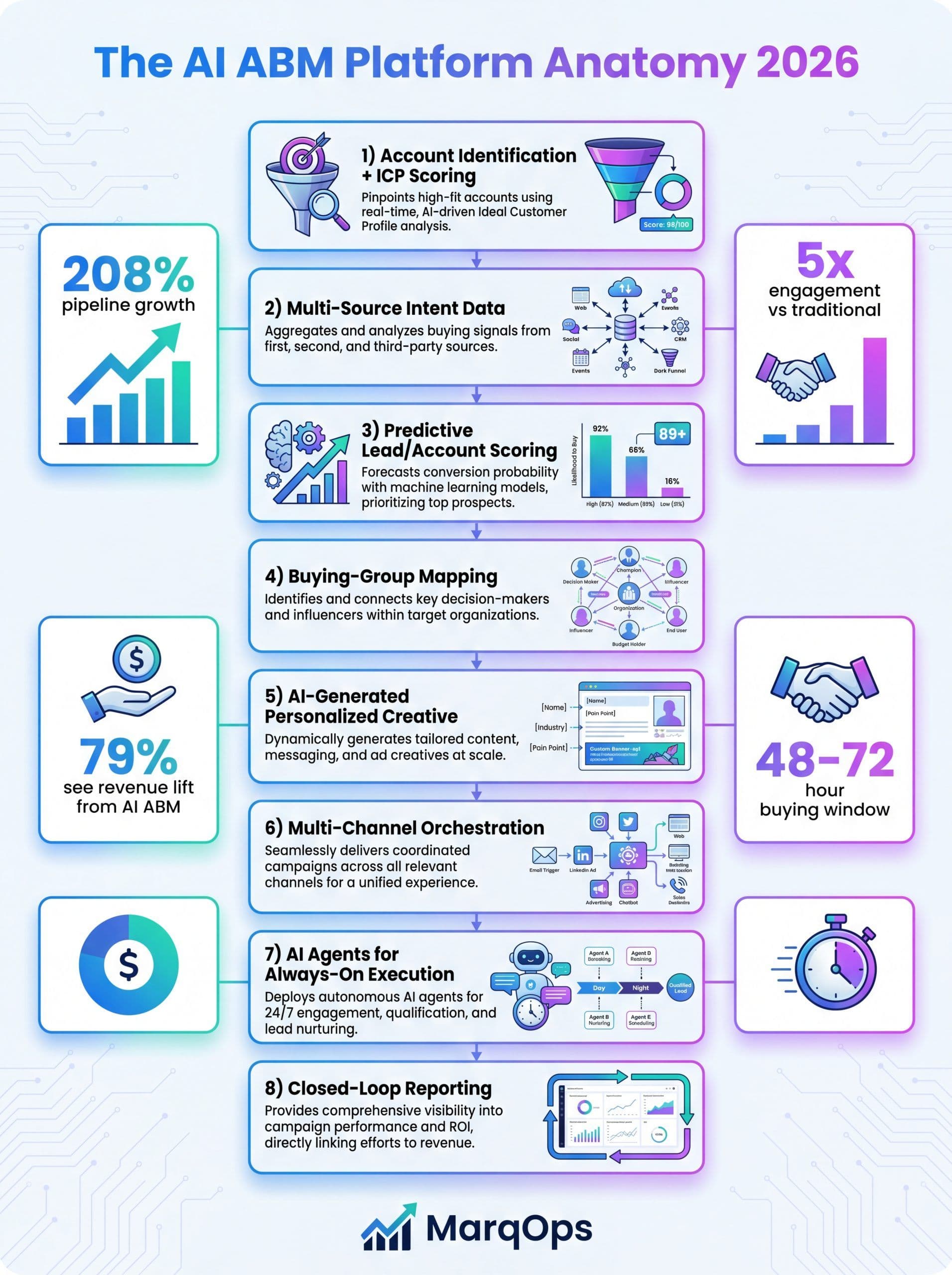
The 2026 AI ABM platform anatomy: from signal capture to closed-won pipeline.
Top AI ABM Platforms Compared
The market has consolidated into three philosophical camps. Knowing which camp a vendor belongs to tells you more than any feature checklist.
6sense (AI-Prediction-First)
6sense processes over a trillion buying signals daily and is built to predict buying stage with high accuracy out of the box, without manual model tuning. It is the platform of choice for enterprise teams that want the AI to do the heavy lifting on prioritization. Strongest fit: $50M+ ARR companies with mature sales operations and budget for a six-figure annual contract.
Demandbase (Orchestration-First)
Demandbase unifies account identification, intent, ads, and campaign management in one interface. It is typically 30% to 50% cheaper than 6sense and tends to win when the team values campaign orchestration and ad targeting over pure predictive precision. Strongest fit: mid-market and enterprise companies that want a single platform for ads plus orchestration.
RollWorks (Ad-First)
RollWorks is the most accessible enterprise-grade ABM platform, with monthly contracts and pricing under $1,000 a month for basic tiers. It focuses on account-based advertising and identification without the complexity of full enterprise ABM. Strongest fit: companies under $5M ARR or teams that want to test ABM before committing to enterprise pricing.
Terminus (Account-Engagement-First)
Terminus emphasizes engagement orchestration across chat, email, ads, and direct mail. It has strong gifting and direct mail integrations that other platforms lack. Strongest fit: B2B teams running heavy account engagement plays in regulated or relationship-driven verticals.
MarqOps (AI-Native, Unified)
MarqOps takes a different angle: rather than positioning as a pure ABM tool, it replaces 7+ disconnected marketing platforms with one AI-native operations layer. Brand Intelligence DNA keeps creative, ads, content, and SEO on-brand from the start, while AI agents handle account research, content production, and campaign orchestration. The result is a 6x faster content output across the entire funnel, not just ABM tiers. Strongest fit: marketing teams who refuse to maintain five SaaS contracts when one platform can run creative, SEO, ads, and account intelligence end-to-end.
| Platform | Best For | Pricing Tier | AI Strength |
|---|---|---|---|
| 6sense | Enterprise predictive ABM | $$$$ | Predictive scoring |
| Demandbase | Mid-market orchestration | $$$ | Campaign management |
| RollWorks | SMB and early ABM | $$ | Ad targeting |
| Terminus | Engagement-heavy plays | $$$ | Multi-channel engagement |
| MarqOps | Unified marketing ops + ABM | $$ | Brand-intelligent agents |
The 48-72 Hour Buying Window
Here is the new reality every B2B marketer needs to internalize. Buyers now complete 60% to 70% of their purchase research independently before talking to a vendor, often consulting AI tools and peer reviews along the way. Once a real evaluation starts, the buying decision compresses into roughly 72 hours.
The buying window broken down
- Hours 0 to 24: Initial research. Buyer Googles, asks ChatGPT, scans Reddit and Slack communities.
- Hours 25 to 48: Active vendor comparison. Demos requested, pricing pages reviewed, peer reviews read.
- Hours 49 to 72: Shortlist formation. Two or three vendors get in the conversation. The rest are filtered out.
If your ABM platform cannot detect intent and trigger personalized outreach inside this window, you are showing up after the shortlist is locked.
This is why signal orchestration is the single most important capability of an AI ABM platform in 2026. The platform must unify first-party, second-party, and third-party signals in real time, fire alerts to the right account owner, and serve personalized creative across channels within hours of detecting in-market intent. Anything slower is a missed deal.
How to Choose the Right ABM Platform
There is no single best ABM platform. There is only the right platform for your stage, team, and goals. Use this five-question framework to narrow the field quickly.
1. What is your annual recurring revenue?
Under $5M ARR: start with RollWorks or MarqOps. Both let you run ABM without locking into six-figure annual contracts. $5M to $50M ARR: Demandbase or MarqOps tend to deliver the best balance of capability and cost. $50M+ ARR: 6sense and Demandbase enterprise tiers earn their keep.
2. How big is your marketing team?
Teams under five people should optimize for AI agents and automation. The more an AI ABM platform can do on autopilot, the more leverage you get per person. This is exactly the gap unified platforms like MarqOps were built to close, since they replace specialist headcount with AI agents that produce content and run campaigns 6x faster.
3. Where is your pipeline gap?
If the problem is generating new pipeline, prioritize platforms with strong intent data and ICP modeling. If the problem is closing existing pipeline, prioritize platforms with deep sales orchestration and account engagement features. Be honest about which side of the funnel needs the most help. Pair the platform with a smart AI marketing strategy so you do not buy capabilities you will never use.
4. How many tools is your team already paying for?
Audit your stack. If you already pay for separate tools for SEO, ads, creative, analytics, and ABM, you are probably wasting 30% to 50% of your software budget on overlap. Platforms that consolidate multiple categories (the unified-stack play) save real money and eliminate the data fragmentation that kills ABM accuracy.
5. How fast does your team need to ship campaigns?
If campaign turnaround is measured in weeks, you have an execution problem no platform will solve. Look for tools with brand-intelligence-driven creative generation, since the bottleneck is almost always creative production, not strategy. Marketing teams using AI for content generation cut production time from 20 to 40 hours per account to 15 to 30 minutes, with output quality holding steady.
Your 90-Day ABM Implementation Roadmap
Most ABM programs fail not because the platform is wrong, but because the rollout is rushed or scope explodes in month one. Use this 90-day phased plan.
Days 1 to 30: Foundation
- Lock in your ICP and tier definitions (tier 1: 1:1 personalization, tier 2: 1:few, tier 3: 1:many).
- Build a clean target account list of 200 to 500 accounts.
- Audit your marketing tech stack and identify what gets retired when the ABM platform goes live.
- Set baseline metrics: MQA conversion rate, pipeline velocity, win rate by tier.
Days 31 to 60: Pilot
- Run one tier-1 play and one tier-2 play in parallel.
- Map the buying group at each tier-1 account (target 6 to 10 contacts).
- Train AI agents on brand voice and tier-specific creative guidelines.
- Wire up alerts so sales gets notified inside the 48 to 72 hour buying window.
Days 61 to 90: Scale
- Expand to all tiers and all motions.
- Review program metrics weekly with sales leadership, not just marketing.
- Document what worked and bake it into your marketing workflow automation playbooks.
- Plan the next 90 days with a focus on what to retire (tactics that did not move pipeline).
Measuring ABM Success: The Metrics That Actually Matter
Vanity metrics will get your ABM budget cut. Pipeline metrics will get it doubled. Here are the ones that actually move the conversation with sales leadership and the CFO.
MQA Conversion Rate
Mature programs hit 22.33% vs 14.19% for less mature ones. This is the single best leading indicator.
Win Rate by Tier
Tier-1 win rate should be 2x to 3x your overall win rate. If it is not, the ABM motion is not working.
Pipeline Velocity
AI-powered ABM can shorten sales cycles by 28% and triple engagement levels.
Pipeline Revenue Lift
Aligned sales and marketing teams report 208% pipeline growth and 38% higher win rates.
Roll these into one report that goes to the executive team monthly, ideally inside an integrated marketing intelligence platform so the numbers are always current. Static slides are a tax on your team and a credibility risk with the CFO.
Where AI ABM Is Headed Next
Three shifts are already shaping the next 12 months. First, agentic ABM is replacing rules-based orchestration. AI agents now propose target accounts, draft outreach, and adjust campaigns autonomously, with humans approving rather than executing. Second, signal sources are diversifying fast. Conversational AI logs, dark social, and private community discussions are becoming as valuable as traditional intent providers. Third, brand consistency is no longer optional. As AI generates more creative, only platforms with strong brand-intelligence guardrails will keep output usable. Teams already running best-in-class marketing automation tools alongside ABM will absorb these shifts faster than teams stitching point solutions together.
Frequently Asked Questions
What is the difference between ABM and AI ABM?
Traditional ABM relies on manual research, static target lists, and human-built campaigns. AI ABM uses predictive scoring, real-time intent data, and generative AI to identify in-market accounts and personalize outreach automatically. The output looks similar; the throughput, accuracy, and cost-per-account are 5x to 10x better with AI in the loop.
Do I need a dedicated ABM platform if I already have HubSpot or Salesforce?
Yes, in most cases. CRMs and marketing automation platforms are systems of record. ABM platforms are systems of intelligence and orchestration. They sit on top of your CRM, ingest external intent and firmographic signals, and orchestrate the account-level plays your CRM was not built to run. Unified platforms like MarqOps can collapse that gap by handling ABM, content, ads, and analytics in one tool, but you still need ABM-specific capabilities somewhere in the stack.
How long does it take to see results from an AI ABM program?
Most teams see lift in tier-1 engagement within 30 to 60 days, MQA conversion improvements within 90 days, and meaningful pipeline impact between months four and six. ABM is not a quick-win channel. The ROI compounds once intent data accumulates and AI models tune to your specific accounts.
What is the minimum team size for an ABM program?
With AI agents in the loop, even a two-person marketing team can run a tier-1 plus tier-2 ABM motion across 100 to 200 accounts. The old rule of thumb (one ABM marketer per 50 accounts) no longer applies. The new rule is one marketer per 200 to 500 accounts if the team is using AI personalization and orchestration tools.
How does brand consistency hold up when AI generates ABM creative?
It only holds up if the platform enforces brand intelligence guardrails. Generic prompt-based generation produces inconsistent output. Platforms like MarqOps use Brand Intelligence DNA to keep tone, voice, visual identity, and messaging on-brand from the first generation, which is what lets teams safely scale AI creative across hundreds of accounts.
Stop running ABM across 7 disconnected tools.
MarqOps unifies creative, content, ads, analytics, and account intelligence in one AI-native platform. Brand Intelligence DNA keeps every output on-brand. AI agents do the heavy lifting. Your team moves 6x faster.
Keep following the signal