AI Marketing Strategy in 2026: A Step-by-Step Framework for Modern Marketing Teams
Build an AI marketing strategy that actually delivers ROI. A 90-day framework with use cases, KPIs, and implementation steps for 2026.
AI Marketing Strategy in 2026: A Step-by-Step Framework for Modern Marketing Teams
TL;DR
- 91% of marketers now use AI in their daily work, but only 41% can prove ROI, a sign that strategy is lagging behind tool adoption.
- The teams winning in 2026 follow a 90-day framework: foundation (audit, baseline, single use case), deployment (3-5 connected use cases), and optimization (measurement, scaling, governance).
- Tool sprawl is the silent killer. Marketing teams running 8 or more disconnected AI tools lose 34% of their efficiency to coordination overhead.
- Successful AI marketing strategies prioritize integration over innovation. Connected tools deliver 2.3x better ROI than standalone solutions with flashier features.
- This guide gives you a step-by-step framework, real use cases, KPIs to track, and the biggest mistakes to avoid.
Table of Contents
- What Is an AI Marketing Strategy?
- Why 2026 Is the Year AI Marketing Strategy Stops Being Optional
- The Real Benefits of AI in Marketing (With Numbers)
- The 90-Day AI Marketing Strategy Framework
- 8 AI in Marketing Examples That Actually Move Numbers
- KPIs and Measurement: How to Prove AI ROI
- 5 AI Marketing Strategy Mistakes to Avoid
- Choosing the Right AI Marketing Stack
- FAQs
What Is an AI Marketing Strategy?
An AI marketing strategy is a structured plan for using artificial intelligence across your marketing operations to drive measurable business outcomes. It is not a list of AI tools you bought. It is a defined operating model that maps AI capabilities to the marketing problems you are actually trying to solve, with clear ownership, KPIs, and integration points across content, paid media, SEO, analytics, and creative production.
In 2026, every serious marketing operations team needs one. The shift from “we use ChatGPT for emails” to a real ai-driven marketing strategy happens when you stop thinking about tools and start thinking about workflows: how AI plugs into briefing, drafting, approval, distribution, attribution, and optimization in a way that compounds over time.
A complete ai marketing strategy framework answers four questions: What jobs are we using AI for? Which data and brand inputs feed those jobs? How do we measure if it is working? What is the human review layer that protects brand integrity? Skip any of those and you end up with the same problem 58% of marketers report in 2026, more output, more chaos, no proof it is working.
Why 2026 Is the Year AI Marketing Strategy Stops Being Optional
The numbers tell the story. According to the latest 2026 research, 91% of marketers now actively use AI in their work, up from 63% just a year ago. Salesforce’s State of Marketing report shows generative AI usage jumping from 51% in 2024 to 87% in 2026, and 84% of marketers now use AI for real-time personalization.
But adoption is not the story anymore. Maturity is. Median payback on AI tooling investments dropped from 7.8 months in 2024 to 4.2 months today. Yet the share of marketers who can prove AI ROI fell from 49% to 41%, according to Gartner research. That gap between “we use AI” and “we can prove it works” is exactly where a real strategic plan earns its keep.
The marketing teams winning in 2026 are not the ones with the most AI tools. They are the ones with the clearest AI marketing strategy and the cleanest data flowing into it.
Here is the new reality: the constraint has moved from budget and tool access to the operating model itself. Median monthly AI spend at mid-market marketing teams jumped from $1,200 in Q1 2025 to $3,400 in Q1 2026, a 183% increase. But teams running 8 or more disconnected AI tools see a 34% efficiency loss from coordination overhead alone. Tool sprawl now costs roughly $18,000 per marketing employee per year in unused licenses, context-switching, and manual data transfer.
Translation: throwing more tools at the problem makes it worse. The 2026 winners standardize their data pipelines before they scale AI. In fact, 83% of AI-enabled marketing teams that grew revenue had standardized data infrastructure in place before deploying AI tools, not after, per Harvard Business Review research. That is the part most strategic guides quietly skip.
The Real Benefits of AI in Marketing (With Numbers)
Forget vague promises about “10x productivity.” Here are the documented benefits of ai in marketing teams are actually capturing in 2026:
Output Multipliers
- 4.1x more published content per marketer per month for teams that adopted AI content tools in 2024
- 4.6x multiplier on content marketing output specifically
- 3.8x on social media production, 2.9x on email
- 30% higher ROI on advertising spend with AI-powered campaign optimization vs. manual
- 11x increase in purchase rate for brands like Yves Rocher using real-time AI personalization
These are not best-case scenarios from vendor decks. They are median results from teams that built a real ai-driven marketing strategy with three things in place: clean data, defined use cases, and integrated tooling. When MarqOps customers consolidate their fragmented stack onto a single brand-intelligent platform, content velocity typically jumps 6x while brand consistency scores stay above 95%.
The benefits compound when AI is connected across functions. Predictive marketing analytics tells you which segments to target. AI personalization tailors the message. AI marketing automation orchestrates the delivery. When those layers share data instead of living in separate tools, ROI follows.
The 90-Day AI Marketing Strategy Framework
This is the ai marketing strategy framework we recommend for marketing teams ready to move beyond ad-hoc AI usage. It is structured in three 30-day phases. Foundation, Deployment, Optimization. Each phase has clear exit criteria. No phase gets skipped.
Phase 1: Foundation (Days 1 to 30)
The goal of Phase 1 is brutal honesty about where you are today. Resist the urge to start generating content on day one. Most failed AI marketing strategies skip this phase and pay for it for the next twelve months.
- Week 1: Audit your current marketing operations. Map every workflow from briefing to publishing. Identify where AI can compress time, reduce errors, or unlock new output. Document your current marketing tech stack and identify overlap.
- Week 2: Establish baseline metrics. Capture content velocity, cost per asset, time to publish, brand consistency score, organic traffic, conversion rates, and CAC. These become your scoreboard.
- Week 3: Pick one use case. One. Not three. The most common starting points (predictive lead scoring, email personalization, content draft generation) deliver visible results in 30 days. Pick what your team will actually use.
- Week 4: Stand up your data foundation. Standardize your brand inputs (voice guide, messaging pillars, style rules) and customer data pipelines. AI is only as good as what feeds it.
Exit criteria for Phase 1: baseline metrics documented, one use case live, data inputs centralized, team trained on the workflow.
Phase 2: Deployment (Days 31 to 60)
Now expand. Add 3 to 5 connected use cases that share the same data and brand inputs. The keyword is connected. If the new use cases require their own logins, their own data uploads, and their own brand briefings, you are building tool sprawl, not strategy.
- Week 5-6: Activate generative SEO. Layer AI-driven keyword clustering, content briefing, and draft generation into your content strategy. Aim for 3-5x current publishing cadence at the same quality bar.
- Week 5-6: Wire up paid media. Connect AI-powered campaign optimization to your Google Ads and Meta accounts. Let AI handle bidding, creative testing, and audience refinement under human oversight.
- Week 7: Deploy AI agents for repetitive ops. Reporting, list cleaning, lead scoring, response generation. The work that drains senior marketer time without compounding value.
- Week 8: Integrate analytics. Push every channel into a unified marketing dashboard. AI cannot optimize what it cannot see.
Exit criteria for Phase 2: 3-5 use cases live and connected, all flowing into one analytics view, content velocity up 3x or more, weekly review cadence with the team.
Phase 3: Optimization (Days 61 to 90)
Phase 3 is where AI marketing strategies become a competitive moat. You are no longer just running AI workflows. You are tuning them based on what is working and ruthlessly killing what is not.
- Week 9: Build your governance layer. Define what AI can publish autonomously, what needs human review, and what is off-limits. Document brand guardrails. The 2026 winners ship faster because they have clearer guardrails.
- Week 10: Run a multi-touch attribution pass. Identify which AI-driven workflows actually drive pipeline. Reallocate budget toward the winners.
- Week 11: Scale what works. The use case driving 80% of the value gets 80% of the investment. The rest gets cut or refactored.
- Week 12: Lock in your operating cadence. Weekly review of AI workflow performance, monthly review of strategy, quarterly tool audit to prevent sprawl.
Exit criteria for Phase 3: proven ROI on at least 60% of AI workflows, governance layer documented, operating cadence in place, board-ready report on AI marketing performance.
MarqOps gives you the entire framework in one platform, brand intelligence, content generation, SEO, paid media, and analytics. No tool sprawl required.
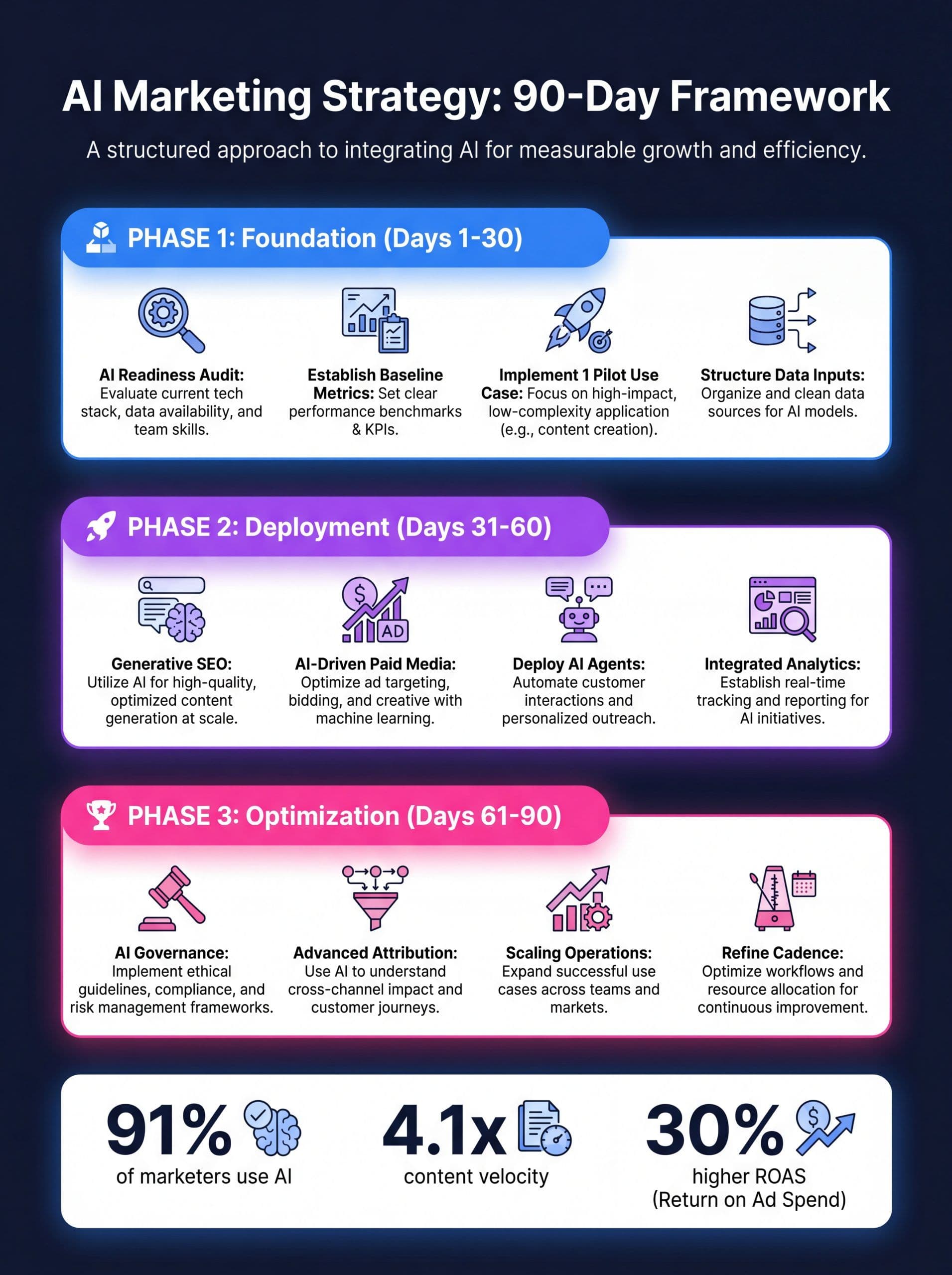
The 90-day AI marketing strategy framework: foundation, deployment, optimization.
8 AI in Marketing Examples That Actually Move Numbers
These are the ai in marketing examples with the strongest measured ROI in 2026. Pick 3 to 5 to start. Trying to do all 8 in your first quarter is how AI marketing strategies fail.
1. AI-Powered Content Production at Scale
Brand-trained AI generates first drafts of blog posts, ad copy, social posts, and emails in minutes instead of hours. The “brand-trained” part matters. Generic AI output without brand voice grounding ships fast and erodes brand equity. Tools like our AI copywriting workflow ground every draft in your voice guide and messaging pillars.
2. Real-Time 1:1 Personalization
AI tailors web experience, email content, and ad creative to each visitor based on behavioral signals. Yves Rocher hit an 11x purchase rate increase by replacing static recommendations with AI-driven real-time personalization. Most brands leave 30%+ revenue on the table by not personalizing past basic segmentation.
3. Predictive Lead Scoring and Pipeline Forecasting
AI scores every lead based on fit and intent, then forecasts pipeline 30, 60, 90 days out. Sales teams stop chasing low-quality leads. Marketing stops over-investing in channels that produce volume but no revenue.
4. Autonomous Campaign Optimization
You set the objective, AI handles bidding, creative variants, audience refinement, and budget reallocation in real time. Performance Max campaigns are an early version of this. The 2026 standard is autonomous orchestration across Google, Meta, LinkedIn, and TikTok with one set of brand inputs.
5. Generative Engine Optimization
As Google AI Mode, ChatGPT, Perplexity, and Claude reshape search, AI helps you optimize for citations in AI-generated answers, not just blue links. Our generative engine optimization guide walks through the full playbook.
6. Creative Automation
AI generates banner sets, video variations, and social cuts at scale, all on-brand. Creative automation is how you ship 200 ad variants for testing without a designer bottleneck.
7. AI-Powered Customer Segmentation
Move beyond rigid demographic segments to real-time behavioral cohorts. AI customer segmentation identifies micro-segments human analysts miss, like “high-intent visitors who price-checked twice in 14 days.”
8. Conversational AI for Lead Capture
AI chat agents qualify visitors, book meetings, and route warm leads to sales. Compared to traditional contact forms, conversational AI typically lifts conversion rates 25-40% because it answers questions in real time instead of forcing visitors into a 7-field form.
KPIs and Measurement: How to Prove AI ROI
The 2026 ROI gap is real. 41% of marketers can prove AI ROI today, down from 49%. The cause is almost always poor measurement design at the start, not bad AI tools. Build these KPIs into your marketing strategy ai from day one and the numbers stop being a debate.
Operational KPIs
- Content velocity: assets shipped per marketer per month
- Cost per asset: fully loaded cost (people + tools) per finished asset
- Time to publish: brief to live, in days
- Brand consistency score: percentage of AI output passing brand QA on first review
Performance KPIs
- Organic traffic growth: with AI-content versus baseline cohort
- Conversion rate lift: on AI-personalized experiences vs. control
- CAC trend: month over month, broken out by channel
- Pipeline velocity: days from lead to opportunity to closed
- ROAS by AI-driven workflow: tagged so you know what is and is not paying off
Stack Health KPIs
- Tool count: active AI tools in the stack (target: under 5 by end of year 1)
- License utilization: percentage of seats actively used
- Coordination overhead: hours per week reconciling output across tools
5 AI Marketing Strategy Mistakes to Avoid
After watching hundreds of marketing teams roll out AI, the same five mistakes keep showing up:
- Buying tools before defining workflows. If you cannot draw the workflow on a whiteboard, do not buy the tool.
- Skipping the brand foundation. AI without a brand voice file produces generic content that quietly erodes brand equity.
- Measuring activity instead of outcomes. “We published 4x more posts” is not a result. “We added 22% organic pipeline” is.
- Letting tool sprawl creep in. Every quarter, audit. If a tool is not pulling weight, kill it. The 8-tool tipping point is real.
- Treating AI as autopilot. The 2026 winners run AI with strong human review at the brand and strategy layer. Nobody is winning with full autonomy yet.
Choosing the Right AI Marketing Stack
There are two valid paths in 2026. Best-of-breed point tools (specialized tools per workflow, integrated through middleware) or unified platforms (one platform handling content, SEO, ads, analytics, and creative). Both can work. The wrong path is “best-of-breed without the middleware,” which is just tool sprawl wearing a strategy hat.
For most mid-market and enterprise marketing teams, unified platforms are winning in 2026 because they collapse coordination overhead. MarqOps replaces 7+ disconnected tools with one brand-intelligent platform, content gen, SEO ops, paid media, creative automation, and a unified dashboard. The same brand DNA, customer data, and analytics flow through every workflow. That is what “ai-driven marketing strategy” looks like in practice.
If you want to compare options, our best AI marketing tools guide, marketing automation roundup, and marketing intelligence platform overview walk through the trade-offs in detail.
See how MarqOps replaces your AI marketing stack
One platform. Brand-perfect output. 6x faster content velocity. SOC 2 ready.
Frequently Asked Questions
What is an AI marketing strategy?
An AI marketing strategy is a structured plan for using artificial intelligence across content, paid media, SEO, analytics, and creative to drive measurable business outcomes. It defines the use cases, the data and brand inputs feeding those use cases, the KPIs to measure success, and the human review layer that protects brand integrity.
How long does it take to build an AI marketing strategy?
A complete AI marketing strategy framework rolls out in 90 days across three phases: foundation (audit and one use case), deployment (3-5 connected use cases), and optimization (governance, attribution, scaling). Sustainable ROI typically takes 6 to 18 months as workflows mature and data quality compounds.
What are the biggest benefits of AI in marketing?
Documented benefits in 2026 include 4.1x more published content per marketer, 30% higher ROAS with AI-powered campaign optimization, and up to 11x purchase rate increases on real-time AI personalization. The compound benefit is faster decision cycles, since AI agents flag issues and recommend reallocations in real time instead of weekly.
How much should a marketing team spend on AI tools?
Early adopters typically allocate 15 to 20% of their marketing budget to AI tools, while mature teams optimize at 25 to 30%. The mid-market median jumped from $1,200 per month in early 2025 to $3,400 per month in early 2026. The bigger lever is consolidation: teams running 5 or fewer integrated tools outperform teams running 8+ disconnected ones, regardless of total spend.
What is the biggest mistake in AI marketing strategy?
Buying tools before defining workflows. The pattern shows up consistently: a team buys 3 to 5 AI tools, never integrates them, never standardizes brand inputs, and 12 months later cannot prove ROI. The fix is to define the workflow first, identify exactly what AI does inside it, and only then pick the tool, ideally one that connects to your existing stack rather than adding another silo.
Keep following the signal