Vibe Marketing in 2026: The Complete Guide to AI-Run Campaigns at Startup Speed
Vibe marketing lets a small team or solo marketer set strategy and let AI agents execute. Learn how it works, the VIBE framework, the right stack, examples, and risks.
Table of Contents
- What Is Vibe Marketing?
- Why Vibe Marketing Exploded in 2026
- How Vibe Marketing Actually Works
- The VIBE Framework
- Building Your Vibe Marketing Stack
- Real Vibe Marketing Examples
- The Risks Nobody Talks About
- Your 30-Day Getting-Started Roadmap
- Frequently Asked Questions
TL;DR
- Vibe marketing is an AI-native way of working where a small team, or even one marketer, sets strategy and brand direction and lets AI agents handle production, testing, and deployment.
- The shift is real: marketing teams using AI report 44% higher productivity and save around 11 hours per week, and campaigns are launching up to 75% faster than manual builds.
- Workflows that used to take eight weeks can now ship in roughly two days, which is why a single skilled vibe marketer can out-execute a traditional 10-person team.
- The winning setup is not 25 disconnected tools. It is one brand-aware operating system plus a couple of specialist tools, which is exactly the gap a unified platform like MarqOps fills.
- The catch: speed without governance creates brand risk. The best vibe marketers pair AI execution with human review and a documented brand voice.
What Is Vibe Marketing?
Vibe marketing is an AI-native approach to marketing where you describe your strategy, set the creative direction, and let AI systems handle the execution. Instead of producing every asset by hand, a marketer becomes an orchestrator. You define the vibe, the brand voice, and the goal, then AI agents generate content, build campaigns, run tests, and optimize performance in continuous cycles.
The term borrows directly from “vibe coding,” where a developer describes what they want in plain language and AI writes the code. Vibe marketing applies that same logic to demand generation, content, paid media, and lifecycle work. You are no longer the person clicking every button. You are the person deciding what good looks like and pointing capable AI at the problem.
This is more than a buzzword. It represents a genuine restructuring of how marketing work gets done, and it sits at the center of the broader move toward agentic marketing, where autonomous agents run campaigns with humans providing strategic oversight rather than manual labor.
Put simply: traditional marketing asks “who on the team can build this?” Vibe marketing asks “what do I want, and which agent can produce it right now?” The constraint shifts from headcount and hours to clarity of direction and quality of inputs.
Why Vibe Marketing Exploded in 2026
Vibe marketing did not appear out of nowhere. It is the natural result of three trends colliding: generative AI getting good enough to produce publishable work, agentic tools becoming able to act autonomously, and marketing teams facing relentless pressure to do more with less. The numbers explain why it caught fire.
44%
higher productivity reported by marketing teams using AI, saving around 11 hours per week
Adoption is now close to universal. Roughly 88% of marketers use AI tools in their day-to-day roles, and 60% use them daily. Median mid-market AI tool spend tripled in a single year, jumping from about $1,200 per month in early 2025 to $3,400 per month in early 2026. Payback on that investment now arrives in around 4.2 months, down from 7.8 months in 2024, and for content-heavy teams it lands in under three months.
Output is the headline story. AI-assisted writing can increase content production speed by up to 400% while cutting per-article cost roughly in half. Campaigns built with AI launch up to 75% faster than those assembled manually. When you compress an eight-week workflow into two days, the economics of an entire marketing department change. That is the engine behind the claim that one capable vibe marketer can out-produce a legacy team.
There is a deeper structural shift too. By the end of 2026, an estimated two-thirds of marketing content created with AI tools will happen outside of centralized content teams. Marketing is decentralizing, and vibe marketing is the operating model that decentralization runs on. If you want the broader data picture, our guide to generative AI marketing breaks down the ROI and use cases in detail.
How Vibe Marketing Actually Works
The mechanics of vibe marketing are different from traditional marketing in one fundamental way: the human stops being the bottleneck for execution and becomes the source of direction and judgment. Here is what the day-to-day actually looks like.
1. You set strategy and brand context once
Everything starts with clear inputs. You define your positioning, your audience, your goals, and most importantly your brand voice. This is the step most people get wrong. AI is only as good as the context you feed it, so codifying your AI brand voice upfront is what separates on-brand output from generic slop. Done well, the brand context persists and informs every asset the system produces afterward.
2. AI generates the first draft of everything
With direction in place, you prompt AI to produce campaign frameworks, content drafts, visual concepts, ad variations, and channel-specific copy. What used to be days of work becomes minutes. This is where creative automation earns its keep, spinning up dozens of on-brand variants instead of one hand-built asset.
3. Agents handle the busywork between steps
No-code automation and agentic tools connect the dots. They move a draft into review, schedule the post, push the ad live, pull performance data back, and recommend the next move. This is the layer that AI workflow automation makes possible, and it is what turns a pile of AI outputs into an actual running marketing operation.
4. You review, refine, and approve
The human stays in the loop on judgment. You check the work, tighten the message, kill anything off-brand, and approve what ships. The skill is no longer production. It is taste, editing, and knowing what good looks like. A capable AI marketing assistant handles the heavy lifting so your time goes to the decisions that actually matter.
5. The system learns and the loop repeats
Performance data feeds back in. The system surfaces what worked, recommends what to create next, and the cycle runs again, faster each time. Vibe marketing is not a one-shot prompt. It is a continuous loop of direction, generation, deployment, and learning.
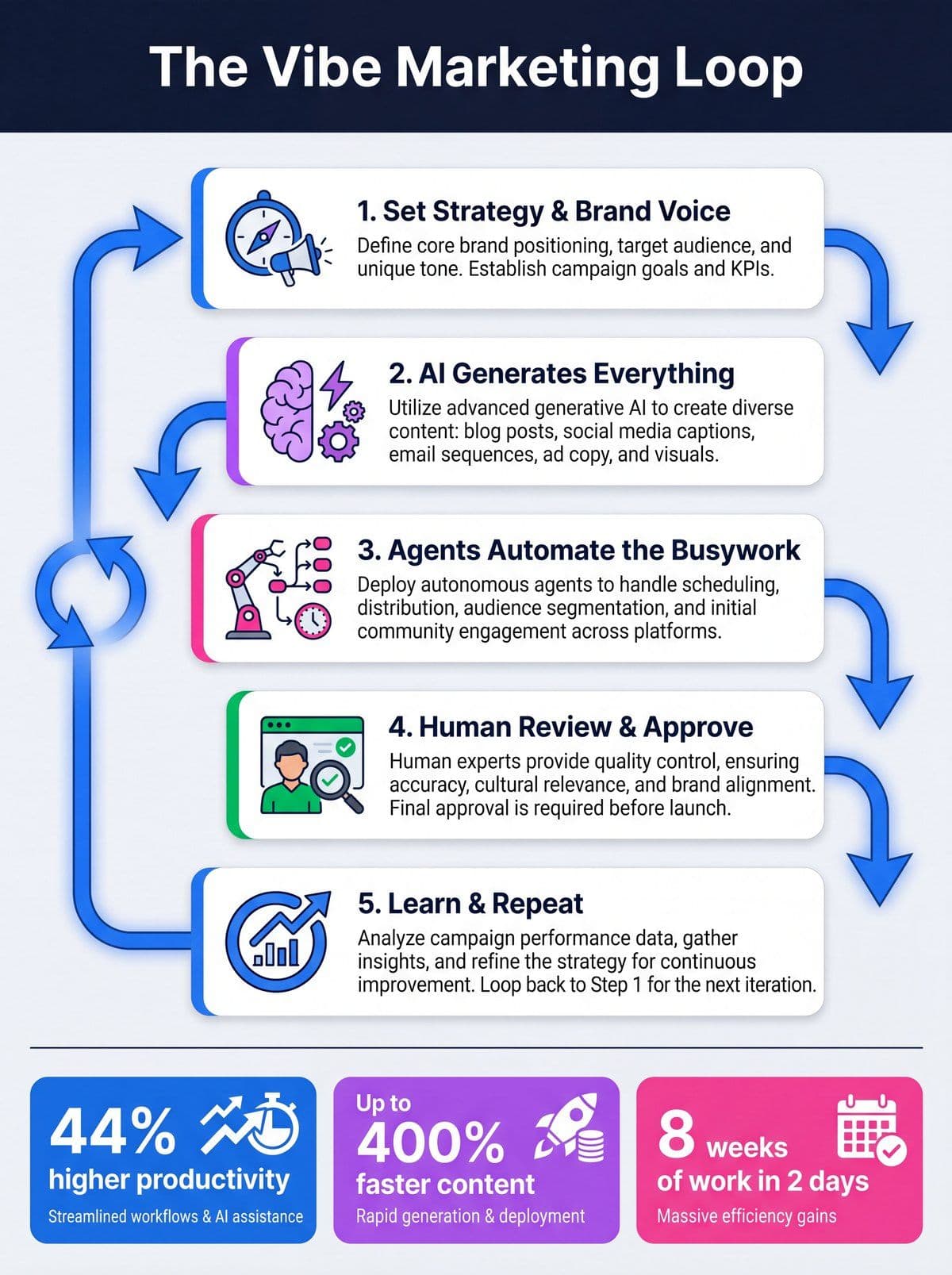
The vibe marketing loop: set direction, let AI execute, review, and learn. Source: MarqOps analysis of 2026 AI marketing data.
The VIBE Framework
To make this repeatable rather than chaotic, it helps to work against a simple framework. We use a four-part model that keeps the speed without losing the brand.
V is for Voice
Codify your brand voice, tone, and guardrails before you generate anything. This is the single highest-leverage input. A documented voice is what lets AI scale your brand instead of diluting it.
I is for Inputs
Feed the system real context: your audience, your offers, your data, your best-performing past work. Better inputs produce better outputs, every time. Garbage in still means garbage out, just faster.
B is for Build
Let AI and agents build the assets, campaigns, and workflows. Move fast here. Generate many options, not one. The cost of a variant is now close to zero, so behave like it.
E is for Evaluate
Apply human judgment and performance data to decide what ships and what gets cut. This is where taste lives and where brand safety is protected. Speed without evaluation is just risk at scale.
The framework is deliberately simple because the hard part is not the steps. It is the discipline to define voice and inputs well, then trust the system to build while you stay focused on evaluation.
Building Your Vibe Marketing Stack
Here is where most teams go wrong. They read a “25 best vibe marketing tools” list and try to wire together two dozen point solutions. The result is a fragile mess of integrations that breaks constantly and never holds consistent brand context. The whole promise of vibe marketing, speed with quality, collapses under tool sprawl.
The teams that win do the opposite. They build a lean stack: one brand-aware operating system that handles content, creative, SEO, and campaign work, plus one or two lighter specialist tools for things like social listening or sentiment. Most teams see the best return from a tight two-or-three tool setup rather than a sprawling one. If you are auditing what you run today, our guide to building a lean, AI-powered marketing tech stack is a useful starting point.
The reason tool sprawl kills vibe marketing is context loss. Every time work hops between disconnected tools, brand voice, audience data, and performance history get dropped. A unified system keeps that context intact end to end, which is exactly why one platform that replaces 7+ disconnected tools outperforms a patchwork.
This is the problem unified AI-powered marketing platforms were built to solve. MarqOps brings creative production, SEO content generation, analytics, and paid advertising under one roof with a shared Brand Intelligence DNA, so every asset comes out brand-perfect from the start instead of needing heavy cleanup. That is what makes 6x faster content output sustainable rather than a one-week novelty. When you are ready to compare options, our roundup of the best AI marketing tools in 2026 covers the field.
Real Vibe Marketing Examples
The pattern shows up across company sizes. A small independent coffee roaster used an AI-driven influencer platform to find local micro-creators, then let the system handle outreach and matching. One creator with 5,000 engaged followers shared her morning ritual featuring the brand, which drove a measurable lift in foot traffic and online orders, all without a dedicated influencer team.
Larger brands show the ceiling. Heinz ran an AI-led creative campaign that contributed to a roughly 15% sales lift, and Spotify’s AI DJ feature drove around a 40% jump in engagement. The common thread is not the size of the budget. It is that a small group set strong creative direction and let AI execute at a scale and speed that would have been impossible by hand.
For solo operators and lean teams, the impact is even sharper. Some report cutting marketing overhead by 70 to 80% while maintaining output, because one person with a well-trained stack can run what used to require a department. The catch, every time, is the upfront investment in setup and brand training. The teams that skip that step get speed and lose the brand. A smart AI content repurposing workflow is often the fastest early win, turning one strong asset into twenty channel-ready pieces.
The Risks Nobody Talks About
Vibe marketing is powerful, but the hype skips over real risk. Speed without guardrails is how brands end up publishing inaccurate, off-tone, or outright embarrassing content at scale. The data is blunt about it.
44%
of organizations have hit at least one negative consequence from generative AI, with inaccuracy the top issue
Nearly all industry professionals see generative AI as a brand safety and misinformation risk, and the most cited problems are hallucinated facts presented as truth, bias baked into training data, and content that is simply low quality or off-brand. The failure is rarely the tool. It is the absence of a clear owner for brand safety and a defined tolerance for risk.
The fix is not to slow down. It is to build review into the flow. The best operators use automation to enable efficient human review at scale rather than choosing between AI and oversight. That means documented quality standards, a clear approval step, and a named owner for brand risk. When those are in place, you keep the speed and protect the brand. When they are missing, vibe marketing becomes a liability generator. Tracking the return on all this matters too, which is why measuring AI marketing ROI properly should be part of your setup from day one.
Your 30-Day Getting-Started Roadmap
You do not need to rebuild your entire operation overnight. Here is a practical way to adopt vibe marketing without breaking what already works.
Week 1: Codify your brand
Document your voice, tone, audience, positioning, and non-negotiables. Pull together your best-performing past content as reference. This single step determines whether everything downstream is on-brand or generic.
Week 2: Pick one workflow and one platform
Choose a single repetitive workflow, such as social content or blog production, and a single unified platform to run it. Resist the urge to bolt on a dozen tools. Prove the loop on one workflow first. Our breakdown of AI agents for marketing can help you decide where to start.
Week 3: Build your review gate
Define who approves what, what your quality bar is, and what gets auto-killed. Put the guardrails in before you scale volume, not after something goes wrong.
Week 4: Scale and measure
Turn up the volume on the workflow that is working, track output and performance, and use the data to expand into a second workflow. From here, the loop compounds.
Vibe marketing is not about replacing marketers. It is about freeing them from production so they can spend their time on strategy, taste, and the decisions that actually move the business. The marketers who win in 2026 are the ones who learn to direct AI well, not the ones who try to out-type it.
Frequently Asked Questions
What is vibe marketing in simple terms?
Vibe marketing is using AI to do the heavy lifting of marketing. You set the strategy and brand direction, then AI agents create content, build campaigns, run tests, and optimize, while you review and approve. It lets a small team or even one person produce work that used to require a full department.
Is vibe marketing just a trend or is it here to stay?
It is built on durable shifts, not hype. With 88% of marketers already using AI tools and content production running up to 400% faster, the underlying economics have permanently changed. The term may evolve, but the operating model of AI-led execution with human oversight is here to stay.
What tools do I need to start vibe marketing?
Fewer than you think. The best setups use one brand-aware platform that handles content, creative, SEO, and campaigns, plus one or two specialist tools. Avoid stitching together 20 disconnected apps, because the context loss between them is what kills brand consistency. A unified platform like MarqOps is designed to replace that sprawl.
Will vibe marketing replace marketing jobs?
It changes the job more than it eliminates it. Production tasks get automated, but strategy, taste, brand judgment, and review become more valuable, not less. The marketers who thrive are the ones who learn to direct AI effectively rather than competing with it on manual output.
How is vibe marketing different from regular marketing automation?
Traditional automation follows fixed rules you set in advance, like sending an email when someone fills a form. Vibe marketing uses generative AI and agents that create new content and make decisions, not just trigger pre-built steps. It is the difference between automating a workflow and having an AI partner that actually produces the work.
Keep following the signal