AI Email Marketing in 2026: The Complete Guide to Higher Opens, Revenue, and Autonomous Sends
AI email marketing in 2026: the dual-engine model of predictive and generative AI, 7 high-impact use cases, the new deliverability rules, agentic lifecycle sends, and a practical roadmap.
TL;DR
- Email still returns roughly $36 to $42 for every $1 spent, and AI is now the lever that separates the top quartile from everyone else.
- The winning setup in 2026 is a dual engine: predictive AI decides who and when, generative AI decides what to say. Programs running both report about 41% more revenue than non-AI programs.
- AI-generated subject lines lift open rates 20 to 40%, and send-time optimization alone adds another 20 to 30%.
- Deliverability got stricter. Gmail, Yahoo, and Microsoft now hard-reject non-compliant bulk mail, so authentication and engagement signals matter more than clever copy.
- The next shift is agentic: AI systems that run entire lifecycle journeys and pick the next best message per subscriber instead of following fixed drip rules.
Table of Contents
- What is AI email marketing?
- Why AI email marketing matters more in 2026
- The dual-engine model: predictive plus generative AI
- 7 high-impact AI email marketing use cases
- Deliverability in 2026: the rules changed
- From drip campaigns to agentic lifecycle email
- Metrics that actually tell you if AI is working
- A practical roadmap to get started
- How MarqOps fits into your email stack
- FAQs
What is AI email marketing?
AI email marketing is the use of machine learning and generative models to plan, write, personalize, time, and optimize email campaigns at a scale no human team could match manually. Instead of a marketer building one newsletter and blasting it to a list, AI drafts dozens of subject-line variants, predicts the best send window for each subscriber, assembles personalized content blocks per person, and keeps optimizing based on who opens, clicks, and buys.
The category has quietly become the highest-leverage place to apply AI in marketing, mostly because email is measurable, repetitive, and directly tied to revenue. Roughly 65% of marketers now use AI-powered tools to automate email personalization at scale, and the gap between AI-assisted programs and everyone else is widening fast. If you are building an AI-native stack, email pairs naturally with your work on AI personalization and AI customer segmentation.
Why AI email marketing matters more in 2026
Email refuses to die. In 2026 it still delivers the highest ROI of any digital channel, with benchmarks landing between $36 and $42 back for every $1 spent, and some programs reaching $45. That is a 3,600% to 3,800% return, and it holds up even as paid acquisition costs climb and social reach keeps shrinking.
41%
more revenue reported by email programs that adopted AI vs. non-AI programs in the same sector
What changed is not that email got better. It is that the inputs email depends on, timing, targeting, and message relevance, are exactly the problems AI is good at solving. Personalized subject lines can raise open rates up to 26%, personalized campaigns can drive roughly 6x more transactions, and AI-powered personalization has been shown to lift email revenue by up to 41%. Those numbers used to require a data science team. Now they come baked into the tooling.
A quick reality check on open rates: the 2025 average sat around 43%, but Apple Mail Privacy Protection inflates that number by pre-loading images. Treat open rate as directional. Click-to-open rate, click rate, and revenue per email are the KPIs that actually tell you whether your AI is working.
The dual-engine model: predictive plus generative AI
The clearest framework to come out of the last year is the dual-engine approach. It splits AI’s job in email into two distinct functions that solve different problems, and the best 2026 programs run both together rather than betting on one.
Predictive AI: the “who” and “when”
Predictive models analyze historical behavior to forecast what a subscriber will do next. In email that means send-time optimization (calculating the individual window when each person is most likely to open), churn-risk scoring, and next-best-action decisions. Send-time optimization on its own lifts open rates 20 to 30%, because the same email simply performs better when it lands at the right moment. This is the same predictive muscle behind customer lifetime value prediction and customer churn prediction, pointed at the inbox.
Generative AI: the “what”
Generative models write. They can produce 50 subject-line variants in seconds, draft preview text and body copy from a prompt, and spin up dynamic content blocks tailored to a segment. The value is not just speed, it is having enough material to run meaningful A/B tests across multiple segments at once instead of testing three subject lines and calling it a day. Just make sure the output stays on-message. Generative email is only safe at scale when it is governed by a consistent AI brand voice, which is where a lot of AI copy quietly goes wrong.
Neither engine is enough alone. Perfect copy sent at the wrong time to the wrong person underperforms. Perfect timing wrapped around generic copy underperforms. The 2026 unlock is integrated frameworks that connect both into a single workflow, so timing, audience, and message get optimized together. For the broader picture beyond email, see our guide to generative AI marketing.
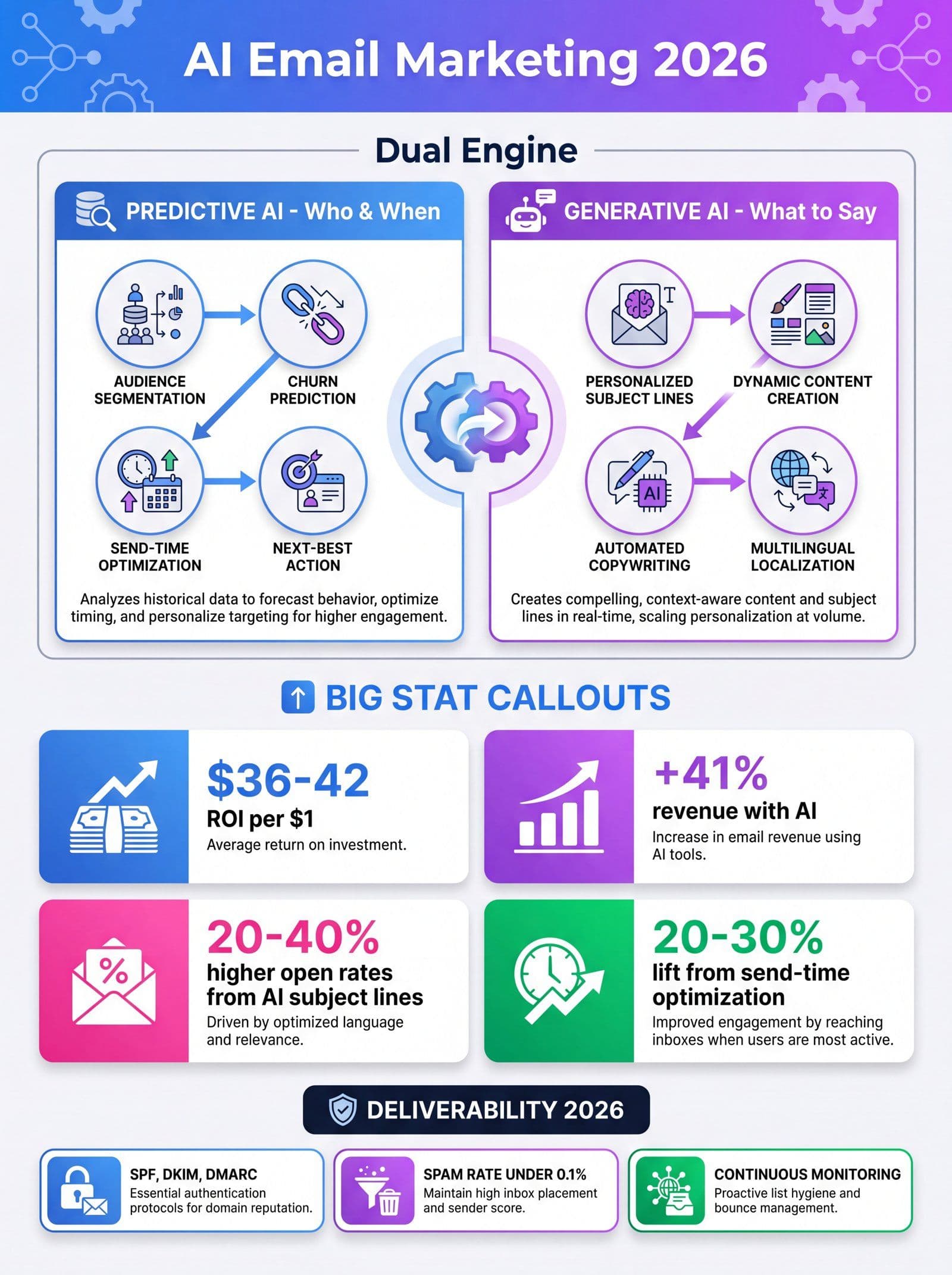
The dual-engine model and key 2026 AI email marketing benchmarks at a glance.
7 high-impact AI email marketing use cases
Here is where AI earns its keep in a real email program, roughly in order of how quickly you will see results.
| Use case | What AI does | Typical impact |
|---|---|---|
| Subject-line generation | Drafts and ranks dozens of variants per send | 20 to 40% higher open rates |
| Send-time optimization | Predicts each subscriber’s open window | 20 to 30% higher opens |
| Dynamic personalization | Assembles per-person content blocks | Up to 41% more revenue |
| Behavioral micro-segmentation | Auto-manages hundreds of live segments | Higher relevance, less list fatigue |
| Product recommendations | Predicts next-best product per contact | Click rates to 3.75% (8.79% top) |
| Churn and re-engagement | Flags at-risk contacts, triggers win-backs | Recovered revenue, cleaner list |
| Lifecycle automation | Runs onboarding, nurture, retention flows | 40 hrs to 15 min per campaign |
That last row is not a typo. One retailer that put AI across its full customer journey cut campaign optimization from 40 hours of manual work to about 15 minutes of human oversight, while generating 2.3 million unique email variations a month across 847 automatically managed micro-segments. That is the kind of throughput that used to be impossible, and it is why teams are folding email into broader marketing workflow automation rather than treating it as a standalone tool.
Deliverability in 2026: the rules changed
None of the above matters if your email lands in spam. This is the part most “AI email” guides skip, and it is where a lot of AI-scaled programs quietly break. In 2026, Gmail, Yahoo, and Microsoft treat bulk senders (anyone sending more than 5,000 emails a day to personal inboxes) far more strictly than before.
The non-negotiables now are SPF, DKIM, and DMARC that pass and align, a published DMARC policy with active progression toward quarantine or reject, one-click unsubscribe (RFC 8058), and spam complaint rates kept below 0.1% (0.3% is the danger line). Since November 2025, Gmail permanently rejects non-compliant bulk mail with hard 5xx errors instead of just filtering it to spam. There is no soft landing anymore.
The catch for AI teams: mailbox providers now weight inbox placement on real engagement (opens, replies, folder moves), not just authentication. So sending more AI-generated email to unengaged contacts actively hurts you. AI should be used to send less, better, to people who want it, not to flood the list because generation is cheap.
This is the discipline that separates mature programs. Use predictive scoring to suppress disengaged contacts, let AI concentrate volume on people showing intent, and treat deliverability as a first-class metric alongside opens and revenue.
From drip campaigns to agentic lifecycle email
The biggest shift underway is structural. For 20 years, email automation meant a marketer building a flowchart: if someone does X, wait two days, send Y. That logic is being replaced by AI systems that manage entire lifecycle journeys and decide the next best action for each subscriber based on current signals rather than fixed sequences.
In practice, an agentic email system does not wait for you to design a win-back flow. It notices a high-value customer is cooling off, checks their history, picks a message and an offer, times the send, and measures whether it worked, then adjusts. This connects directly to the broader move toward AI lifecycle marketing and the agent-driven stacks we cover across the MarqOps blog. It also raises the bar on governance: when an agent is sending on your behalf, brand consistency and approval guardrails stop being nice-to-haves.
Metrics that actually tell you if AI is working
AI makes it easy to generate more of everything, which makes it easy to fool yourself with vanity numbers. Anchor your program on the metrics that connect to money and reputation, not the ones that just look busy.
Revenue per email and revenue per recipient are the truest measures of whether personalization and timing are paying off, because they roll opens, clicks, and conversions into one number tied to the P&L. Click-to-open rate tells you whether the content delivered on the subject line’s promise, which matters more now that raw open rate is distorted by privacy features. List engagement over time, the share of your list opening or clicking in the last 30, 60, and 90 days, is your early-warning system for deliverability trouble. And spam complaint rate deserves a permanent spot on the dashboard, because a program can look healthy on revenue while quietly burning sender reputation.
The teams getting the most from AI treat these as a closed loop: the model optimizes, you measure revenue and engagement, and those results feed back into the next send. Wiring email results into your wider marketing analytics instead of judging campaigns inside a siloed email dashboard is what turns AI email from a feature into a compounding advantage.
Common mistakes to avoid
Three failure modes show up again and again. The first is sending more just because generation is free, which trains mailbox providers to bury you. The second is letting AI write unsupervised, producing copy that is grammatically fine but off-brand or subtly wrong, which is why a governed brand voice and human review on high-stakes sends still matter. The third is optimizing for opens instead of revenue, chasing a metric that privacy features already inflated. Avoid those three and you are ahead of most programs.
A practical roadmap to get started
You do not need to rebuild your stack overnight. A sane sequence for the next quarter looks like this:
- Fix deliverability first. Confirm SPF, DKIM, and DMARC pass and align, add one-click unsubscribe, and get your spam rate under 0.1%. Everything else is wasted effort until this is solid.
- Turn on send-time optimization. It is the fastest, lowest-risk win, usually a toggle in modern platforms, and it lifts opens 20 to 30% with no copy changes.
- Add generative subject lines and preview text. Generate variants, A/B test them per segment, and keep the winners. Pair this with AI copywriting workflows so the whole email, not just the subject, stays sharp.
- Layer in dynamic personalization. Move from name-merge tokens to real per-person content blocks driven by behavior. This is where the revenue lift lives.
- Unify your data and measurement. AI is only as good as the signals it sees. Feed it clean, unified behavioral data from a customer data platform, and track results in your marketing analytics, not just the email tool’s dashboard.
- Graduate to lifecycle automation. Once the basics compound, hand the recurring journeys (onboarding, nurture, retention) to AI and reserve human time for strategy and brand.
If you are evaluating platforms to run this on, start with our roundup of the best AI email marketing tools in 2026, then widen the lens to the best marketing automation tools in 2026. B2B teams should also look at the B2B marketing automation playbook.
How MarqOps fits into your email stack
The hard part of AI email in 2026 is not any single feature, it is the fragmentation. Your copy lives in one tool, your data in another, your analytics in a third, and your brand rules in a slide deck nobody reads. That is exactly the gap MarqOps was built to close. One platform replaces 7+ disconnected marketing tools, so the same brand-intelligent system that writes your subject lines also knows your audience data and reports on revenue in a unified dashboard.
Because MarqOps runs on Brand Intelligence DNA, generative email output arrives brand-perfect from the start instead of needing three rounds of edits, and teams see roughly 6x faster content output across email and every other channel. When your email AI shares a brain with your creative, SEO, and analytics, you stop stitching tools together and start compounding results.
Start Free – No Card RequiredSee How MarqOps Works
Frequently asked questions
Does AI email marketing actually improve results, or is it hype?
The data is consistent: email programs that adopted AI report around 41% more revenue than non-AI programs in the same sector, AI-generated subject lines lift opens 20 to 40%, and send-time optimization adds another 20 to 30%. The gains are real, but they depend on clean data and good deliverability, not on the AI alone.
What is the difference between predictive and generative AI in email?
Predictive AI decides who to email and when, using behavioral data to forecast the best send time and flag churn risk. Generative AI decides what to say, drafting subject lines, preview text, and body copy. The strongest 2026 programs run both together in a single dual-engine workflow.
Will AI-generated emails hurt my deliverability?
They can if you use AI to send more email to unengaged contacts. In 2026 mailbox providers weight inbox placement on real engagement, so volume for its own sake backfires. Use AI to send less but better, suppress disengaged contacts, and keep spam complaints below 0.1%.
What is agentic email marketing?
It is the shift from fixed drip flows to AI systems that manage full lifecycle journeys autonomously, choosing the next best message and offer per subscriber based on live signals rather than rules you hard-code in advance. Governance and brand guardrails become critical once agents send on your behalf.
How do I start with AI email marketing without a data team?
Start with deliverability, then flip on send-time optimization, then add generative subject lines and dynamic personalization. Modern platforms bundle these as features, so you no longer need in-house data scientists. A unified system like MarqOps connects the copy, data, and analytics so you can run the whole loop from one place.
Keep following the signal