Product-Led Growth in 2026: The Complete Guide for Marketing Teams
Product-led growth (PLG) lets the product itself drive acquisition, conversion, and expansion. Here is what PLG is, why it grows revenue 50% faster, the metrics that matter, and how to build a PLG motion in 2026.
TL;DR
- Product-led growth (PLG) makes the product itself the main engine for acquisition, conversion, and expansion, instead of relying on sales reps and demos to carry every deal.
- PLG companies grow revenue around 50% faster than sales-led peers while spending roughly 39% less on sales and marketing to do it.
- The metrics that matter shift from MQLs to activation rate, product-qualified leads (PQLs), and net revenue retention (NRR). PQLs convert at 25 to 30% versus 5 to 10% for MQLs.
- The winning 2026 model is hybrid: self-serve product creates qualified in-product demand, then a lean sales-assist layer closes the accounts worth a human conversation.
- Marketing’s new job is to drive sign-ups, accelerate activation, and read product signals, work that a unified, AI-powered stack like MarqOps makes far easier.
Table of Contents
- What Is Product-Led Growth?
- Why Product-Led Growth Wins in 2026
- Product-Led Growth vs Sales-Led Growth
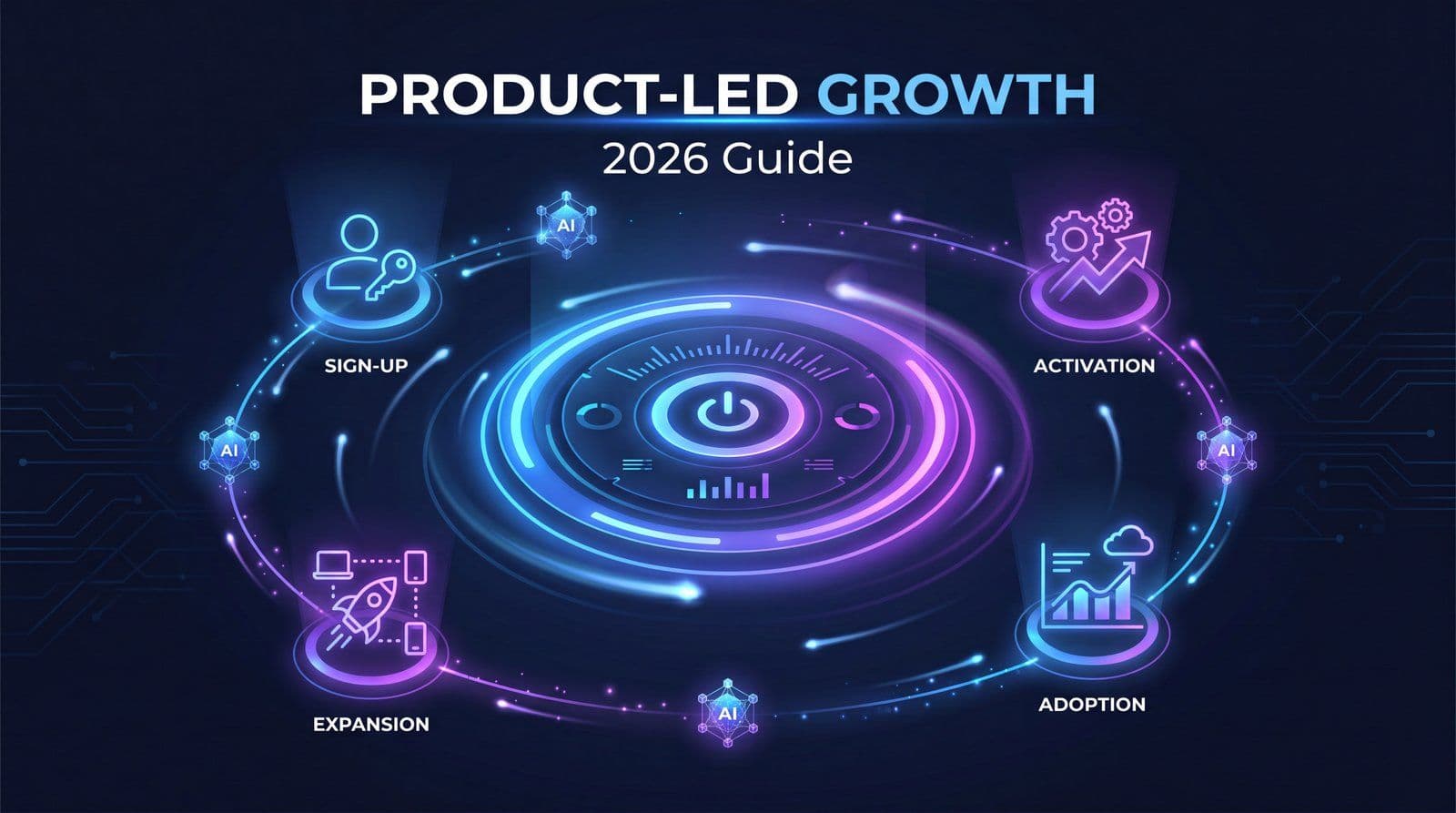
- The Product-Led Growth Flywheel
- The PLG Metrics That Actually Matter
- Product-Led Growth Examples
- AI, Product-Led Sales, and the Hybrid Motion
- How to Build a PLG Motion: A 6-Step Roadmap
- Frequently Asked Questions
What Is Product-Led Growth?
Product-led growth (PLG) is a go-to-market strategy where the product itself drives how customers find you, sign up, get value, and expand their spend. Instead of a salesperson walking a prospect through a demo before they ever touch the software, the user experiences the value first, often through a free trial or freemium tier, and the upgrade decision follows naturally from that experience.
This is a real inversion of the traditional B2B playbook. For two decades, software was sold top-down: marketing generated leads, sales booked demos, and the product was something buyers only saw after signing a contract. PLG flips the order. Acquisition, activation, and revenue all start inside the product. Marketing’s job becomes getting the right people to sign up and helping them reach value fast, which is a meaningful change from the lead-handoff model most teams still run inside their AI marketing funnel.
PLG is no longer a fringe tactic. In 2026, roughly 58% of B2B SaaS companies run some form of product-led motion, and among companies above $50 million in ARR that figure jumps to 91%. It has crossed from a clever growth hack into the default operating model for modern software.
The simplest definition: in product-led growth, the product is your best salesperson, your best marketer, and your best customer success rep. Everything else exists to amplify what the product already does.
Why Product-Led Growth Wins in 2026
The case for PLG is not ideological, it is financial. The numbers consistently favor companies that let the product carry more of the growth load.
50%
faster revenue growth for PLG leaders versus traditional sales-led SaaS
PLG companies post median annual revenue growth around 35% versus 26% for non-PLG peers, and the leaders specifically expand at roughly 50% year over year. They also do it more efficiently, spending about 39% less on sales and marketing to generate that growth. When buyers can self-serve, you do not need an army of reps to acquire every account.
There are three structural reasons PLG is pulling ahead right now:
1. Buyers want to try before they talk to anyone. A reported 94% of B2B buyers now use AI during their purchase process, and a growing share start research in an AI chatbot rather than a search engine. Shortlists form before a vendor even knows the buyer exists. A free, frictionless product is how you get on that shortlist without a single sales call. This is also why LLM SEO and product discoverability now go hand in hand.
2. Efficient growth is back in fashion. The era of growth at any cost is over. PLG’s lower customer acquisition cost and faster payback make it the natural fit for a market that rewards capital efficiency, which shows up directly in stronger marketing ROI.
3. Expansion revenue compounds. Product-led companies report 15 to 20% higher net revenue retention than sales-led counterparts. When usage drives upgrades, every activated team becomes a growth account on its own, without a renewal call.
Product-Led Growth vs Sales-Led Growth
PLG and sales-led growth are not enemies, they are different motions suited to different deal sizes and buying processes. The common 2026 rule of thumb ties the motion to annual contract value (ACV): product-led below roughly $5K, sales-led above $50K, and a hybrid motion winning the broad $10K to $50K middle.
| Dimension | Product-Led Growth | Sales-Led Growth |
|---|---|---|
| First touch | User signs up and tries the product | Lead books a demo with a rep |
| Lead signal | Product-qualified lead (PQL) from real usage | Marketing-qualified lead (MQL) from form fills |
| Conversion rate | 25 to 30% of PQLs convert | 5 to 10% of MQLs convert |
| Best for | Lower ACV, fast value, broad audience | High ACV, complex, multi-stakeholder deals |
| Cost to acquire | Low, self-serve scales without headcount | High, every deal needs human time |
The PQL conversion gap is the single most important line in that table. Products that qualify leads on real usage convert at three to five times the rate of products chasing form-fill MQLs. That is why smart teams are rebuilding their lead scoring around in-product behavior rather than demographic guesswork.
The Product-Led Growth Flywheel
Sales-led growth is usually drawn as a funnel: leads pour in the top, deals fall out the bottom, and you start over. PLG works as a flywheel instead, where each happy user feeds the next cycle. There are four stages, and they loop continuously.
Acquire. Users find you through search, AI assistants, word of mouth, or built-in sharing, then sign up with no credit card and no sales call. The lower the friction here, the faster the wheel spins.
Activate. The new user reaches their first real value moment, the “aha” where the product clicks. This is the make-or-break stage, and we will see why in the metrics section below.
Adopt. The activated user builds the product into their routine, invites teammates, and uses more features. Usage deepens and the account becomes sticky, which is exactly where AI personalization earns its keep by nudging users toward the next valuable action.
Expand. The team upgrades to a paid tier, adds seats, or buys more usage. Because expansion comes from real value, it compounds into the high NRR that makes PLG economics work, and it pairs naturally with customer lifetime value prediction to spot which accounts will grow.
Why a flywheel beats a funnel: in a funnel, growth resets every quarter. In a flywheel, every activated user adds momentum through referrals, expansion, and content, so growth gets cheaper and faster the longer it runs.
The PLG Metrics That Actually Matter
When you move to product-led growth, your dashboard has to change. Pageviews and MQLs tell you almost nothing about whether the flywheel is spinning. Here are the metrics that do.
Activation Rate
This is the percentage of new users who reach your defined value milestone, and it is the most important number in the entire funnel because everything downstream depends on it. The leverage is enormous: improving activation from 20% to 30% has the same top-line effect as a 50% increase in sign-up volume, at a fraction of the cost. Top PLG companies target 40 to 60% activation, with best-in-class reaching 70%+.
The flip side is the “zombie user” problem. In a typical PLG funnel, 40 to 60% of free users never reach activation. They sign up, poke around, and vanish without ever experiencing core value. Fixing activation is almost always the highest-leverage work a product-led team can do.
Product-Qualified Leads (PQLs)
A PQL is a user who has hit a behavioral threshold that signals buying intent, usually a mix of usage frequency, feature-adoption depth, and engagement. These are activated users who have already felt the value firsthand. As noted above, PQLs convert at 25 to 30% versus 5 to 10% for MQLs, which is why PQLs are the currency of a product-led organization.
Net Revenue Retention (NRR)
NRR measures how much revenue you keep and grow from existing customers, including upgrades, expansion, and churn. The median across SaaS sits around 110%, with the top quartile at 120%+, and high-NRR companies grow roughly 2.5 times faster than low-NRR ones. Strong NRR is the clearest sign that your adopt and expand stages are healthy. Pairing it with customer churn prediction lets you protect the base before revenue leaks out.
Time to Value (TTV)
How long it takes a new user to reach their aha moment. Shorter is better, and a maturing product shows TTV falling across cohorts. If your first customer took three months to see results and your twentieth takes three weeks, your onboarding is working.
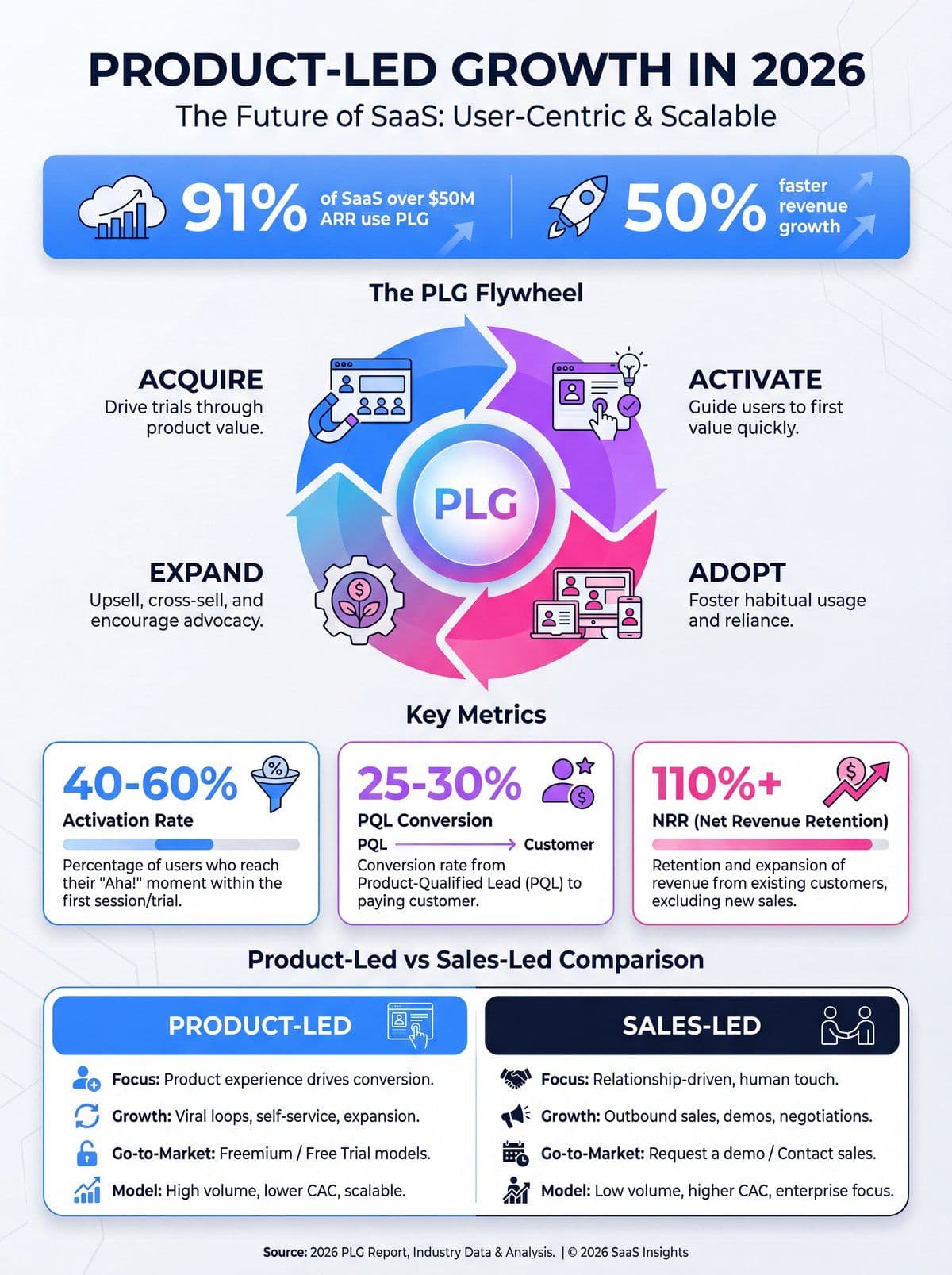
Product-led growth in 2026: adoption, the flywheel, and the metrics that matter.
Product-Led Growth Examples
The PLG playbook is best understood through the companies that wrote it. A few stand out for the scale they reached on the strength of the product alone.
Canva turned a freemium-first model and built-in virality into 260 million monthly active users and $3.5 billion in ARR growing 40%+ per year. Anyone can design something useful in minutes, share it, and feel the pull to upgrade.
Figma gave users powerful design tools with no credit card required, then let collaboration spread the product organically across teams. That motion carried it past a $1 billion annual revenue run rate. The lesson: when the product is inherently multiplayer, every user becomes a distribution channel.
Slack grew from zero to 8 million daily active users in about four years on a generous free tier and an interface so intuitive that teams adopted it before IT noticed. Value was immediate and tangible, which is the whole point of activation.
A 2026 shift worth noting: Slack, Notion, HubSpot, and Calendly have all tightened their free tiers in the last two years. The new norm is “strategic freemium,” giving free users genuine value while creating natural pressure to upgrade, rather than giving everything away.
AI, Product-Led Sales, and the Hybrid Motion
Pure PLG has a ceiling. Self-serve is brilliant for landing and expanding small teams, but the biggest enterprise deals still want a human. That is why the dominant 2026 model is product-led sales (PLS), a hybrid where the self-serve product creates qualified, in-product demand and a lean sales-assist layer converts the accounts worth a conversation.
The data backs the hybrid approach. Hybrid companies hit their NRR targets 67% of the time versus 58% for pure PLG, and product-led-sales companies are twice as likely to achieve 100%+ year-over-year revenue growth as sales-led-only peers. The trick is routing: let everyone self-serve, then surface the PQLs that show enterprise-shaped usage to a small, focused sales team.
AI is what makes this routing possible at scale, and it has stopped being a differentiator. By 2026, 87% of marketers used generative AI in at least one workflow, up from 51% just two years earlier. Leading go-to-market teams now run on unified intelligence layers that sync product usage, CRM data, and marketing signals into one place, then act on it. AI agents watch for PQL thresholds, trigger the right in-product nudge, personalize onboarding, and flag the accounts a human should call, all the work that used to require a dedicated ops team. This is the same shift toward agentic marketing that is reshaping campaign execution across the board.
Where MarqOps fits: a PLG motion lives or dies on whether marketing, product signals, and creative all read from the same data. MarqOps replaces 7+ disconnected tools with one brand-intelligent platform, so the sign-up campaign, the onboarding email, the in-product nudge, and the analytics dashboard all share the same context. Teams ship activation experiments 6x faster because the creative, the targeting, and the measurement no longer live in separate tabs.
How to Build a PLG Motion: A 6-Step Roadmap
You do not flip a switch and become product-led. Here is a practical sequence marketing and growth teams can run.
Step 1: Define your activation milestone. Pick the single in-product action that best predicts retention. For a design tool it might be “published first design,” for a database it might be “invited a teammate.” Everything else keys off this definition, so get it right.
Step 2: Pick a free model that fits your value. Free trial, freemium, or a reverse trial. Match the model to how fast users feel value and how clearly your free tier creates upgrade pressure. Generous enough to hook, limited enough to convert.
Step 3: Cut time to value. Replace long setup flows with progressive checklists that guide users to first value in 3 to 5 steps instead of 10+. This is the highest-leverage onboarding work you can do. A fast, AI-built landing page that sets the right expectation before sign-up helps too.
Step 4: Instrument PQL scoring. Define the usage signals that mean intent, then score every active user against them. Feed PQLs to sales, feed everyone else to automated nurture. Tie this into your broader RevOps data so marketing, product, and sales agree on what a qualified user looks like.
Step 5: Build expansion loops. Add in-product prompts that drive sharing, seat growth, and upgrades at the moment a user hits a limit or a high-value action. Layer in AI customer segmentation so the right nudge reaches the right cohort.
Step 6: Unify your data and creative. None of the above works if product analytics, marketing, and creative live in silos. Connect them so signals flow in real time and your team can act on them. A unified marketing operations foundation is what turns a PLG strategy on paper into a flywheel that actually spins.
Frequently Asked Questions
What is product-led growth in simple terms?
Product-led growth is a strategy where the product itself drives customer acquisition, conversion, and expansion. Users try the product first, usually through a free trial or freemium tier, and the upgrade decision follows from the value they experience, rather than from a sales demo. The product does the selling.
What is the difference between product-led growth and sales-led growth?
In product-led growth, users self-serve and qualify themselves through real usage as product-qualified leads. In sales-led growth, a rep guides every prospect through a demo and qualifies them as marketing-qualified leads from form fills. PLG suits lower-priced, fast-value products, while sales-led fits high-value, complex deals. Most companies now blend both in a hybrid motion.
What are the most important product-led growth metrics?
The core PLG metrics are activation rate (the share of new users who reach first value), product-qualified leads (users whose behavior signals intent), net revenue retention (how much revenue you keep and grow from existing customers), and time to value. Activation rate is the most leverage-rich, since everything downstream depends on it.
Is product-led growth better than sales-led growth?
Neither is universally better, they fit different deal sizes. PLG companies grow about 50% faster and spend 39% less on sales and marketing, which is why it wins for self-serve products. But large enterprise deals still need human selling. The strongest 2026 results come from hybrid product-led sales, which uses self-serve to create demand and a lean sales team to close big accounts.
How does AI support product-led growth?
AI powers the routing and personalization that make PLG scale. AI agents monitor product usage to detect product-qualified leads, trigger the right in-product nudge, personalize onboarding to cut time to value, and flag the accounts worth a sales conversation. A unified, AI-powered platform like MarqOps connects product signals, marketing, and creative so the whole flywheel acts on the same real-time data.
Keep following the signal