Best Conversion Rate Optimization Tools in 2026: 12 AI-Powered Platforms Marketing Teams Use to 2x Conversions
The best conversion rate optimization tools of 2026 ranked. Compare 12 AI-powered CRO platforms for testing, personalization, and analytics. Lift conversions 15-25%.
TL;DR
- The conversion rate optimization tools market hit $2.86B in 2026 and 48% of vendors now ship AI-based features that lift testing efficiency by 31%.
- AI-powered CRO platforms deliver 15-25% conversion lifts on average, and personalized CTAs convert 202% better than generic ones.
- The 12 best conversion rate optimization tools split into four jobs: testing (Optimizely, VWO), personalization (Mutiny, Dynamic Yield), behavioral analytics (Hotjar, Microsoft Clarity, Glassbox), and conversational CRO (Drift, Intercom).
- Most teams stitch together 4-6 of these tools and lose context. A unified marketing platform with brand-aware AI replaces that stack and runs CRO inside the same system as your creative, ads, and analytics.
- Start with one job (testing or personalization), prove a 10%+ lift in 90 days, then expand to the next layer.
Table of Contents
- What is conversion rate optimization (and why it matters in 2026)
- Why AI changes the conversion rate optimization tools game
- How we ranked the best CRO tools
- The 12 best conversion rate optimization tools in 2026
- CRO tools by use case (testing, personalization, analytics, chat)
- Conversion rate optimization services vs DIY tools
- Best conversion rate optimization tools for Shopify
- Conversion rate optimization examples that drove real lifts
- Building your CRO tool stack without the bloat
- The unified approach: replacing 5 CRO tools with one platform
- How to start with CRO this quarter
- FAQs
What is conversion rate optimization (and why it matters in 2026)
Conversion rate optimization is the process of increasing the percentage of website or app visitors who take a desired action. That action might be a purchase, a demo request, a free trial signup, an email subscription, or a download. The right conversion rate optimization tools help you test variations, watch how real users behave, personalize what they see, and decide what to ship next, all without guesswork.
Here is why this category matters more than ever in 2026. The conversion rate optimization software market hit $2.86 billion this year and is on pace to reach $6.22 billion by 2035 at a 8.9% CAGR. Firms using CRO tools report an average ROI of 223%. And 78% of global enterprises are now prioritizing conversion improvement on web and mobile, which means the question is no longer whether to do CRO. The question is which tools to pick and how to plug them into your marketing stack without creating a tab-switching nightmare.
223%
average ROI from CRO tools (across enterprises in 2026)
Why AI changes the conversion rate optimization tools game
Old-school CRO meant a quarterly A/B test on your homepage hero. You guessed at a hypothesis, ran it for six weeks, and hoped for statistical significance. AI broke that loop.
Between 2023 and 2025, more than 48% of CRO software vendors launched AI features. The result: testing efficiency improved by 31%. AI-powered conversion rate optimization tools now do four things human teams could not do at scale:
- Generate test variants automatically. Instead of writing five headline variations by hand, AI proposes 50 grounded in your brand voice, ranks them by predicted lift, and only ships the strongest.
- Personalize in real time, not after the visit. Modern AI personalization tools change page copy, offers, and product recommendations based on the visitor’s source, intent, and behavior, all within milliseconds.
- Predict winners with smaller samples. 59% of enterprises now run predictive testing algorithms, which call winners faster and cut the cost of dead-end experiments.
- Surface friction without manual session review. AI watches every session replay, clusters rage clicks and dead taps, and tells you the three pages costing you the most revenue.
The output: 15-25% conversion lifts on average, with some brands hitting 125% with AI-driven page personalization. This is why 57% of enterprises now use AI-driven optimization tools and why automated personalization influences 62% of real-time visitor journeys.
How we ranked the best CRO tools
We evaluated 35+ CRO platforms against six criteria that matter to marketing teams running real campaigns:
- Lift quality: Does the tool actually move conversion rates, and can it prove it with statistical rigor?
- AI depth: Is AI a marketing badge or does it shape what gets tested, who sees what, and which winners get rolled out?
- Integration with your stack: Does it plug into your CMS, analytics, ads, and email tools without three months of setup?
- Speed to value: How fast can a non-technical marketer launch a test or a personalization rule?
- Pricing transparency: Is the cost public and predictable as your traffic scales?
- Quality of insights: Beyond raw test results, does the tool tell you why a variant won?
The 12 best conversion rate optimization tools in 2026
Here are the platforms most marketing teams are evaluating right now, with what each one is genuinely good at.
1. Optimizely
The original enterprise A/B testing platform, now repositioned as a full digital experience suite. Strong server-side and feature flag testing, deep statistical engine, and a strong AI Sentinels feature that flags anomalies during live tests. Best fit: enterprise marketing and product teams running 50+ experiments per quarter. Pricing is on request and lands in five-figure annual contracts.
2. VWO (Visual Website Optimizer)
Mid-market favorite. Combines A/B testing, multivariate testing, heatmaps, session recordings, and a CDP-style visitor profiles layer. The AI-powered SmartStats engine calls winners with smaller samples than frequentist methods. Strong choice for teams that want testing plus behavioral analytics in one tool.
3. Mutiny
Account-based personalization built for B2B. Detects company, industry, and intent in real time and rewrites homepage copy, hero images, and CTAs to match. Mid-market and enterprise SaaS brands report 30-40% lift in demo conversions. Pricing starts mid-five figures.
4. Dynamic Yield
Personalization platform now owned by Mastercard. Strong in retail, ecommerce, and large media sites. AI ranking models personalize product grids, content modules, recommendations, and email. Better suited for teams with developer support during rollout.
5. Hotjar
The behavioral analytics tool most marketers cut their CRO teeth on. Heatmaps, scroll maps, session recordings, on-site surveys, and an AI summarization layer that turns 100 recordings into one paragraph of friction patterns. Free tier available. Best for early-stage CRO programs.
6. Microsoft Clarity
Free behavioral analytics from Microsoft. Heatmaps, session recordings, and AI-powered insights with no traffic limits. Lacks the testing layer but is a no-brainer for teams that want unlimited session replay without burning budget.
7. Drift
Conversational marketing and AI chatbots. Routes high-intent visitors to sales and books meetings inside the chat. Users who engage with AI chat convert up to 4x more often. Strong fit for B2B teams with a sales-led motion.
8. Intercom
AI-first messaging platform. Fin AI agent answers product questions, qualifies leads, and books calls. Pairs naturally with onboarding flows for SaaS and ecommerce. Considered the leading conversational CRO tool by many product-led growth teams in 2026.
9. Unbounce
Landing page builder with Smart Traffic, an AI router that sends each visitor to the variant most likely to convert them. Adds 30% lift on average versus standard A/B splits. Strong fit for paid acquisition teams pairing with AI landing page generators.
10. Glassbox
Enterprise digital experience analytics. Captures every interaction across web and mobile and uses AI to surface technical errors costing revenue (broken forms, slow pages, JavaScript failures). Used by financial services, telco, and travel.
11. Crazy Egg
Lightweight CRO suite with heatmaps, A/B testing, and surveys at SMB pricing. Good entry point for teams that want all the basics without enterprise contracts.
12. AB Tasty
Strong personalization and experimentation platform popular in Europe. AI-powered widget recommendations and feature flagging make it a serious enterprise contender. Solid fit for teams replacing legacy Optimizely contracts.
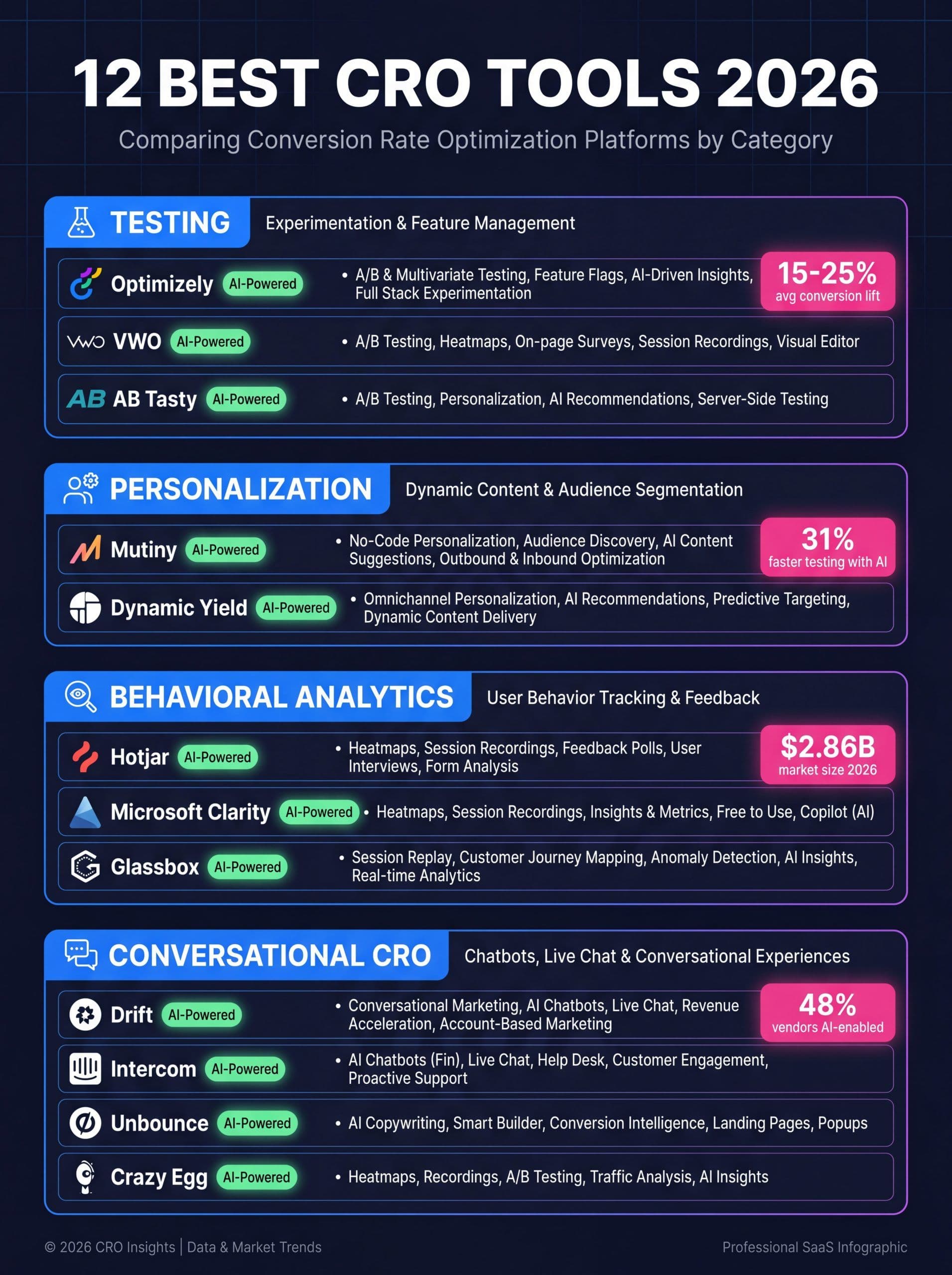
Comparison of the 12 best conversion rate optimization tools in 2026 by category and AI capability.
CRO tools by use case
Most teams do not need all 12. They need one tool per job. Here is how to think about it.
Testing and experimentation
Optimizely, VWO, AB Tasty. Pick based on team size: enterprise scale picks Optimizely, mid-market picks VWO, EU teams or those replacing Optimizely contracts pick AB Tasty.
Personalization
Mutiny for B2B SaaS, Dynamic Yield for retail and media. If you are running paid traffic to landing pages, Unbounce Smart Traffic does dynamic routing without a separate platform.
Behavioral analytics
Hotjar for SMB and mid-market, Microsoft Clarity for unlimited free recordings, Glassbox for enterprise compliance-heavy industries.
Conversational CRO
Drift for sales-led B2B, Intercom for product-led SaaS and ecommerce. Both ship AI agents that book calls and qualify leads autonomously.
A common pattern: marketing teams end up with 4-6 of these tools running side by side. Each one has its own dashboard, its own user list, its own brand assets. By the time you have stitched results together, the next campaign has launched. This is exactly the fragmentation MarqOps was built to solve.
Conversion rate optimization services vs DIY tools
You will see two flavors of help in this market: conversion rate optimization software you run yourself, and conversion rate optimization services agencies that run programs for you. Both have a place.
Use a service when you do not have an in-house experimentation lead, when you need a research-backed audit before picking tools, or when leadership wants third-party benchmarks. Strong agencies in this space include Conversion.com, SiteTuners, and Invesp.
Use DIY tools when your team has at least one analyst or marketer who can write hypotheses, your traffic is high enough to reach significance (10,000+ monthly conversions on the page being tested), and you want compounding internal knowledge of what works for your audience.
Most mature programs do both: an agency drives the strategy, the in-house team operates the tools day to day. AI is collapsing the gap, however. AI agents now handle hypothesis generation, variant copy, and analysis that used to require a dedicated CRO consultant.
Best conversion rate optimization tools for Shopify
If you run an ecommerce store on Shopify, the conversion rate optimization shopify stack looks slightly different. Most general CRO tools work, but a few are purpose-built for Shopify and integrate at the theme and product layer.
- Shopify Audiences and Search & Discovery: Native AI personalization on collection pages and search results, free with Shopify Plus.
- Rebuy: AI-powered upsell and cross-sell engine. Cart and product page personalization with predicted bundles.
- Vitals: Bundles 40+ CRO apps (urgency timers, social proof, sticky add-to-cart) into one Shopify-native suite.
- Visually: A/B testing built specifically for Shopify themes. Lower friction than installing Optimizely on a Shopify store.
- Hotjar and Microsoft Clarity: Both have one-click Shopify install for behavioral analytics.
For Shopify Plus brands at scale, pair these with the AI tools above (Mutiny for landing page personalization, Dynamic Yield for product recommendations) and you have a stack that rivals what BigCommerce enterprises run.
Conversion rate optimization examples that drove real lifts
Theory is fun. Numbers are better. Here are real conversion rate optimization examples from 2025 and 2026 case studies:
- Walmart, ACT Fibernet, and Flos USA: Increased conversions by up to 125% using AI-powered page personalization.
- SaaS analytics firm: 29% lift in demo request conversion from dynamic AI website personalization. 41% reduction in bounce rate on product pages and 22% increase in average session depth from target accounts.
- Ecommerce brand on Shopify: 31.56% increase in orders from product page optimization. A USP highlight box drove 66.2% more order revenue. An exit-intent popup added another 12.27%.
- B2B email program: AI-generated email campaigns delivered 94% higher conversion rates than non-AI controls.
- Personalized CTAs broadly: Convert 202% better than generic CTAs and that gap is widening in 2026.
These are not edge cases. They reflect what the better-resourced AI personalization, testing, and behavioral analytics tools are now delivering as table stakes.
Building your CRO tool stack without the bloat
The classic CRO stack in 2026 looks like this:
- Testing platform (Optimizely or VWO)
- Personalization layer (Mutiny or Dynamic Yield)
- Behavioral analytics (Hotjar, Clarity, or Glassbox)
- Conversational layer (Drift or Intercom)
- Landing page builder (Unbounce, Instapage, or Webflow)
- Plus your CDP, your CMS, your email tool, your ad platforms, your marketing dashboard, your reporting layer.
That is 8-10 tools. Each has its own seat licensing, contract renewal, integration debt, and brand asset library. The 2026 problem is not finding good tools. It is keeping context as data moves between them. A test winner in Optimizely needs to flow into Mutiny so the personalized version uses the new copy. The Hotjar friction insight needs to land in your marketing tech stack backlog. Your Drift conversion data needs to roll up into your multi-touch attribution model.
This is the fragmentation tax, and it is what kills most CRO programs after year two.
The unified approach: replacing 5 CRO tools with one platform
MarqOps takes a different bet on conversion rate optimization tools. Instead of stacking single-job tools, it runs CRO inside the same platform that handles your creative production, SEO content, paid ads, and analytics. Three reasons that matters:
- Brand Intelligence DNA: Every test variant, every personalized headline, every chat response is generated against your verified brand voice. No more off-brand copy slipping into a winning test.
- One context across the funnel: The ad creative, the landing page, the on-page personalization, and the email follow-up all share the same AI context. The visitor experience stays coherent from click to conversion.
- One dashboard, one source of truth: Conversion lifts, ad spend, content performance, and revenue attribution live in one view. No more cross-tool spreadsheet reconciliation.
Marketing teams running MarqOps replace an average of 7 disconnected tools with one platform and ship 6x faster on creative output. CRO becomes a continuous loop instead of a quarterly project.
How to start with CRO this quarter
If your team has never run a structured CRO program, here is the 90-day plan that works without burning budget on tools you outgrow.
Days 1-30: Install behavioral analytics
Drop Microsoft Clarity (free) or Hotjar on your top 5 highest-traffic pages. Watch 50 session recordings. Note where users hesitate, scroll back, or rage-click. You will find 3-5 problems worth testing in week one.
Days 31-60: Run your first 3 tests
Pick one of: VWO, Optimizely Free, or your CMS’s built-in testing layer. Hypothesis first. One variable at a time. Run until significance (or 4 weeks max). Document why each test won or lost.
Days 61-90: Add personalization
Once you have validated test wins, layer personalization on the top of the funnel where ad spend is heaviest. Mutiny if B2B SaaS, Dynamic Yield if ecommerce, Unbounce Smart Traffic if you are landing-page-heavy. Measure incremental lift over the static baseline.
By the end of the quarter you should have one validated lift of 10% or more, plus a backlog of 8-12 hypotheses ranked by predicted ICE score (impact, confidence, effort). That is the foundation for an ongoing program.
FAQs
What is conversion rate optimization?
Conversion rate optimization (CRO) is the practice of increasing the share of website or app visitors who complete a desired action, such as buying, signing up, or requesting a demo. Modern CRO uses a mix of A/B testing, AI personalization, behavioral analytics, and conversational tools to improve conversions continuously rather than once a quarter.
What are the best conversion rate optimization tools in 2026?
The best conversion rate optimization tools in 2026 fall into four categories. For testing: Optimizely, VWO, AB Tasty. For personalization: Mutiny and Dynamic Yield. For behavioral analytics: Hotjar, Microsoft Clarity, and Glassbox. For conversational CRO: Drift and Intercom. Most marketing teams use 4-6 of these together, or move to a unified marketing platform like MarqOps that consolidates the jobs into one system.
How much do conversion rate optimization tools cost?
CRO tool pricing ranges from free (Microsoft Clarity, Optimizely Free) to mid-five figures per year for enterprise platforms like Optimizely or Mutiny. Mid-market tools like VWO, Hotjar Business, and Drift typically run $200-$2,000 per month depending on traffic and seats. Most teams budget 5-10% of paid acquisition spend for CRO tooling and services combined.
What is AI conversion rate optimization and how is it different?
AI conversion rate optimization uses machine learning to generate test variants, personalize page elements in real time, predict winners with smaller samples, and surface friction patterns automatically. Compared with traditional CRO, AI cuts testing time by 31% on average and delivers 15-25% conversion lifts. The shift in 2026 is that AI is no longer a feature, it is the operating layer of every modern CRO platform.
Which conversion rate optimization tools work best for Shopify?
For Shopify stores, the best conversion rate optimization tools blend Shopify-native apps (Rebuy for upsells, Vitals for bundled CRO features, Visually for theme A/B testing, Shopify Audiences for native AI personalization) with general behavioral analytics like Microsoft Clarity or Hotjar. Shopify Plus brands often layer in Mutiny or Dynamic Yield for advanced personalization on collection and product pages.
Keep following the signal