AI Customer Experience: The 2026 Marketing Playbook for Personalization at Scale
AI customer experience is now a core marketing discipline. See the 5 pillars of AI CX, the rise of agentic AI, real brand examples, and a roadmap to close the execution gap.
TL;DR
- AI customer experience has moved from a contact-center add-on to a core marketing discipline, with 88 to 91% of marketers now using AI daily and 92% of brands running AI-powered personalization.
- The payoff is real: marketing teams using AI report an average 41% revenue lift and a 32% drop in customer acquisition costs, while personalized email returns 43:1 versus 12:1 without it.
- Agentic AI is the next leap. Gartner predicts that by 2027, more than 40% of customer experiences will be driven by autonomous systems that plan and execute journeys in real time.
- The gap is execution, not ambition. While 96% of companies say AI improves customer-facing work, only 1 in 5 have integrated it across channels because their tools are fragmented.
- Winning at AI CX in 2026 means unifying data, creative, and analytics in one place. That is exactly the problem MarqOps was built to solve.
Table of Contents
- What Is AI Customer Experience?
- Why AI CX Became a Marketing Priority in 2026
- The Five Pillars of AI-Driven Customer Experience
- From Reactive to Agentic: The Next Wave
- Real AI Customer Experience Examples
- The Execution Gap (and How to Close It)
- A Practical Roadmap for Marketing Teams
- Frequently Asked Questions
What Is AI Customer Experience?
AI customer experience, often shortened to AI CX, is the use of artificial intelligence to understand, predict, and shape every interaction a person has with your brand. It spans the full journey, from the first ad impression to the post-purchase email, and it pulls signals from behavior, context, and history to deliver the right message at the right moment.
For years, AI CX lived inside customer service. It powered chatbots and deflected support tickets. That framing is now outdated. The fastest-growing use of AI customer experience sits inside marketing teams, where it drives AI personalization, real-time targeting, and journey design. The reason is simple: marketers own the touchpoints that shape how customers feel about a brand long before they ever contact support.
Put plainly, AI customer experience is less about answering questions faster and more about anticipating needs. It turns a generic funnel into a responsive system that adapts to each individual as they move from awareness to loyalty.
AI CX is not a single tool. It is a layer that connects your data, creative, and analytics so the customer feels understood at every step, regardless of which channel they use.
Why AI CX Became a Marketing Priority in 2026
Two things happened at once. Customer expectations climbed, and AI finally became capable enough to meet them at scale. Around 71% of consumers now prefer personalized shopping experiences, and 76% say they prefer to buy from brands that personalize. A generic experience is no longer neutral. It actively costs you conversions.
At the same time, adoption crossed the tipping point. Between 88% and 91% of marketers report using AI tools in their daily work in 2026, up from roughly 50% just two years earlier. Nearly all brands, about 92%, now use AI-powered personalization to shape customer experiences. AI CX stopped being a competitive edge and became table stakes.
41%
average revenue increase reported by marketing teams using AI, alongside a 32% reduction in customer acquisition costs
The financial case is hard to ignore. AI-driven campaigns typically deliver a 15 to 40% uplift in marketing ROI through sharper targeting and lower costs. In e-commerce, AI personalization can push returns as high as 400% while cutting acquisition costs by up to 50%. Personalized email alone returns 43:1, compared with 12:1 for brands that never personalize. Nine out of ten marketers say personalization has increased their ROI, and 93% of CMOs report that generative AI is delivering clear, measurable returns.
This is why AI customer experience now sits next to marketing ROI on the boardroom agenda. The technology is no longer experimental, and the numbers behind it are too large to treat as a side project.
The Five Pillars of AI-Driven Customer Experience
A strong AI CX program is not one big model. It is five capabilities working together. Most marketing teams already have pieces of this stack. The challenge is connecting them.
1. Unified Customer Data
Everything starts with data. AI can only personalize what it can see, so a clean, connected view of each customer is the foundation. This is where an AI customer data platform earns its place, stitching together first-party signals, behavior, and history. The richer the profile, the smarter every downstream decision becomes. Teams that lead with intent data and AI customer segmentation consistently outperform those running on guesswork.
2. Predictive Intelligence
Once the data is connected, AI starts to anticipate. Predictive analytics models forecast who is likely to buy, who is about to leave, and what each customer is worth over time. Pairing churn prediction with customer lifetime value lets teams spend where it matters and rescue revenue before it walks out the door.
3. Real-Time Personalization
Hyper-personalization continuously ingests live signals, such as browsing actions, current context, and engagement patterns, and adapts content, timing, and offers for each individual. This is where the experience starts to feel human. Websites using AI chatbots report 23% higher conversion rates, and brands that lead in personalization grow at compound rates roughly 10% higher than laggards.
4. Orchestrated Journeys
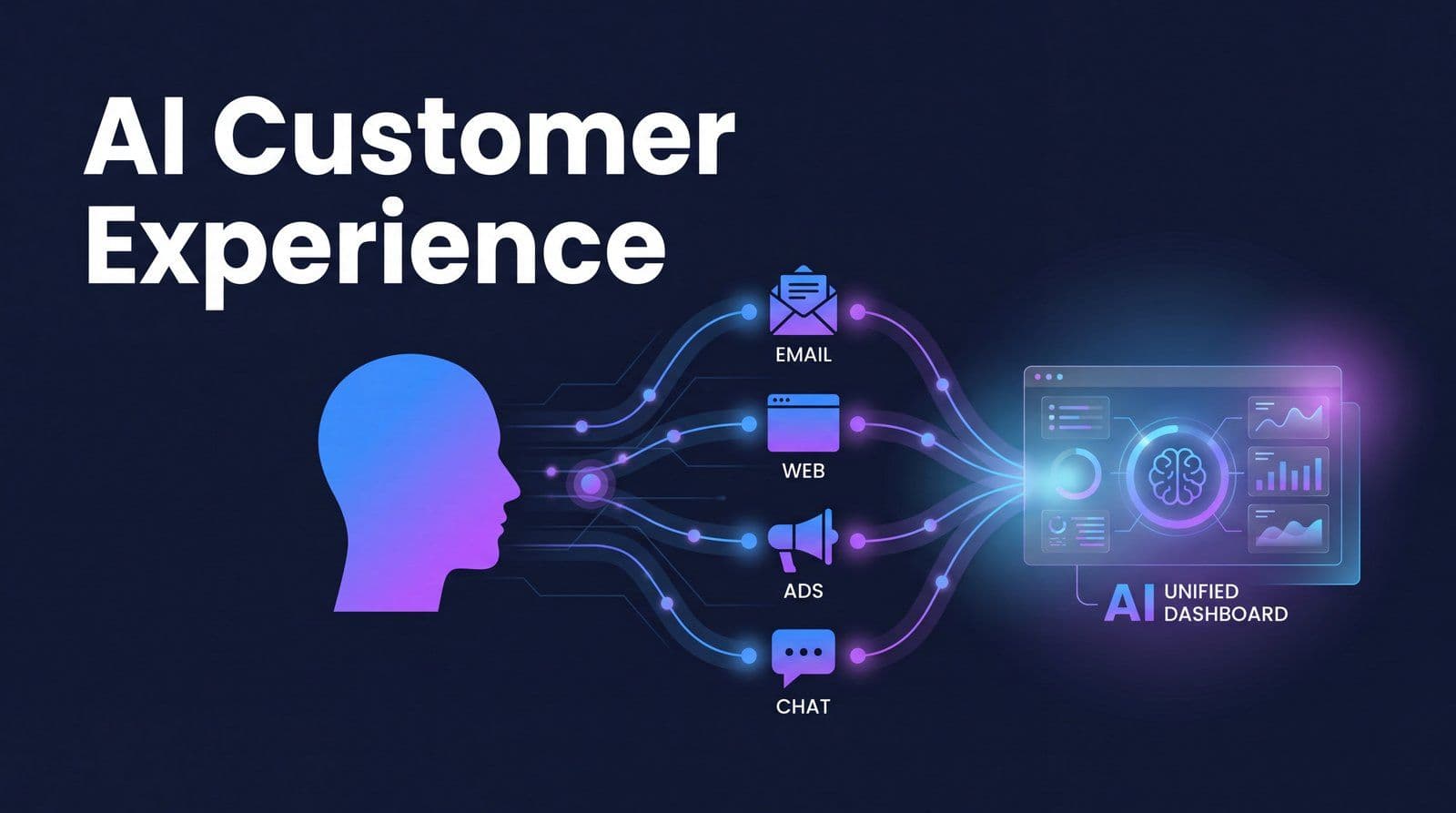
Personalization at a single touchpoint is good. Personalization across every touchpoint is transformative. Customer journey orchestration coordinates messages across email, web, ads, and chat so the customer experiences one continuous story rather than disconnected campaigns. This is the engine behind effective omnichannel marketing and modern lifecycle marketing.
5. Consistent Brand Expression
The hidden risk of AI CX is inconsistency. When dozens of automated touchpoints fire across channels, they can drift off-brand fast. Maintaining a coherent brand voice across every AI-generated interaction is what separates a polished experience from a robotic one. MarqOps approaches this with Brand Intelligence DNA, so AI output stays on-brand from the very first draft instead of needing constant cleanup.
When these five pillars run on the same platform instead of seven disconnected tools, the customer experience stops feeling stitched together and starts feeling designed.
From Reactive to Agentic: The Next Wave
The biggest shift in AI customer experience is the move from reactive AI to agentic AI. Traditional AI predicts. It tells you a customer is likely to churn. Agentic AI acts. It can plan and execute a full retention campaign, from research to outreach, within guardrails you define.
This is not a distant forecast. Already, 34% of enterprise marketing teams run at least one autonomous agent in production, more than double the 14% reported in late 2025. Gartner predicts that by 2027, more than 40% of customer experiences will be driven by agentic systems capable of autonomous orchestration.
By 2026, agentic AI is shifting customer experience from channel-based and reactive to journey-based and autonomous. AI CX is no longer a differentiator. It is the expected baseline.
What makes agentic systems powerful is the feedback loop. Performance data flows back into the system, the agent learns what works, and it adjusts its next action automatically. That is a self-optimizing experience, and it compounds over time. Marketing teams move from running campaigns to supervising outcomes. This builds directly on the rise of conversational marketing, where the conversation itself becomes the channel.
Real AI Customer Experience Examples
The theory is convincing, but the proof is in deployment. A few examples show how far AI CX has already come:
| Brand | AI CX Application | Result |
|---|---|---|
| Klarna | GenAI assistant for shopping and support | Handled the workload of 700 full-time agents in its first month |
| Virgin Money | Redi, a conversational AI assistant | Over 2 million customer interactions at a 94% satisfaction rate |
| Amazon | Rufus, a generative shopping assistant | Real-time, product-specific answers personalized to each shopper |
What these examples share is not a single clever chatbot. It is a system that connects data, intent, and response in real time. The brands winning with AI customer experience treat it as infrastructure, not a feature.
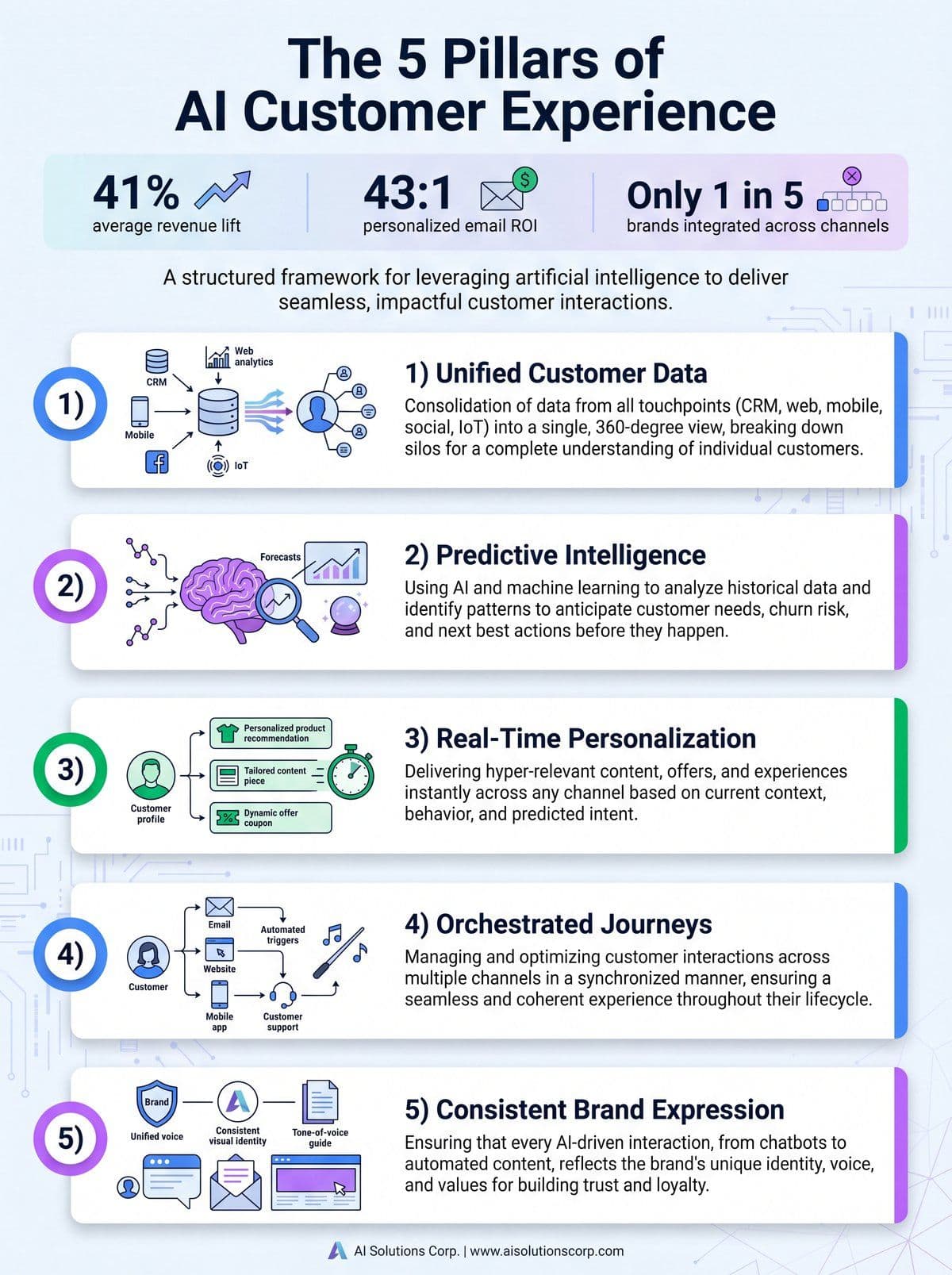
The five pillars of AI customer experience and the 2026 numbers behind them.
The Execution Gap (and How to Close It)
Here is the uncomfortable truth most reports bury. Adoption is not the problem anymore. Execution is. While 96% of companies say AI is improving their customer-facing operations, only 1 in 5 brands have fully integrated AI across their channels. The ambition is there. The plumbing is not.
The root cause is fragmentation. The average marketing team juggles a separate tool for data, another for email, another for ads, another for analytics, and another for creative. Each one holds a slice of the customer, and none of them talk to each other. AI trained on a fragment can only personalize a fragment. The result is a disjointed experience that feels automated in the worst way.
1 in 5
brands have fully integrated AI across channels, even though 96% say AI improves customer-facing work
This is precisely the gap MarqOps was designed to close. By replacing seven or more disconnected tools with one platform, it gives AI a complete view of the customer and a unified dashboard for analytics, ads, SEO, and creative. No tab-switching, no data silos, no off-brand output. That is also why teams report up to 6x faster content production once creative and marketing analytics live in the same system. Closing the execution gap is less about buying more AI and more about removing the seams between the AI you already have. The platforms that win here are the AI marketing platforms built for unification from the start.
A Practical Roadmap for Marketing Teams
You do not need to boil the ocean. A focused, staged approach beats a sprawling transformation every time. Here is a roadmap marketing teams can start this quarter.
Step 1: Audit and unify your data
Map where customer data lives today and how fragmented it is. Consolidate first-party signals into a single profile before adding more AI. Personalization quality is capped by data quality, so this step pays for everything that follows.
Step 2: Pick one high-value journey
Resist the urge to automate everything. Choose a single journey with clear revenue impact, such as cart abandonment, onboarding, or win-back. Instrument it, personalize it, and measure the lift before expanding.
Step 3: Add predictive layers
Introduce churn and lifetime-value models so your AI moves from reactive to anticipatory. Use these scores to prioritize spend and trigger the right experience automatically.
Step 4: Protect the brand
Before you scale automated touchpoints, lock in brand guardrails so every AI-generated message sounds like you. This is where Brand Intelligence DNA keeps a high-volume program from drifting off-tone.
Step 5: Measure, learn, and expand
Tie every experience to a metric, feed results back into the system, and only then widen the scope. The goal is a compounding loop, not a one-time launch.
How to Measure AI CX Success
A roadmap is only as good as the metrics behind it. The mistake many teams make is measuring AI customer experience by activity, such as messages sent or tickets deflected, rather than by outcome. The numbers that matter sit closer to revenue and loyalty.
Track a small, honest set of indicators. On the experience side, watch conversion rate, customer satisfaction, and net promoter score to confirm the experience actually feels better. On the value side, monitor average order value, repeat purchase rate, and lifetime value to confirm the experience is worth more. And on the efficiency side, watch acquisition cost and content production speed, two areas where AI tends to show fast, visible gains. Brands that lead in personalization grow at compound rates roughly 10% higher than laggards, so even small, consistent lifts compound into a meaningful gap over a year.
The trap to avoid is measuring each channel in isolation. A win in email that quietly cannibalizes paid social is not a win. This is where a unified view earns its keep, letting you see the full journey rather than a stack of disconnected dashboards. When measurement lives in one place, the feedback loop that powers agentic systems gets sharper, and your AI gets smarter with every cycle.
AI customer experience in 2026 is not about adding another bot to your stack. It is about giving AI a complete, connected view of the customer so it can deliver experiences that feel personal, consistent, and timely. The teams that unify their data, creative, and analytics will set the standard. Everyone else will spend the year explaining why their experience still feels stitched together.
Frequently Asked Questions
What is AI customer experience?
AI customer experience is the use of artificial intelligence to understand, predict, and shape every interaction a customer has with a brand. It spans the full journey, from the first ad to post-purchase follow-up, using data and behavior signals to deliver the right message at the right time across every channel.
How does AI improve customer experience for marketing teams?
AI improves customer experience by unifying customer data, predicting needs, and personalizing content in real time across channels. Marketing teams using AI report an average 41% revenue increase and a 32% reduction in customer acquisition costs, with personalized email returning 43:1 versus 12:1 without personalization.
What is the difference between traditional AI and agentic AI in CX?
Traditional AI predicts outcomes, such as flagging a customer likely to churn. Agentic AI goes further by planning and executing entire workflows autonomously within set guardrails, such as running a full retention campaign from research to outreach. Gartner predicts that by 2027, more than 40% of customer experiences will be driven by agentic systems.
Why do most AI customer experience programs underperform?
The main reason is fragmentation. While 96% of companies say AI improves customer-facing work, only 1 in 5 have integrated it across channels. When customer data is split across separate tools, AI can only personalize a fragment, which produces disjointed experiences. Unifying data, creative, and analytics in one platform closes this execution gap.
How can a marketing team start with AI customer experience?
Start by auditing and unifying your customer data, then pick one high-value journey to personalize, such as cart abandonment or onboarding. Add predictive models for churn and lifetime value, set brand guardrails so output stays on-tone, then measure results and expand. A staged approach beats a sprawling transformation.
Keep following the signal