Product Marketing in 2026: The Complete Guide to Positioning, Launches, and AI-Powered GTM
What product marketing is, what PMMs own in 2026, and how to build positioning, launches, and messaging that win. Benchmarks, examples, and a 90-day roadmap.

TL;DR
- Product marketing is the discipline that connects what you build to who buys it, owning positioning, messaging, launches, and sales enablement across the full customer journey.
- The stakes are real: 66% of new products fail within two years, and weak positioning is one of the most common causes.
- In 2026, PMMs are AI-augmented operators. 87% of marketers use generative AI in at least one workflow, and 34% of enterprise teams already run autonomous agents in production.
- Category framing is the highest-leverage variable in messaging tests, with winning variants lifting click-to-demo rates by an average of 19 percentage points.
- Platforms like MarqOps unify the research, content, creative, and analytics work that used to require 7+ disconnected tools, so product marketers can ship launches 6x faster.
Table of Contents
- What Is Product Marketing?
- Product Marketing vs Product Management vs Demand Gen
- The Core Responsibilities of Product Marketing in 2026
- Positioning and Messaging: The Foundation
- The Product Launch Playbook
- How AI Is Rewiring Product Marketing
- Product Marketing Metrics That Matter
- Product Marketing Examples Worth Stealing
- Your 90-Day Product Marketing Roadmap
- FAQs
What Is Product Marketing?
Product marketing is the end-to-end discipline of bringing a product to market and keeping it winning there. It covers market and customer research, positioning, messaging, pricing input, go-to-market planning, product launches, sales enablement, and the feedback loops that keep all of it honest. If demand generation answers “how do we get more pipeline,” product marketing answers “why should anyone care about this product in the first place.”
The distinction matters because the failure data is brutal. Roughly 66% of new products fail within two years of launch, and about 70% of projects approved for development never become commercial successes. Most of those products did not fail because engineering shipped something broken. They failed because nobody clearly articulated who the product was for, what problem it solved, and why it beat the alternatives. That articulation work is product marketing.
In practice, product marketing sits at the intersection of product, sales, marketing, and customer success. A strong product marketing manager (PMM) knows the market as well as an analyst, the buyer as well as a rep, and the product almost as well as the product manager. That cross-functional position is exactly why sales and marketing alignment initiatives so often route through the PMM team: they own the shared language both sides use to describe value.
Product Marketing vs Product Management vs Demand Gen
These three roles get confused constantly, so here is the clean separation:
| Role | Core Question | Owns |
|---|---|---|
| Product Management | What should we build, and why? | Roadmap, requirements, prioritization |
| Product Marketing | How do we take it to market and win? | Positioning, messaging, launches, enablement |
| Demand Generation | How do we create and capture demand at scale? | Campaigns, channels, pipeline targets |
Put simply: product managers build the product, product marketers give it a story, and demand generation teams amplify that story until it fills the pipeline. When any one of the three is weak, the other two feel it immediately. A brilliant campaign cannot rescue confused positioning, and crisp positioning goes nowhere without distribution.
Team sizes reflect how strategic the function has become. Across 800+ teams surveyed in 2026, median PMM headcount sits at 4 full-time roles at $50M ARR, 9 at $250M ARR, and 22 at $1B+ revenue. Mid-level PMM salaries now run $120K to $165K base in most US markets, with senior roles at $160K to $210K.
The Core Responsibilities of Product Marketing in 2026
The “Foundational Four” of product marketing remain positioning, messaging, launches, and research. But the 2026 role has expanded in two important directions.
1. Market and customer intelligence
PMMs own the truth about the market: competitor moves, win-loss patterns, pricing shifts, and buyer sentiment. Modern teams tie this intelligence directly to revenue data, tracking buying signals and intent data so competitive insight reaches sales while deals are still open, not in a quarterly readout after they close.
2. Positioning and messaging
The strategic core of the job: deciding what market frame the product competes in, who it serves, and what makes it the obvious choice. More on this below, because it is where most products quietly die.
3. Launch and go-to-market execution
PMMs orchestrate launches across product, sales, marketing, and support. Benchmark data shows the median $50M ARR company runs 2.4 tier-1 launches per year, while the top quartile runs 4.1. That gap compounds: launch quarters average a 38% pipeline lift, so teams that launch well and often simply create more revenue moments. This is also where product marketing overlaps with the emerging discipline of GTM engineering, which automates the operational plumbing beneath launches.
4. Sales enablement
Battlecards, competitive one-pagers, demo narratives, and objection handling guides. Enablement has surged as a PMM responsibility, and AI sales enablement tooling now lets small PMM teams keep hundreds of assets current without weekend heroics.
5. Post-purchase adoption (the new frontier)
PMM involvement in customer onboarding has nearly doubled since 2024. The logic is sound: the person who wrote the value promise should verify it gets delivered in the first 90 days. This shift pairs naturally with product-led growth motions, where the product experience itself is the primary conversion channel.
A useful mental model: product marketing owns the “why us” narrative at every stage of the funnel, from the first ad impression to the onboarding email. If the story changes between touchpoints, buyers notice, and trust leaks.
Positioning and Messaging: The Foundation
Positioning is the decision about what your product is, for whom, and against what alternative. Messaging is how that decision shows up in words. Teams that skip the first step and jump straight to copywriting end up with beautiful sentences about a confusing product.
A workable positioning process has five inputs:
- Competitive alternatives. What would customers do if you did not exist? (Often the answer is “spreadsheets,” not a rival vendor.)
- Unique capabilities. Features and attributes only you have.
- Value themes. What those capabilities actually do for the customer, in outcome language.
- Best-fit customers. The segment that feels the pain most acutely, defined in a living ideal customer profile.
- Market category. The frame of reference that makes your value obvious in seconds.
That last input deserves special attention. In 2026 messaging experiments, category framing tests produced a clear winner 54% of the time, and the winning frame lifted click-to-demo conversion by an average of 19 percentage points. No headline tweak, feature list reorder, or social proof placement comes close to that impact. The category you claim is the single highest-leverage sentence in your marketing.
+19 pts
average click-to-demo lift from a winning category-framing test, the highest-leverage variable in PMM experiments
Once positioning is set, codify it in a messaging framework: one core narrative, three to four supporting pillars, and proof points for each pillar. Every asset, from the homepage to the sales deck to the nurture emails, draws from this single source. Consistency is where an AI brand voice system earns its keep, keeping hundreds of AI-assisted assets on-message without a human reviewing every line.
The Product Launch Playbook
Launches are where product marketing strategy becomes visible. A reliable playbook has three phases:
Pre-launch (6 to 8 weeks out)
- Tier the launch (tier 1 = cross-functional resourcing, paid promotion, full enablement bundle; tier 3 = changelog and email).
- Finalize positioning, messaging, and naming. Test the category frame before committing.
- Build the asset bundle: landing page, demo script, battlecards, FAQ, launch email sequence.
- Enable sales and support teams early enough that they can pitch it before launch day, not after.
Launch week
- Coordinate announcement across owned, earned, and paid channels from one calendar.
- Arm reps with a “who to call first” list built from intent and engagement data.
- Monitor early funnel metrics daily and fix message-market friction fast.
Post-launch (weeks 2 to 12)
- Track adoption, pipeline influence, and win rates, not just signups.
- Feed win-loss insights back into positioning within 30 days.
- Plan the “second wave”: case studies, webinars, and integration stories that extend momentum. Benchmarks show launch pipeline lift decays from +38% in the launch quarter to +12% two quarters later, so the follow-through program matters as much as launch day.
Coordinating all of this across channels is a genuine operational challenge, which is why mature teams treat launches as a marketing orchestration problem: one plan, one asset system, one measurement layer.
How AI Is Rewiring Product Marketing
The 2026 reality: 87% of marketers now use generative AI in at least one workflow, up from 51% in 2024, and 34% of enterprise marketing teams run at least one autonomous agent in production, more than double the share from late 2025. Product marketing has been one of the biggest beneficiaries because so much of the job is synthesis: reading the market, distilling it into narrative, and translating that narrative into dozens of assets.
Four AI shifts matter most for PMMs:
- Always-on competitive intelligence. AI agents monitor competitor sites, pricing pages, reviews, and social channels continuously, turning competitive analysis from a quarterly deck into a live strategic input tied to win-loss data.
- Adaptive messaging. Instead of annual messaging refreshes, AI enables structured testing across personas and segments, so messaging iterates weekly. Combined with agentic marketing systems, winning variants propagate across channels automatically.
- Asset production at launch speed. One approved messaging framework can now generate the landing page, emails, social posts, and sales one-pagers in hours. Marketers report recovering an average of 6.1 hours per week with AI, and 75% of companies report positive ROI from generative AI.
- Insight on demand. PMMs increasingly query campaign and adoption data in natural language rather than wrestling with dashboards, which shortens the loop between signal and decision.
The catch: AI multiplies whatever you feed it. Teams with sharp positioning ship 6x more on-message content. Teams with fuzzy positioning ship 6x more confusion. Get the strategy right first, then scale it.
This is exactly the problem MarqOps was built to solve. Instead of a PMM juggling a research tool, a writing assistant, a design tool, an SEO platform, an ads manager, and an analytics dashboard, MarqOps unifies the stack into one platform with Brand Intelligence DNA at the core. Your positioning, voice, and visual identity live in the system, so every asset the AI produces is brand-perfect from the start, and one platform replaces 7+ disconnected tools.
Product Marketing Metrics That Matter
Product marketing has historically struggled with measurement because its impact routes through other teams. The fix is to measure at three levels:
- Message performance: category-frame test results, landing page conversion, demo request rate, message recall in win-loss interviews.
- Launch performance: launch-quarter pipeline lift, feature adoption at 30/60/90 days, sales asset usage rates, competitive win rate shifts.
- Revenue influence: PMM-touched pipeline, average deal size in well-positioned segments, retention among customers who onboarded against the value narrative.
The connective metric across all three is pipeline, which is why modern PMMs report through the same lens as pipeline marketing: revenue influenced, not activities completed. A unified dashboard for analytics, ads, SEO, and creative removes the tab-switching that used to make this reporting a monthly chore.
Product Marketing Examples Worth Stealing
Slack: reframe the category. Slack positioned itself as “where work happens,” not “enterprise messaging.” The bigger frame expanded its addressable market and made feature-by-feature comparisons with competitors irrelevant. Lesson: pick the category where your strengths are the buying criteria.
Notion: let the community carry the message. Notion’s users created thousands of templates that showed, rather than told, what the product could do, propelling it to a $10B+ valuation. Lesson: the most credible product marketing asset is a customer demonstrating value in public.
Apple: sell outcomes, not specs. “Shot on iPhone” turned customers into the campaign and a camera spec into a cultural statement. Apple rarely competes on price or feature counts; it competes on meaning. Lesson: outcome language beats capability language in every segment where buyers are not engineers.
Your 90-Day Product Marketing Roadmap
Days 1 to 30: Learn the truth
- Run 10 to 15 win-loss and customer interviews.
- Audit existing messaging across the site, decks, and campaigns for consistency gaps.
- Map competitive alternatives, including “do nothing” and spreadsheets.
Days 31 to 60: Decide and codify
- Draft positioning with the five inputs above and pressure-test the category frame with a live A/B test.
- Build the messaging framework: one narrative, three to four pillars, proof points.
- Stand up your AI content system with brand voice and positioning loaded in, so scaling starts on-message.
Days 61 to 90: Ship and measure
- Run one tiered launch end to end with the new framework.
- Refresh sales enablement assets and track their usage.
- Report message, launch, and revenue metrics to leadership, then set the next quarter’s test agenda.
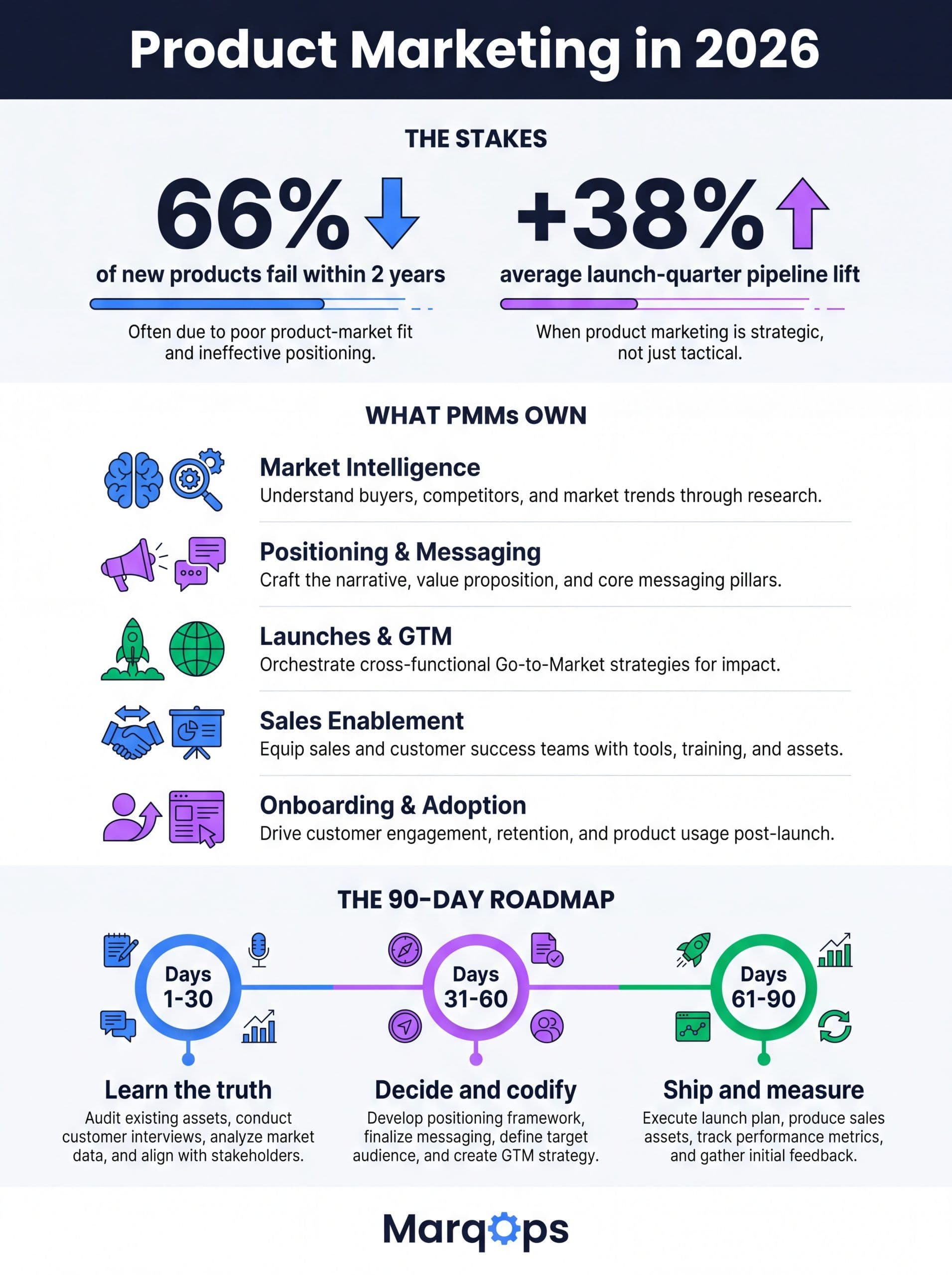
Product marketing in 2026: the responsibilities, benchmarks, and roadmap at a glance.
Frequently Asked Questions
What is product marketing in simple terms?
Product marketing is the work of connecting a product to its market: researching buyers, deciding how to position the product against alternatives, writing the messaging, running launches, and equipping sales teams to sell it. Product managers decide what to build; product marketers make sure the right people understand why it matters and buy it.
What does a product marketing manager (PMM) do day to day?
A PMM’s week typically mixes customer and win-loss interviews, competitive monitoring, writing and testing messaging, planning launches, building sales enablement assets like battlecards, and reporting on adoption and pipeline metrics. In 2026, much of the production work is AI-assisted, so PMMs spend more time on strategy and less on formatting slides.
How is product marketing different from product management?
Product management owns what gets built: the roadmap, requirements, and prioritization. Product marketing owns how it goes to market: positioning, messaging, launch execution, and sales enablement. The two roles are partners; PMs bring market problems in, PMMs carry product value out.
What metrics should product marketing own?
Measure at three levels: message performance (conversion rates, category-frame test results), launch performance (launch-quarter pipeline lift, feature adoption at 30/60/90 days), and revenue influence (PMM-touched pipeline, competitive win rates, retention against the value narrative). Benchmarks show launch quarters average a 38% pipeline lift, making launches the clearest PMM revenue moment.
How is AI changing product marketing?
AI has moved product marketing from periodic to continuous: competitive intelligence runs always-on, messaging is tested and adapted weekly, and one approved framework can generate launch assets in hours instead of weeks. With 87% of marketers using generative AI and a third of enterprise teams running autonomous agents, the differentiator is no longer access to AI but the quality of the positioning you feed it. Unified platforms like MarqOps keep that positioning embedded in every asset the AI produces.
Keep following the signal
Related field notes
Marketing Operations
Marketing Project Management Software in 2026: How to Choose Without Adding Tool #122
11 min readMarketing Analytics
Marketing Attribution Software in 2026: The Buyer's Guide for a Stack That Won't Stop Growing
11 min readMarketing Operations