ChatGPT for Marketing in 2026: The Complete Guide (Plus 30 Prompts)
A practical 2026 guide to ChatGPT for marketing: real use cases across content, SEO, ads, email and social, 30 copy-paste prompts, a prompt framework, and where it falls short.

ChatGPT for Marketing in 2026: The Complete Guide (Plus 30 Prompts)
ChatGPT went from novelty to default marketing tool in under three years. Here is how the best teams actually use it in 2026, the prompts that get results, and the guardrails that keep your brand from sounding like everyone else’s.
TL;DR
- Roughly three in four marketers now use ChatGPT at least weekly, and 65% use it regularly. It is the most common AI model in marketing workflows.
- The highest-value use cases are ideation, first drafts, SEO outlines, ad copy variants, and repurposing. Marketers report saving around 52% of production time.
- Prompt quality decides output quality. Specific prompts loaded with real context (customer language, offers, constraints) beat generic one-liners every time.
- ChatGPT still hallucinates, drifts off brand voice, and produces generic copy that readers spot in two sentences. Human review is not optional.
- ChatGPT is a strong assistant but not a system of record. Teams scaling AI content pair it with brand governance and a unified platform like MarqOps so output stays on brand and connected to SEO, ads, and analytics.
Table of Contents
- What ChatGPT for marketing actually means in 2026
- The adoption data: how marketers really use it
- 7 high-value use cases (with what to watch for)
- 30 ChatGPT prompts for marketing
- The prompt framework that gets better output
- Where ChatGPT falls short for marketing
- Beyond ChatGPT: turning prompts into a system
- FAQs
What ChatGPT for marketing actually means in 2026
When people say ChatGPT for marketing, they no longer mean “type a question and copy the answer.” In 2026, ChatGPT is a working surface that marketers use across the day: brainstorming campaign angles, drafting emails, cleaning up messy briefs, summarizing research calls, building SEO outlines, and spinning one asset into ten. With GPT-5.4 (released March 2026) handling longer context, images, files, and web browsing, the tool covers far more of the workflow than the text box that launched in late 2022.
The shift matters because marketing work is fragmented by nature. A single campaign touches copy, design, SEO, paid media, email, and reporting. ChatGPT slots into each of those steps as a fast first-drafter and thinking partner. That is exactly why it spread so quickly, and also why so many teams end up with inconsistent, off-brand output. The tool is horizontal. Your brand is not.
Quick definition: ChatGPT for marketing is the practice of using OpenAI’s conversational AI to accelerate marketing tasks (ideation, writing, research, analysis, and repurposing) through well-structured prompts, while keeping a human in the loop for strategy, accuracy, and brand voice.
The adoption data: how marketers really use it
Adoption is no longer the story. Usage is nearly universal on marketing teams. What separates results now is how the tool is used.
3 in 4
marketers use ChatGPT at least weekly ~52%
average production time saved on content 60%
use it for content ideation
Survey data through 2026 shows around 65% of marketers use ChatGPT regularly, and it remains the most-named AI model for content creation. About 60% reach for it during ideation and 51% use AI tools for content optimization, including SEO prep and email. Teams that lean on it for first drafts report cutting production time by roughly half, and around 49% use it specifically to build SEO outlines.
Two nuances are worth holding onto. First, only about 5% of all ChatGPT use cases are marketing copywriting, which tells you the tool is a general assistant, not a purpose-built marketing system. Second, marketers increasingly run a multi-model stack: alongside ChatGPT, roughly 15% use Gemini and 10% use Claude. The takeaway is that no single model wins every task, so the smartest teams route work to whichever engine produces the best result. That principle sits at the core of modern generative AI marketing.
7 high-value use cases (with what to watch for)
Here is where ChatGPT earns its keep in 2026, and the failure mode to guard against in each.
1. Content ideation and outlining
ChatGPT is excellent at breaking a blank page. Feed it your audience, offer, and a topic, and it will return angles, headline options, and a structured outline in seconds. This is the single most reliable win. Watch for: safe, obvious angles. Push it with follow-ups like “give me three contrarian takes” before you commit. Pair the output with a real AI content strategy so ideation ladders up to business goals.
2. First-draft copywriting
Landing pages, product descriptions, and long-form drafts come together 60% to 80% faster with a solid brief. The draft is a starting point, not a finish line. Watch for: generic phrasing and invented specifics. Every AI copywriting tool needs an editor who owns voice and facts, which is why brand teams still treat drafts as raw clay. See our AI copywriting tool guide for a fuller workflow.
3. SEO outlines and briefs
ChatGPT can cluster keywords, draft meta descriptions, and structure a page around search intent. In 2026 it is also a research target itself, so optimizing for AI answers matters as much as classic rankings. Watch for: outdated or fabricated stats. Verify every number. Then think about LLM SEO and how your content earns citations inside AI answers.
4. Paid ad copy and variants
Responsive search ads thrive on volume, and ChatGPT can generate dozens of headline and description variants tuned to a keyword theme. Some teams report meaningfully higher click-through and lower cost per click when prompts are specific and paired with disciplined testing. Watch for: policy violations and overclaiming. Combine the variants with AI for Google Ads so testing, not guessing, picks the winners.
5. Email and lifecycle copy
Subject lines, nurture sequences, and re-engagement flows are a natural fit. ChatGPT drafts the sequence, you set the strategy and segmentation. Watch for: bland subject lines that all sound the same. Feed it your best-performing past emails as examples. Our roundup of AI email marketing tools covers where dedicated platforms outperform a raw chat window.
6. Social content and repurposing
One webinar becomes a thread, five posts, a newsletter blurb, and a set of captions. Repurposing is where ChatGPT delivers outsized leverage. Watch for: the tell-tale AI cadence that readers spot instantly on LinkedIn and X. Rewrite hooks in a human voice. See AI content repurposing and the best AI social media post generators for scaled workflows.
7. Research synthesis and analysis
Drop in call transcripts, survey exports, or competitor pages and ask ChatGPT to extract themes, objections, and positioning gaps. This turns hours of reading into a working summary. Watch for: confident misreads. Spot-check against the source. This is a fast on-ramp to using an AI marketing assistant across your whole workflow.
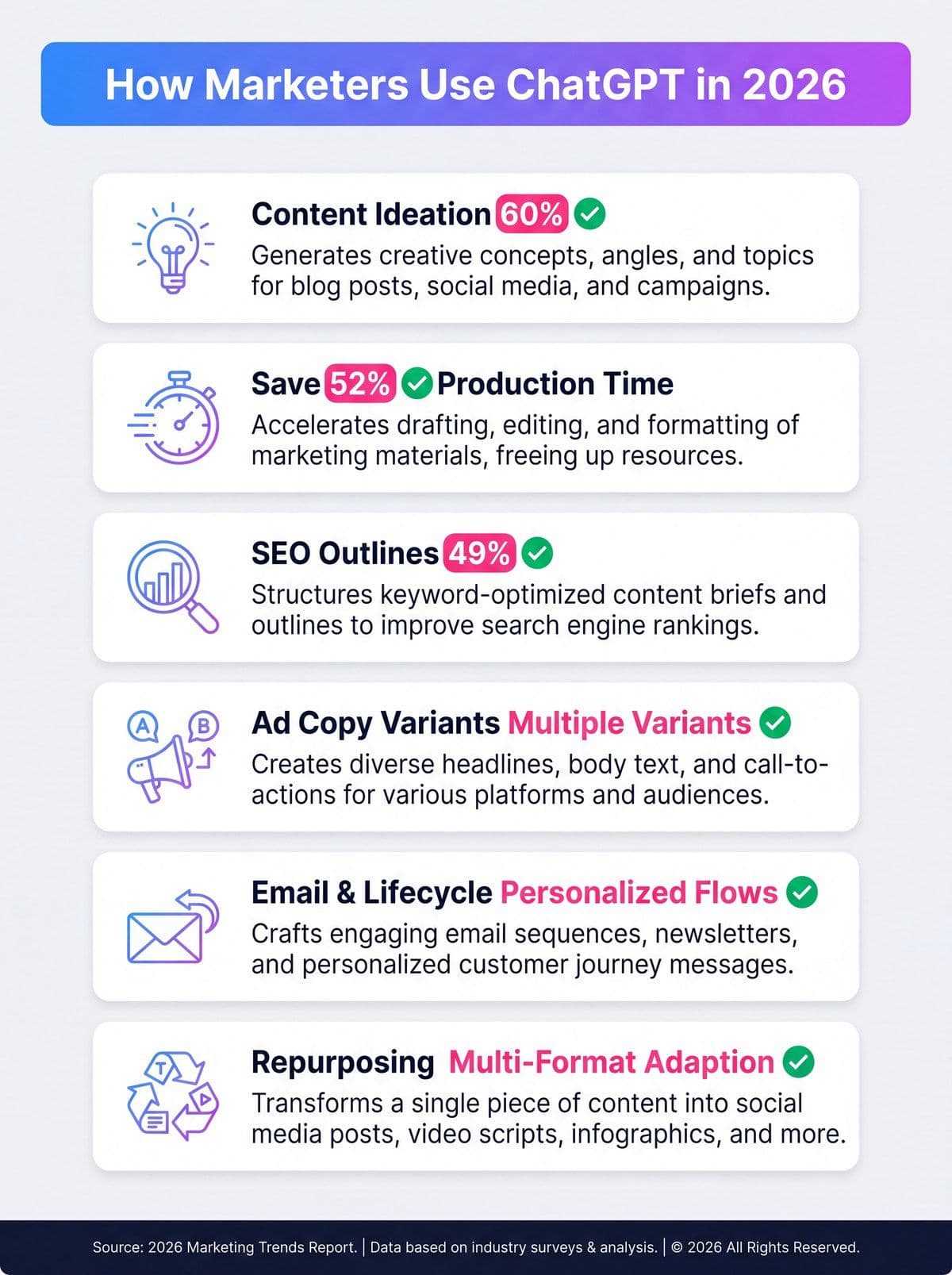
How marketing teams put ChatGPT to work across the funnel in 2026.
30 ChatGPT prompts for marketing
Copy these ChatGPT prompts for marketing, then replace the bracketed placeholders with your real details. The more specific your inputs, the sharper the output.
Strategy and positioning
1. “Act as a CMO. Given this offer: [offer], summarize our positioning in one sentence, then list three sharper alternatives with the trade-off of each.”
2. “Build an ideal customer profile for [product]. Include role, top three pains, buying triggers, and the objection most likely to stall a deal.”
3. “Turn these sales-call notes into a value proposition: [paste notes]. Use the customer’s own words where possible.”
4. “Give me a 90-day content plan for [audience] targeting [goal], mapped to funnel stage with one primary keyword per piece.”
SEO and content
5. “Create an SEO outline for the keyword [keyword]. Include H2s and H3s, search intent, a suggested meta title under 60 characters, and a meta description under 155 characters.”
6. “Cluster these keywords into topic groups and suggest one pillar page per cluster: [paste keywords].”
7. “Rewrite this paragraph to be clearer and more scannable without losing meaning: [paste text].”
8. “Draft 10 FAQ questions and concise answers a buyer of [product] would search for.”
9. “List the questions an AI assistant would need answered to recommend [product], so we can cover them on the page.”
Paid ads
10. “Write 15 responsive search ad headlines (30 characters max) and 4 descriptions (90 characters max) for [product], theme: [keyword theme].”
11. “Give me three ad angles for [audience]: one pain-led, one outcome-led, one social-proof-led.”
12. “Draft primary text, headline, and description for a Meta ad promoting [offer] to [audience].”
13. “Suggest 10 negative keywords to exclude for a campaign selling [product].”
Email and lifecycle
14. “Write a 4-email welcome sequence for [product]. Give each email a goal, subject line, and 120-word body.”
15. “Generate 12 subject lines for [campaign]. Mix curiosity, benefit, and urgency, and flag any that risk spam filters.”
16. “Draft a re-engagement email for subscribers inactive 90 days, tone: [tone].”
17. “Turn this blog post into a newsletter intro of 90 words with one clear CTA: [paste post].”
Social and repurposing
18. “Turn this article into a LinkedIn post with a strong first line and no hashtags: [paste article].”
19. “Write a 6-part X thread from this content, one idea per post: [paste content].”
20. “Give me 10 short-form video hooks for [topic] aimed at [audience].”
21. “Repurpose this webinar transcript into five posts, one newsletter, and three quote graphics: [paste transcript].”
22. “Rewrite this caption to sound like a human wrote it, cut the AI cadence: [paste caption].”
Analysis and operations
23. “Summarize these customer reviews into the top five themes with a representative quote each: [paste reviews].”
24. “Analyze this competitor page and list their messaging, target buyer, and three gaps we could own: [paste text].”
25. “Given this campaign data, tell me what likely drove the change and what to test next: [paste data].”
26. “Draft a creative brief for [asset] including objective, audience, key message, and mandatories.”
27. “Write a QA checklist for reviewing AI-drafted marketing copy before publish.”
28. “Convert this messy brief into a clear one-page spec: [paste brief].”
29. “Draft a landing page wireframe in sections for [offer], with the goal of [conversion goal].”
30. “Create a brand-voice cheat sheet from these three sample posts so future drafts stay consistent: [paste posts].”
The prompt framework that gets better output
The gap between a mediocre and a great ChatGPT output is almost always the prompt. A simple, repeatable structure fixes most of it. Think of it as five parts: role, context, task, constraints, and examples.
Role tells ChatGPT who to be (“Act as a B2B demand-gen marketer”). Context loads real detail: your audience, offer, and the situation. This is the highest-leverage input. Prompts fed with genuine internal context (win-loss language, support tickets, onboarding objections) produce far stronger drafts than a generic topic line. Task states exactly what you want. Constraints set the boundaries: word count, format, tone, what to avoid. Examples show the target by pasting two or three pieces of your best past work.
Rule of thumb: if the output feels generic, the prompt was generic. Add one more layer of real context and specificity, and the quality usually jumps. The best prompt engineering for marketers is really just better briefing.
One more habit that compounds: save your winning prompts. Most teams rewrite the same prompt from scratch every week. A shared prompt library, tied to your brand voice and offers, turns one good result into a repeatable one. That is the bridge from ad hoc chatting to an actual AI content optimization process.
Where ChatGPT falls short for marketing
Being clear-eyed about the limits is what separates teams that scale AI content from teams that quietly damage their brand. Four issues come up again and again in 2026.
Hallucinations are structural. Even the latest models will confidently cite statistics that do not exist, reference reports never published, and attribute quotes to people who never said them. As one AI executive put it, models “will always hallucinate. That will never go away.” For marketers, that means every stat, claim, and citation needs a human check before it ships.
Brand voice drifts. ChatGPT writes in a voice that is technically correct and broadly appealing, but rarely distinct. Readers can spot AI-flavored copy within two sentences, and the moment they do, your brand reads as interchangeable with every competitor defaulting to the same tool. Without a defined voice, AI fills the blanks for you, usually with something generic. This is exactly why a documented AI brand voice matters more than ever.
Output is disconnected. A chat window does not know your SEO targets, your ad performance, your CRM, or last quarter’s analytics. You end up copying text out of ChatGPT and pasting it into seven other tools, losing context at every hop. The writing is fast, but the operation around it is still manual.
It scales sameness. When everyone prompts the same model with similar inputs, everyone gets similar output. In a world where AI content is everywhere, generic at scale is a liability, not an advantage. The winning teams in 2026 use AI with restraint and keep humans firmly in the strategy and voice seats.
The point is not to use ChatGPT less. It is to wrap it in the right process: real context in, human judgment on top, and brand rules that hold no matter which model wrote the draft.
Beyond ChatGPT: turning prompts into a system
ChatGPT is a brilliant assistant. It is not a marketing operating system. The teams getting the most from AI in 2026 have stopped treating “open ChatGPT” as the workflow and started building a system around it: consistent brand rules, the right model for each task, and output that stays connected to SEO, ads, and analytics instead of scattering across tabs.
This is the problem MarqOps was built to solve. Instead of stitching ChatGPT together with six or seven point tools, MarqOps runs creative production, SEO content, paid advertising, and analytics on one platform. Its Brand Intelligence DNA means output arrives on brand from the start rather than needing a heavy edit pass to sound like you. And because it uses a multi-model AI pipeline rather than betting on a single engine, you get the best result for each task instead of vendor lock-in. Teams that move from ad hoc prompting to a unified system regularly report producing content around 6x faster, without the brand drift.
If you already lean on ChatGPT daily, the next step is not a better prompt. It is a place for those prompts to live, run on brand, and connect to everything else you measure. That shift is the heart of a modern AI marketing strategy, and it is where casual AI use becomes a durable advantage.
Frequently asked questions
Is ChatGPT good for marketing?
Yes, for the right jobs. ChatGPT is strong at ideation, first drafts, SEO outlines, ad variants, and repurposing, and most marketers save around half their production time on those tasks. It is weaker at final brand-voice copy, accurate facts, and anything that needs live business data, so a human stays in the loop for strategy, accuracy, and voice.
What are the best ChatGPT prompts for marketing?
The best prompts assign a role, load real context (audience, offer, past examples), state a clear task, and set constraints like word count and tone. Practical starting points include SEO outline prompts, responsive search ad headline prompts, welcome-email-sequence prompts, and repurposing prompts. The 30 prompts above cover strategy, SEO, ads, email, social, and analysis.
Can ChatGPT replace a marketing team?
No. ChatGPT accelerates individual tasks but cannot own strategy, judgment, brand voice, or accountability. It does not know your live performance data and it hallucinates facts. Think of it as leverage for your team, not a replacement, and pair it with human review and a system that keeps output on brand.
How do I keep ChatGPT content on brand?
Give it examples of your best writing, a documented brand-voice cheat sheet, and specific constraints in every prompt. Always edit the draft rather than publishing raw output. At scale, a platform with built-in brand governance, like MarqOps and its Brand Intelligence DNA, enforces voice automatically so drafts arrive on brand instead of needing a rewrite.
Should I only use ChatGPT, or other AI models too?
Most marketing teams now run a multi-model stack. ChatGPT is the most common, but many also use Gemini and Claude because different models excel at different tasks. A multi-model approach avoids vendor lock-in and gives you the best output per task, which is why unified platforms route work across engines rather than relying on one.
ChatGPT will keep getting better at the tasks above. The teams that win are not the ones with the cleverest prompt, but the ones that put AI inside a system that protects their brand and connects the work. That is the shift from using ChatGPT to operating with it.
Keep following the signal
Related field notes
Marketing Operations
Marketing Project Management Software in 2026: How to Choose Without Adding Tool #122
11 min readMarketing Analytics
Marketing Attribution Software in 2026: The Buyer's Guide for a Stack That Won't Stop Growing
11 min readMarketing Operations