AI Marketing Agency in 2026: What They Do, What They Cost, and How to Spot the Fakes
A complete 2026 guide to AI marketing agencies: what they actually do, real pricing benchmarks ($1K to $50K+/month), the margin trap squeezing agency profits, and seven questions that expose AI washing.

Every marketing agency now calls itself an AI marketing agency. Very few of them are. The gap between the two is where budgets get burned, and in 2026 it is a gap worth roughly $3,000 to $15,000 a month of your retainer.
This guide covers both sides of the table. If you are hiring an AI marketing agency, you will learn what they actually do, what the going rates are, and the seven questions that separate real capability from AI washing. If you run an agency, you will learn why AI is quietly compressing your margins and what the agencies with 30% profit margins are doing differently.
TL;DR
- An AI marketing agency uses AI systems to run strategy, content, media buying, and reporting, rather than just using ChatGPT to draft copy faster.
- Pricing in 2026: $1K to $3K/month entry level, $3K to $8K/month for boutique multi-channel, $10K to $50K+/month for full-service. AI SEO retainers average around $3,200/month.
- Adoption is near-universal but shallow. 87% of marketers use generative AI in at least one workflow, yet only 41% of agencies have shipped an actual AI agent.
- The margin trap is real. AI compresses delivery timelines 3 to 4x, which means the same client outcome generates far fewer billable hours. Hourly billing is dying.
- AI washing is epidemic. The tell is not the pitch, it is whether the agency can name its tools, show its pipeline, and configure attribution before the first publish.
- The winners consolidate. Teams running five or fewer core tools generate 23% higher marketing-attributed pipeline per head than teams juggling 25 or more.
Table of Contents
- What Is an AI Marketing Agency?
- The Three Models: Assisted, Native, and Platform-Led
- What an AI Marketing Agency Actually Does
- What It Costs in 2026
- The Margin Trap Nobody Puts in the Pitch Deck
- How to Vet One: 7 Questions That Expose AI Washing
- How to Build an AI-Native Agency
- Frequently Asked Questions
What Is an AI Marketing Agency?
An AI marketing agency is a marketing services firm that uses artificial intelligence as the operating layer of its delivery, not as a garnish on top of it. The distinction matters more than it sounds.
A traditional agency with a ChatGPT subscription is still a traditional agency. The strategist still writes the brief by hand, the copywriter still drafts in a doc, the media buyer still logs into six dashboards on Monday morning, and the account manager still assembles the report in slides on Thursday night. AI shaved a few hours off each step. The shape of the work did not change.
A genuine AI marketing agency changes the shape. Research runs continuously instead of quarterly. Content is generated against a codified brand model rather than a style guide PDF nobody opens. Bid adjustments happen because an agent detected an anomaly at 3am, not because someone noticed on Tuesday. Reporting is a live surface, not a deliverable.
The practical test: if you removed the AI tooling tomorrow, would the agency’s output slow down by 20% or would it stop? If it merely slows down, you are buying a traditional agency at a premium.
The Three Models: Assisted, Native, and Platform-Led
Most agencies calling themselves AI-powered fall into one of three tiers. Knowing which one you are talking to tells you what you are really paying for.
1. AI-Assisted (the majority)
Humans do the work, AI speeds up individual tasks. Copy drafts, image variations, meeting summaries. This is where roughly 87% of marketers already sit, and it is genuinely useful. HubSpot’s 2026 trends data has marketers recovering about 6.1 hours a week on average. But it is table stakes, not a differentiator, and it does not justify a premium retainer.
2. AI-Native (the real thing)
AI agents own defined workflows end to end, with humans reviewing at checkpoints rather than executing every step. An SEO agent runs the keyword research, drafts the brief, produces the piece, and queues it for editorial review. A media agent monitors spend pacing and flags or pauses underperformers. Only 41% of agencies have even one agent shipped, though that is up sharply from 9% a year earlier. This is where agentic marketing stops being a buzzword and starts being an operating model.
3. Platform-Led (the emerging model)
The agency runs on a single unified platform rather than stitching together a dozen point tools. Strategy, content supply chain, paid media, creative, and analytics live in one system that shares a common brand model and a common data layer. Delivery gets faster because nothing has to be re-explained to a new tool at every handoff.
This is the model MarqOps was built for. One platform replaces 7+ disconnected marketing tools, and a Brand Intelligence DNA layer means every asset comes out on-brand from the first generation instead of after the third revision round.
What an AI Marketing Agency Actually Does
Strip away the positioning and the deliverables cluster into four areas. Here is what “AI-powered” should mean in each.
Content and SEO operations
Not “we use AI to write blog posts.” The real version: continuous keyword and SERP monitoring, briefs generated from live competitive gaps, drafts produced against a codified brand voice, and an editorial layer where a human strategist actually kills the bad ones. Increasingly this also means optimizing for AI search, since a growing share of queries never produce a click. If your agency cannot explain GEO versus SEO or how AI Overviews are eating your top-of-funnel traffic, they are optimizing for the internet of 2022.
Paid media
Automated bid and budget management, creative variant generation at volume, and anomaly detection that catches a runaway campaign before it burns a week of budget. Google and Meta have absorbed much of the tactical optimization already, which means the agency’s value has moved upstream into creative, feed quality, and measurement. Good AI PPC management is now mostly about giving the platform’s algorithm better inputs and honest conversion signals.
Creative production
Volume without brand drift. This is the hardest one to do well, because most AI creative output is fast and slightly wrong, which creates more review work than it saves. The agencies that get it right encode brand rules into the generation step itself rather than catching violations in QA. Creative automation only pays off when the first draft is usable.
Analytics and attribution
A live marketing dashboard instead of a monthly slide deck, plus honest measurement. Ask specifically how they handle multi-touch attribution and whether they run incrementality tests. Any agency that reports last-click ROAS and calls it proof of value is selling you a number, not a result. Clean AI marketing analytics is the least glamorous part of the stack and the fastest way to tell a serious shop from a dressed-up one.
What It Costs in 2026
Pricing has stratified. Here are the current bands.
| Tier | Monthly Cost | What You Get |
|---|---|---|
| Freelancer / small shop | $1,000 to $3,000 | One or two channels. Usually AI-assisted, rarely AI-native. |
| Boutique agency | $3,000 to $8,000 | Multi-channel campaigns, dedicated account management. |
| Full service | $10,000 to $50,000+ | Mid-market and enterprise. Strategy, media, creative, measurement. |
| AI SEO retainer (avg) | ~$3,200 | Range runs $2,000 to $20,000+ depending on scope. |
| Custom AI build | $50K to $500K+ (project) | Bespoke systems. Ongoing monitoring runs $500 to $5,000/month. |
The more interesting shift is in how agencies charge. The hybrid retainer-plus-performance model is where the profitable shops are landing: a $3,000 base plus $50 per qualified lead over target, or a $5,000 base plus 5% of attributable new revenue. About 38% of US digital agencies have moved at least one service line off hourly billing, and 29% report clients pushing back on hourly rates specifically because they know AI made the work faster.
3.2x
Median reported ROI on agentic AI. But the bottom quartile sits at 0.7x, below break-even.
That spread is the whole story. AI does not reliably return value. It returns value when it is wired into a real workflow with real measurement, and it quietly destroys value when it is bolted on for the pitch.
The Margin Trap Nobody Puts in the Pitch Deck
Here is the uncomfortable math, and it is aimed at agency owners.
AI is compressing deliverable timelines by 3 to 4x at some creative shops. If you bill hourly, you just cut your own revenue for the same client outcome. You made the work cheaper to produce and handed the entire saving to the client. The average digital agency earned a 13% after-tax net margin in 2025, down from a long-run average closer to 15%. That is not a coincidence.
Meanwhile the staffing pyramid is inverting. 23% of agencies cut junior copywriting headcount in 2025 and 31% planned further cuts in 2026, while demand for senior strategists climbed. The bottom of the pyramid was always where agencies made their margin. AI ate it.
There are only three honest responses:
- Charge for outcomes, not hours. Value-based pricing is projected to cover 25 to 30% of agency service lines by end of 2027. McKinsey already ties roughly a quarter of its global fees to measurable client outcomes.
- Take on more clients per head. Only works if your delivery is genuinely systematized, which brings us to the tool problem.
- Move up the value chain. Sell strategy, measurement, and GTM engineering, where judgment still commands a premium.
Most agencies are attempting none of the three and wondering why a 3x productivity gain did not show up in the P&L.
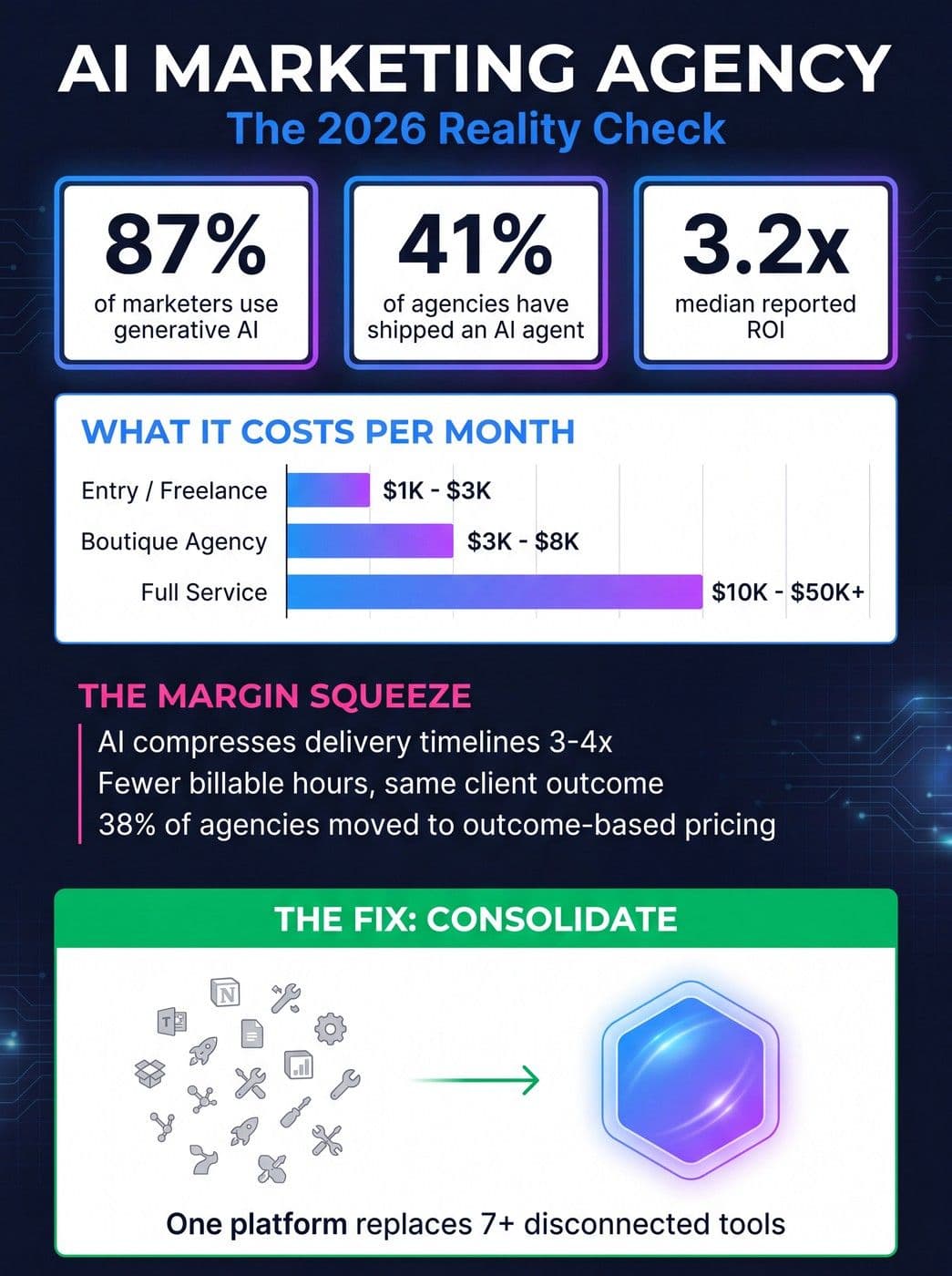
The AI marketing agency landscape in 2026: adoption, pricing, and the margin squeeze.
How to Vet One: 7 Questions That Expose AI Washing
AI washing is the practice of layering AI language over a product or service that has no real AI underneath. It is rampant, and the FTC has been actively pursuing cases under its Operation AI Comply sweep. The good news is that it collapses under specific questions, because genuine practitioners answer from experience and AI washers answer from a slide deck.
Ask these, and listen for operational grounding rather than confidence:
- “Name the specific tools and models in your pipeline, and what each one does.” Real answer: a list, with roles, and an opinion about why. Washed answer: “proprietary AI technology.”
- “Walk me through what a human reviews before something reaches me.” If there is no editorial checkpoint, you are the QA layer.
- “Show me a piece of work and tell me which parts the AI produced.” Genuine shops are relaxed about this. Washers get cagey.
- “How will you configure conversion tracking and UTM parameters before the first publish?” If they cannot set up GA4 conversion events before anything ships, they cannot connect their work to your revenue. This is disqualifying, not a minor setup detail.
- “What is your AI governance and data policy?” An agency claiming heavy AI usage with no privacy or data governance framework is either exaggerating or exposing you to liability.
- “What did AI get wrong on a recent client, and what did you change?” The single best question. Nobody with real deployment experience lacks a war story. A flawless answer is a fabricated one.
- “What happens to my brand voice at volume?” Ask how brand rules are enforced. If the answer is “our writers review everything,” their AI is not doing much. If it is a codified AI brand voice model applied at generation time, they have actually built something.
Two more red flags worth naming. Deflecting case study questions to NDAs is usually concealing the absence of case studies, not protecting them. And rebranding a 2018 rules-based chatbot as a “conversational AI agent” without a single software update is textbook AI washing.
How to Build an AI-Native Agency
If you run an agency and the margin section above stung, here is the rebuild.
Step 1: Kill the tool sprawl
Most agencies in the 5 to 30 person band run six to nine separate subscriptions. Mid-market marketing teams run 18 to 25 tools. Gartner has the average enterprise at 91 martech tools using only 42% of their capabilities. Every one of those seams is a place where brand context, campaign data, and institutional knowledge get dropped on the floor.
The payoff for fixing it is measurable. Teams with five or fewer core tools generate 23% higher marketing-attributed pipeline per head than teams managing 25 or more, driven by less integration overhead and cleaner data (92% clean attribution rates versus 67% in sprawling stacks). Audit your marketing tech stack and be ruthless.
Step 2: Build a brand intelligence layer
The reason AI output needs so much rework is that the model has no persistent understanding of the brand. It gets a prompt, not a memory. Encode voice, positioning, visual rules, banned claims, and proof points into a layer that every generation step reads from. This is the difference between AI that saves your team time and AI that creates a new review queue.
Step 3: Ship agents, not prompts
A prompt is a task. An agent owns a workflow with a defined trigger, a defined output, and a defined escalation path. Start with one: the weekly reporting pack, the SEO brief, the ad copy variant set. Get it genuinely reliable before you build a second. The 41% of agencies with an agent shipped are not doing anything exotic. They just picked one workflow and finished it.
Step 4: Reprice
Once delivery is systematized, hourly billing is actively working against you. Move to retainer-plus-performance or outcome pricing so that your efficiency gain lands in your margin instead of your client’s.
Agencies running on MarqOps report roughly 6x faster content output, because the brand model, the content engine, the ad tooling, and the analytics all sit on one data layer. No re-briefing a new tool at every handoff.
Frequently Asked Questions
What does an AI marketing agency do?
An AI marketing agency uses artificial intelligence to run marketing workflows rather than just accelerate individual tasks. In practice that means continuous keyword and competitor research, content produced against a codified brand model, automated bid and budget management with anomaly detection, creative generated at volume within brand rules, and live attribution reporting instead of monthly slide decks. The key test is whether AI owns defined workflows end to end or simply speeds up a human doing the same job.
How much does an AI marketing agency cost?
Most AI marketing agency retainers run $3,000 to $15,000 per month in 2026. Entry-level packages from freelancers and small shops cost $1,000 to $3,000 per month for one or two channels. Boutique agencies charge $3,000 to $8,000 for multi-channel work with dedicated account management. Full-service agencies serving mid-market and enterprise clients charge $10,000 to $50,000+. AI SEO services average around $3,200 per month. Custom AI development projects are priced separately, typically $50,000 to $500,000+.
Is an AI marketing agency worth it, or should I just use AI tools myself?
It depends on whether you need capability or capacity. AI tools have collapsed the cost of production, so if your bottleneck is drafting content or generating creative variants, a platform plus one competent in-house marketer often beats a retainer. If your bottleneck is strategy, measurement, or channel expertise you do not have internally, an agency still earns its fee. What almost never makes sense is paying agency rates for output you could generate yourself in an afternoon.
How do I know if an agency is really using AI or just saying it is?
Ask them to name the specific tools and models in their pipeline and describe what each one does. Genuine practitioners answer with specifics and opinions. AI washers answer with phrases like “proprietary AI technology” and cannot describe their workflow. Two other reliable tells: ask whether they can configure GA4 conversion events and UTM tracking before the first publish, and ask what AI got wrong on a recent client engagement. Anyone with real deployment experience has a war story.
Will AI replace marketing agencies?
It is replacing a specific layer of them. Junior production work is being automated fast, with 23% of agencies cutting junior copywriting headcount in 2025 and 31% planning further cuts. But demand for senior strategists, technical analysts, and AI-native operators is growing. The agencies at risk are the ones whose value was throughput. The ones whose value is judgment, measurement, and accountability for outcomes are doing fine, and often charging more.
What is the ROI of AI in marketing?
Median reported ROI on agentic AI sits around 3.2x, but the distribution is wide enough to be a warning: the bottom quartile of deployments come in at 0.7x, below break-even. By use case, McKinsey data puts AI content drafting at roughly 3.2x, personalization engines at 2.7x, audience research at 2.4x, and ad copy at 2.3x. The variance is explained almost entirely by whether the AI is wired into a measurable workflow or bolted on top of one.
The Short Version
If you are buying, ignore the word “AI” on the website and interrogate the pipeline. Specificity is the signal. If the agency cannot tell you which model writes the draft, who reviews it, and how conversion is tracked before anything ships, you are paying a premium for work you could get cheaper elsewhere.
If you are building, the productivity gain is real but it does not automatically become profit. It becomes profit only when you consolidate the stack, encode the brand once instead of re-explaining it to every tool, ship agents that own whole workflows, and price for the outcome rather than the hour.
The agencies that figure this out are not going to be competing on headcount much longer. They will be competing on how good their systems are.
Keep following the signal
Related field notes
Marketing Operations
Marketing Project Management Software in 2026: How to Choose Without Adding Tool #122
11 min readMarketing Analytics
Marketing Attribution Software in 2026: The Buyer's Guide for a Stack That Won't Stop Growing
11 min readMarketing Operations