AI Market Research Tools in 2026: 10 Platforms That Turn Data Into Decisions
Discover the 10 best AI market research tools in 2026. Compare features, pricing, and use cases from competitor analysis to brand monitoring and audience insights.

TL;DR
AI market research tools are replacing manual surveys, scattered spreadsheets, and gut-feel decisions with real-time data, automated competitor tracking, and synthetic audience testing. In 2026, 87% of marketers use generative AI in at least one workflow, and market intelligence agents can save up to a full workday per week per analyst. This guide compares 10 top platforms – from Crayon and SparkToro to Brandwatch and MarqOps – so you can pick the right mix for competitor analysis, brand monitoring, audience insights, and trend tracking. Skip ahead to our comparison table if you already know what you need.
Table of Contents
- What Are AI Market Research Tools?
- Why the Shift Is Happening Right Now
- 5 Core Use Cases for AI in Market Research
- How to Choose an AI Market Research Tool
- Top 10 AI Market Research Tools in 2026
- Side-by-Side Comparison Table
- A Practical AI-Powered Research Workflow
- Common Pitfalls and How to Avoid Them
- FAQs
- Next Steps
What Are AI Market Research Tools?
AI market research tools are software platforms that use machine learning, large language models, and predictive analytics to gather, synthesize, and act on market data without the heavy lifting traditional research requires. Instead of running multi-week studies and waiting on slide decks, marketing teams pull in continuous signals from competitor websites, social platforms, review sites, search trends, and survey panels – then let AI surface what matters in minutes.
The category covers a wide range of capabilities: competitor tracking, brand sentiment monitoring, synthetic audience testing, trend detection, primary survey automation, and predictive demand forecasting. The common thread is that AI does the heavy analysis work so marketers can focus on judgment and execution.
For marketing operations leaders looking to unify these capabilities under one roof, platforms like MarqOps integrate brand intelligence, content creation, and market signals into a single dashboard – so research insights flow directly into campaigns instead of getting stranded in a research team silo.
Why the Shift Is Happening Right Now
Three forces are converging in 2026 to make AI-powered research a default rather than an experiment:
1. Adoption has crossed the tipping point. 94% of companies globally now use AI in at least one business function, and 87% of marketers use generative AI in at least one workflow – up from 51% just two years ago. This means competitors are already moving faster on insights, and teams that still rely on quarterly research cycles are losing ground.
2. Time savings are real and measurable. HubSpot’s 2026 AI Trends report finds that marketers recover 6.1 hours per week on average using AI, with senior practitioners saving 8 to 10 hours. Salesforce reported a 20% productivity boost across teams using market intelligence agents – roughly one full workday per week per analyst.
3. ROI is showing up in the data. 71% of marketing leaders who adopted AI in 2024-2025 report positive ROI within six months, compared with 48% just two years earlier. Hyperpersonalized marketing fueled by better audience research is producing 10 to 30% revenue lift in the organizations that deploy it well.
The implication is clear: AI market research is no longer about “trying something new.” It is about staying competitive in an environment where rivals are running 10 to 15 times faster on campaign creation and optimization, often informed by always-on intelligence agents.
5 Core Use Cases for AI in Market Research
1. Competitor Intelligence
AI agents continuously scrape competitor websites, ad libraries, pricing pages, and product launches. Instead of a quarterly competitor deck, you get real-time alerts when a rival changes positioning, drops a new feature, or launches a campaign. Tools like Crayon and SimilarWeb dominate here.
2. Brand and Sentiment Monitoring
Social listening platforms with AI sentiment analysis track how your brand and competitors are perceived across millions of conversations. Brandwatch, Sprout Social, and Talkwalker process language nuance that older keyword-based tools miss – sarcasm, emerging slang, contextual praise versus complaint.
3. Audience Insights and Persona Discovery
AI clusters audiences by behavior, interests, and language patterns instead of crude demographics. SparkToro and Audiense pull “where your audience hangs out” data from across the web – podcasts they listen to, accounts they follow, sites they read – and turn it into addressable segments. For deeper persona work, see our guide to AI customer segmentation.
4. Survey and Primary Research Automation
Tools like Attest, Quantilope, and Remesh run AI-moderated surveys and qualitative panels. AI codes open-ended responses, surfaces themes, and generates report-ready insights in hours – not weeks. Synthetic audience testing (using LLMs to simulate target persona reactions) is also gaining ground for early-stage concept testing.
5. Trend and Demand Forecasting
Google Trends, Glimpse, and Exploding Topics use AI to spot emerging keywords, products, and behaviors before they hit mainstream tracking tools. Pair this with your own analytics through a marketing intelligence platform and you can move on opportunities while competitors are still planning.
How to Choose an AI Market Research Tool
The “best” tool depends on what you are actually trying to learn. Use this short checklist before you commit to a contract:
Define the research question first. Are you tracking competitor moves, validating a positioning hypothesis, sizing a market, or monitoring brand health? Each maps to a different category of tool. Buying a survey platform when you really need competitor intelligence is the most common mistake we see.
Check the data sources. Some tools pull from public web data (great for competitive and trend work), others rely on opt-in consumer panels (better for primary research and demographic accuracy). Ask the vendor exactly where data originates, how recent it is, and how they handle gaps.
Test the AI quality, not the marketing copy. Run the same question through three vendors and compare the synthesis. Watch for hallucinations, generic summaries, and broken citations – all three are still common in 2026.
Look at integrations. A tool that only lives inside its own dashboard creates another silo. Look for native connections into your CRM, analytics stack, ad platforms, and content tools. The goal is insights that flow into action – not PDFs that sit in Slack.
Evaluate cost per insight, not per seat. Some platforms charge by user, others by query volume or data refresh rate. Map your real research cadence to the pricing model before signing.
Top 10 AI Market Research Tools in 2026
1. MarqOps
Best for: Marketing teams that want brand intelligence, market signals, and content execution in a single platform.
MarqOps replaces 7 or more disconnected tools with a unified system that pulls competitor activity, brand sentiment, SEO trends, and ad performance into one dashboard – then turns those insights directly into on-brand creative and content. The Brand Intelligence DNA layer means every output, from a research summary to a campaign asset, is anchored to your voice and visual identity from the start.
Pricing: Starts free, scales with usage. Start Free – No Card Required.
2. Crayon
Best for: Real-time competitor tracking and battlecards.
Crayon monitors millions of data sources for competitor changes – pricing, product launches, content, hiring, executive movements. Sales and product marketing teams use it to keep battlecards current and surface competitive threats before they show up in lost-deal reports.
3. Brandwatch
Best for: Enterprise social listening and brand reputation.
Brandwatch aggregates billions of online conversations and runs AI sentiment analysis across them. Strong for global brands monitoring perception in multiple languages and tracking how campaigns land across communities.
4. SparkToro
Best for: Audience research without surveys.
SparkToro answers “where does my audience actually spend time?” by analyzing what real users follow, read, and listen to. Perfect for finding podcasts to pitch, influencers to partner with, and publications to target.
5. SimilarWeb
Best for: Traffic and digital footprint analysis.
SimilarWeb gives you competitor traffic estimates, top channels, keyword exposure, and audience overlap. Combined with your own analytics, it shows where competitors are winning and where the white space is.
6. Quantilope
Best for: Quantitative research automation.
Quantilope automates the heaviest parts of quantitative studies – segmentation, MaxDiff, conjoint analysis – and uses AI to generate insights and reports. Cuts traditional study timelines from weeks to days.
7. Attest
Best for: On-demand consumer surveys.
Attest delivers fielded consumer surveys in 124 countries with AI-assisted question design and instant analysis. Useful for fast concept testing, brand tracking, and category exploration.
8. Perplexity AI
Best for: Cited, real-time desk research.
Perplexity is a search engine built on LLMs that returns sourced answers to research questions. Many teams use it as a faster alternative to manual web research for sizing markets, finding stats, and synthesizing reports.
9. Glimpse
Best for: Spotting rising trends.
Glimpse analyzes Google Trends data and consumer behavior signals to identify trends before they peak. Helpful for content planners and product marketers looking for early-stage themes.
10. Audiense
Best for: Social audience segmentation and influencer mapping.
Audiense clusters social audiences into behavioral segments and surfaces high-affinity creators within each group. Strong for influencer programs and social-first targeting.
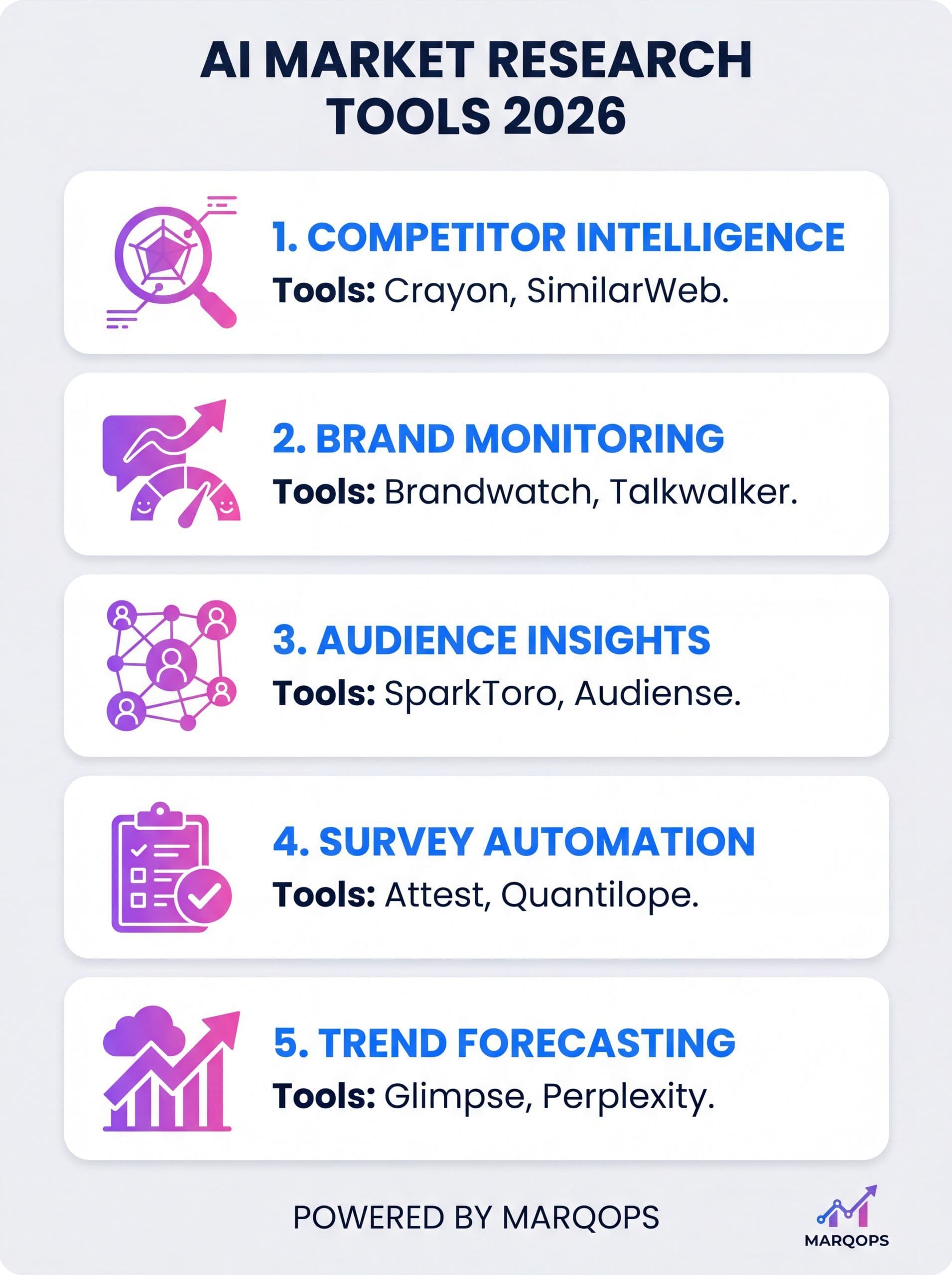
AI Market Research Tools at a Glance: capabilities, use cases, and ideal teams.
Side-by-Side Comparison Table
| Tool | Primary Use | Best For | Pricing Tier |
|---|---|---|---|
| MarqOps | Unified brand intelligence + content | Marketing teams replacing 7+ tools | Free to Enterprise |
| Crayon | Competitor tracking | Sales and product marketing | Mid to Enterprise |
| Brandwatch | Social listening | Enterprise brand teams | Enterprise |
| SparkToro | Audience research | Content and PR teams | SMB to Mid |
| SimilarWeb | Traffic analysis | Growth and SEO | Mid to Enterprise |
| Quantilope | Quant research | Insights teams | Enterprise |
| Attest | Consumer surveys | Brand and product | Mid |
| Perplexity AI | Desk research | Any researcher | Free / Pro |
| Glimpse | Trend spotting | Content and product | SMB to Mid |
| Audiense | Audience clustering | Social and influencer | Mid |
A Practical AI-Powered Research Workflow
Buying tools is the easy part. Here is how the highest-performing teams actually run a research cycle in 2026:
Monday – signal sweep. Run automated competitor and category alerts (Crayon, SimilarWeb, Brandwatch). Pull a weekly intelligence brief that synthesizes what changed in your market in the last 7 days.
Tuesday and Wednesday – audience deepening. Use SparkToro or Audiense to refresh persona data. Run a small Attest survey if you need primary signal on a specific question.
Thursday – synthesis. Bring everything into one workspace. Teams using a unified marketing dashboard avoid the silo problem here. Use AI to draft an executive summary and a recommendation memo.
Friday – decision and action. Translate insights directly into briefs, content, or campaign updates. This is where most research dies in older workflows. Platforms that connect insights to creative output (like MarqOps) collapse the gap. For more on that connection, see our take on creative automation.
Common Pitfalls and How to Avoid Them
Pitfall 1: Treating AI output as ground truth. AI summaries hallucinate. Cross-check every stat against the original source, especially for numbers and dates. Use tools that show their citations.
Pitfall 2: Buying for capability, not workflow. A best-in-class tool that nobody uses is a sunk cost. Run a 30-day pilot with the team that will actually own the tool before signing an annual contract.
Pitfall 3: Ignoring the integration layer. If insights cannot flow into your CRM, content tools, or ad platforms, they will not change behavior. Bake integration testing into your evaluation. A unified marketing tech stack matters more than any one tool.
Pitfall 4: Letting research outpace decisions. Some teams over-research and under-decide. Set a clear cadence: every insight needs a “so what” and a directly responsible owner within 5 business days.
Pitfall 5: Privacy and compliance gaps. Make sure any tool that handles personal data is GDPR, CCPA, and SOC 2 compliant – and that your vendor’s AI training practices align with your own data policies.
FAQs
What is the best AI tool for market research in 2026?
There is no single “best” – it depends on the question. For unified brand intelligence and content execution, MarqOps. For competitor tracking, Crayon. For audience research, SparkToro. For desk research, Perplexity. The best teams stack 2 to 4 tools that cover different layers and integrate them into one dashboard.
Are there free AI market research tools that actually work?
Yes. Perplexity AI has a strong free tier for desk research, Google Trends and Exploding Topics offer free trend data, and SparkToro has a limited free plan. MarqOps also offers a free tier with no credit card required. Free tools are excellent for early-stage validation; paid tools matter when you need depth and continuity.
Can AI replace traditional market research entirely?
Not yet, and probably not ever for high-stakes decisions. AI accelerates pattern detection, hypothesis generation, and synthesis – but human judgment is still essential for nuanced positioning, ethical review, and qualitative depth. Use AI to do more research faster, not to skip judgment.
How accurate are AI-generated market research insights?
Accuracy varies widely by tool and prompt quality. Tools that cite sources (Perplexity, Brandwatch with verified panels, Quantilope with audited methodology) tend to be more reliable than open-ended LLM summaries. Always verify critical statistics against primary sources before acting on them.
How much do AI market research tools cost?
Pricing ranges from free (Perplexity basic, Google Trends) to enterprise contracts north of $50,000 per year (Brandwatch, Quantilope). Most marketing teams will spend between $200 and $5,000 per month total across 2 to 4 tools depending on company size and research cadence.
What is the difference between AI market research and traditional market research?
Traditional research relies heavily on human-fielded surveys, focus groups, and analyst-written reports – typically taking weeks per study. AI market research automates data collection, synthesis, and reporting using machine learning, runs continuously, and connects directly into operational systems like CRM and ad platforms. The result: faster cycle times, more data points, and tighter loops between insight and action.
How do I integrate AI market research into my existing workflow?
Start by mapping your current research questions and pain points. Pick one tool that addresses the highest-frequency question (competitor monitoring is a common starting point), pilot it with one team, and define a weekly cadence for reviewing outputs. Once the workflow is stable, layer in additional tools and integrate outputs into your marketing dashboard so insights flow directly into decisions.
Next Steps
The best teams in 2026 do not run research as a separate function – they treat it as a continuous signal layer that feeds every campaign, every brief, and every dashboard. The tools above are pieces of that picture. Tying them together is the harder problem.
If you are evaluating how to move from a fragmented research stack to a unified, AI-powered marketing operations platform that turns insights into action automatically, MarqOps was built for exactly that. One brand-intelligent system covers competitor signals, content creation, SEO ops, ad management, and analytics – so research outputs flow straight into campaigns instead of getting stuck in slide decks.
Keep following the signal